


Cerebral processing of auditory stimuli in patients with irritable bowel syndrome
- PMID: 16586541
- PMCID: PMC4124347
- DOI: 10.3748/wjg.v12.i11.1723
Cerebral processing of auditory stimuli in patients with irritable bowel syndrome
Abstract
Aim: To determine by brain functional magnetic resonance imaging (fMRI) whether cerebral processing of non-visceral stimuli is altered in irritable bowel syndrome (IBS) patients compared with healthy subjects. To circumvent spinal viscerosomatic convergence mechanisms, we used auditory stimulation, and to identify a possible influence of psychological factors the stimuli differed in their emotional quality.
Methods: In 8 IBS patients and 8 controls, fMRI measurements were performed using a block design of 4 auditory stimuli of different emotional quality (pleasant sounds of chimes, unpleasant peep (2000 Hz), neutral words, and emotional words). A gradient echo T2*-weighted sequence was used for the functional scans. Statistical maps were constructed using the general linear model.
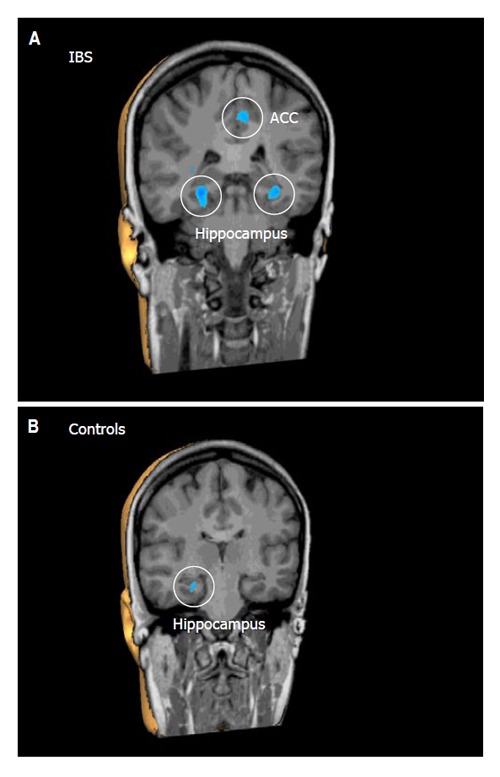
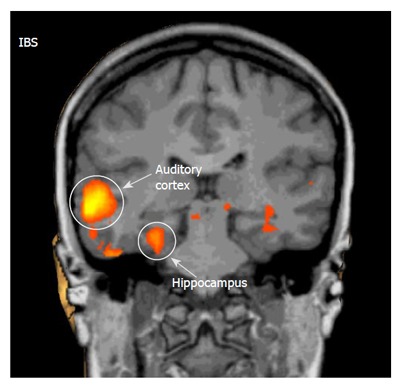
Results: To emotional auditory stimuli, IBS patients relative to controls responded with stronger deactivations in a greater variety of emotional processing regions, while the response patterns, unlike in controls, did not differentiate between distressing or pleasant sounds. To neutral auditory stimuli, by contrast, only IBS patients responded with large significant activations.
Conclusion: Altered cerebral response patterns to auditory stimuli in emotional stimulus-processing regions suggest that altered sensory processing in IBS may not be specific for visceral sensation, but might reflect generalized changes in emotional sensitivity and affective reactivity, possibly associated with the psychological comorbidity often found in IBS patients.
Figures
References
-
- Bouin M, Plourde V, Boivin M, Riberdy M, Lupien F, Laganiere M, Verrier P, Poitras P. Rectal distention testing in patients with irritable bowel syndrome: sensitivity, specificity, and predictive values of pain sensory thresholds. Gastroenterology. 2002;122:1771–1777. doi: 10.1053/gast.2002.33601. - DOI - PubMed
-
- Porcelli P. Psychological abnormalities in patients with irritable bowel syndrome. Indian J Gastroenterol. 2004;23:63–69. - PubMed
-
- Mayer EA, Naliboff BD, Chang L, Coutinho SV. V. Stress and irritable bowel syndrome. Am J Physiol Gastrointest Liver Physiol. 2001;280:G519–G524. - PubMed
MeSH terms
LinkOut - more resources
Full Text Sources
