PRKCA and multiple sclerosis: association in two independent populations
- PMID: 16596167
- PMCID: PMC1420678
- DOI: 10.1371/journal.pgen.0020042
PRKCA and multiple sclerosis: association in two independent populations
Abstract
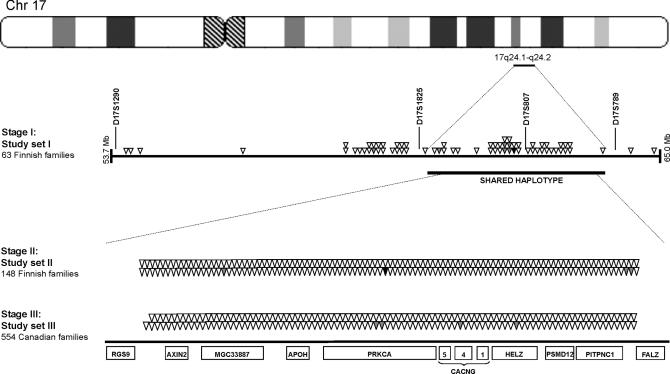
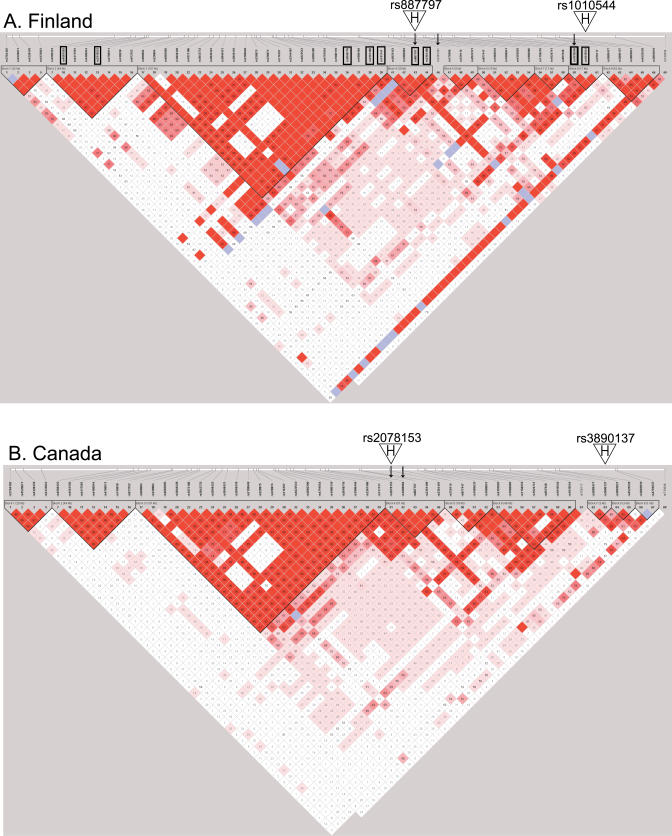
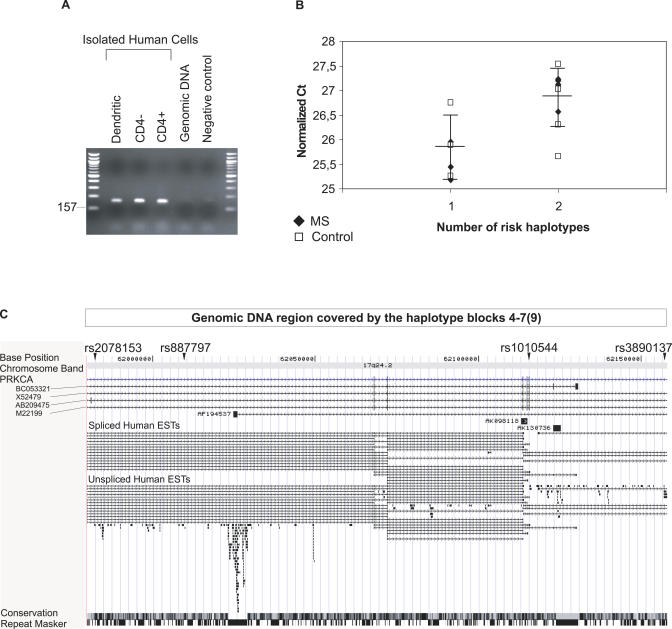
Multiple sclerosis (MS) is a chronic disease of the central nervous system responsible for a large portion of neurological disabilities in young adults. Similar to what occurs in numerous complex diseases, both unknown environmental factors and genetic predisposition are required to generate MS. We ascertained a set of 63 Finnish MS families, originating from a high-risk region of the country, to identify a susceptibility gene within the previously established 3.4-Mb region on 17q24. Initial single nucleotide polymorphism (SNP)-based association implicated PRKCA (protein kinase C alpha) gene, and this association was replicated in an independent set of 148 Finnish MS families (p = 0.0004; remaining significant after correction for multiple testing). Further, a dense set of 211 SNPs evenly covering the PRKCA gene and the flanking regions was selected from the dbSNP database and analyzed in two large, independent MS cohorts: in 211 Finnish and 554 Canadian MS families. A multipoint SNP analysis indicated linkage to PRKCA and its telomeric flanking region in both populations, and SNP haplotype and genotype combination analyses revealed an allelic variant of PRKCA, which covers the region between introns 3 and 8, to be over-represented in Finnish MS cases (odds ratio = 1.34, 95% confidence interval 1.07-1.68). A second allelic variant, covering the same region of the PRKCA gene, showed somewhat stronger evidence for association in the Canadian families (odds ratio = 1.64, 95% confidence interval 1.39-1.94). Initial functional relevance for disease predisposition was suggested by the expression analysis: The transcript levels of PRKCA showed correlation with the copy number of the Finnish and Canadian "risk" haplotypes in CD4-negative mononuclear cells of five Finnish multiplex families and in lymphoblast cell lines of 11 Centre d'Etude du Polymorphisme Humain (CEPH) individuals of European origin.
Conflict of interest statement
Competing interests. The authors have declared that no competing interests exist.
Figures
References
-
- Ebers GC, Bulman DE, Sadovnick AD, Paty DW, Warren S, et al. A population-based study of multiple sclerosis in twins. N Engl J Med. 1986;315:1638–1642. - PubMed
-
- Ebers GC, Sadovnick AD, Risch NJ. A genetic basis for familial aggregation in multiple sclerosis. Canadian Collaborative Study Group. Nature. 1995;377:150–151. - PubMed
-
- Sadovnick AD, Armstrong H, Rice GP, Bulman D, Hashimoto L, et al. A population-based study of multiple sclerosis in twins: Update. Ann Neurol. 1993;33:281–285. - PubMed
-
- Ebers GC, Kukay K, Bulman DE, Sadovnick AD, Rice G, et al. A full genome search in multiple sclerosis. Nat Genet. 1996;13:472–476. - PubMed
-
- Haines JL, Ter-Minassian M, Bazyk A, Gusella JF, Kim DJ, et al. A complete genomic screen for multiple sclerosis underscores a role for the major histocompatability complex. The Multiple Sclerosis Genetics Group. Nat Genet. 1996;13:469–471. - PubMed
Publication types
MeSH terms
Substances
Grants and funding
LinkOut - more resources
Full Text Sources
Medical
Research Materials
Miscellaneous