


Intraocular pressure alterations following intravitreal triamcinolone acetonide
- PMID: 16597664
- PMCID: PMC1857192
- DOI: 10.1136/bjo.2006.090340
Intraocular pressure alterations following intravitreal triamcinolone acetonide
Abstract
Aims: To determine the prevalence of intraocular pressure (IOP) alterations following intravitreal injection of triamcinolone acetonide (IVTA) and to assess possible risk factors of IOP elevation in eyes receiving single and/or repeat injections.
Methods: Retrospective, consecutive case series. 570 consecutive eyes of 536 patients who received a single IVTA injection (4 mg/0.1 ml) and a second set of 43 eyes of 40 patients who received a second injection. Retrospective review of all IVTA cases performed by three vitreoretinal surgeons over a 42 month period beginning in 2000. The main outcome measure was change in IOP defined as absolute value of IOP elevation (5 mm Hg or higher, 10 mm Hg or higher), and percentage of baseline (30% or higher increase from baseline IOP).
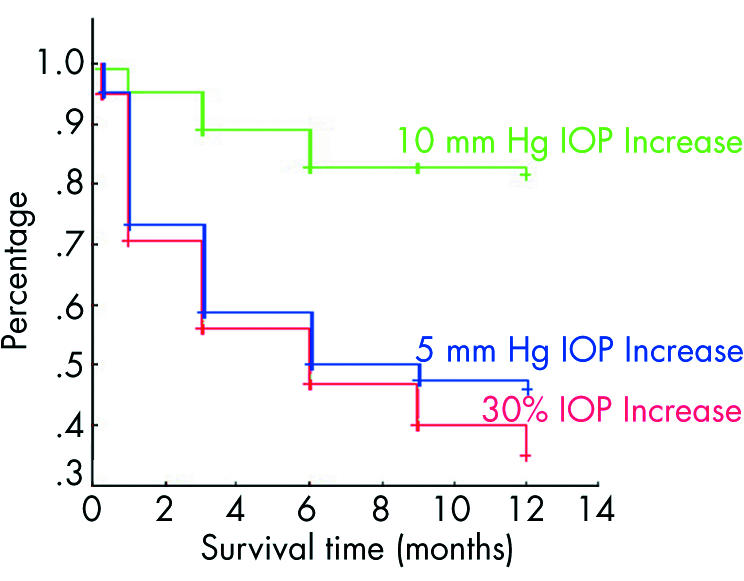
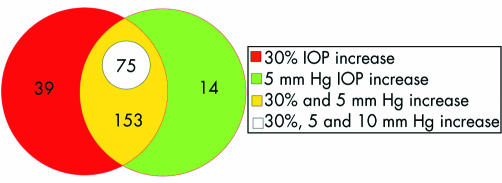
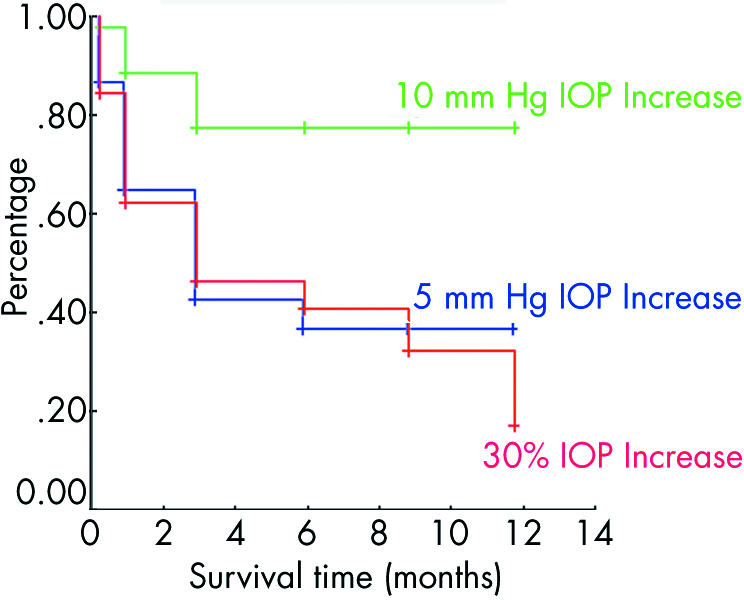
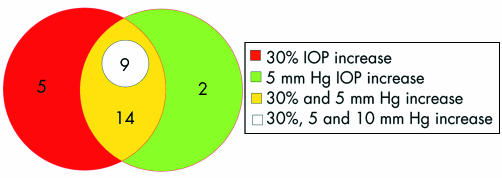
Results: Of the 528 eyes receiving single injections, 281 (53.2%) had an IOP elevation; 267 eyes (50.6%) experienced an elevation of IOP of at least 30%, and 245 (45.8%) and 75 (14.2%) eyes had an increase of 5 mm Hg or 10 mm Hg or more, respectively. Baseline IOP greater than 16 mm Hg is a risk factor for post-injection IOP elevation. Of the 43 eyes which received a second injection, 28 (65.1%) experienced an increase in IOP of at least 30% of baseline. Filtering surgery was required in five (0.094%) of the single and one (2.3%) of repeat injection eyes.
Conclusions: Elevated IOP after IVTA is common and patients should be monitored beyond 6 months post-injection. Patients with a baseline IOP more than 16 mm Hg or receiving a second injection should be carefully monitored for an elevated IOP.
Conflict of interest statement
Conflict of interest: none.
Comment in
-
The problem of pressure elevation associated with intravitreal triamcinolone.Br J Ophthalmol. 2006 Aug;90(8):934-5. doi: 10.1136/bjo.2006.093310. Br J Ophthalmol. 2006. PMID: 16854833 Free PMC article.
References
-
- Benhamou N, Massin P, Haochine B.et al Intravitreal triamcinolone for refractory pseudophakic macular edema. Am J Ophthalmol 2003135246–249. - PubMed
-
- Conway M D, Canakis C, Livir‐Rallatos C.et al Intravitreal triamcinolone acetonide for refractory chronic pseudophakic cystoid macular edema. J Cataract Refract Surg 20032927–33. - PubMed
-
- Challa J K, Gillies M C, Penfold P L.et al Exudative macular degeneration and intravitreal triamcinolone: 18 month follow up. Aust N Z J Ophthalmol 199826277–281. - PubMed
-
- Gillies M C, Simpson J M, Luo W.et al A randomized clinical trial of a single dose of intravitreal triamcinolone acetonide for neovascular age‐related macular degeneration: one‐year results. Arch Ophthalmol 2003121667–673. - PubMed
-
- Jonas J B, Akkoyun I, Budde W M.et al Intravitreal reinjection of triamcinolone for exudative age‐related macular degeneration. Arch Ophthalmol 2004122218–222. - PubMed
Publication types
MeSH terms
Substances
Grants and funding
LinkOut - more resources
Full Text Sources
Medical
