


Development of conventional and real-time nucleic acid sequence-based amplification assays for detection of Chlamydophila pneumoniae in respiratory specimens
- PMID: 16597845
- PMCID: PMC1448673
- DOI: 10.1128/JCM.44.4.1241-1244.2006
Development of conventional and real-time nucleic acid sequence-based amplification assays for detection of Chlamydophila pneumoniae in respiratory specimens
Abstract
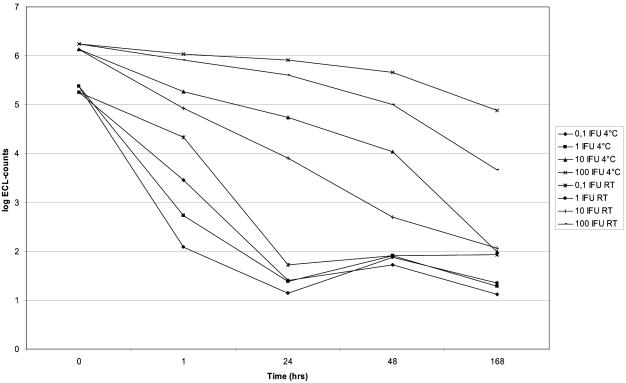
Isothermal nucleic acid sequence-based amplification (NASBA) was applied to the detection of Chlamydophila pneumoniae 16S rRNA by using the NucliSens basic kit (bioMérieux, Boxtel, The Netherlands). The assay was originally developed as a conventional NASBA assay with electrochemiluminescence detection and was subsequently adapted to a real-time NASBA format by using a molecular beacon. C. pneumoniae RNA prepared from a plasmid construct was used to assess the analytical sensitivity of the assay. The sensitivity of the NASBA assay was 10 molecules of in vitro wild-type C. pneumoniae RNA and 0.1 inclusion-forming unit (IFU) of C. pneumoniae. In spiked respiratory specimens, the sensitivity of the C. pneumoniae NASBA assay varied between 0.1 and 1 IFU/100 mul sample, depending on the type of specimen. Finally, conventional and real-time NASBA were applied to respiratory specimens previously tested by PCR. A 100% concordance between the test results was obtained.
Figures
References
-
- Black, C. M., P. I. Fieds, T. O. Messmer, and B. P. Berdal. 1994. Detection of Chlamydia pneumoniae in clinical specimens by polymerase chain reaction using nested primers. Eur. J. Clin. Microbiol. Infect. Dis. 13:752-756. - PubMed
-
- Boman, J., A. Allard, K. Persson, M. Lundborg, P. Juto, and G. Wadell. 1997. Rapid diagnosis of respiratory Chlamydia pneumoniae infection by nested touchdown polymerase chain reaction compared with culture and antigen detection by EIA. J. Infect. Dis. 175:1523-1526. - PubMed
-
- Bruisten, S. M., P. Oudshoorn, P. van Swieten, B. Boeser-Nunnink, P. van Aarle, S. P. Tondreau, and H. T. M. Cuypers. 1997. Stability of HIV-1 RNA in blood during specimen handling and storage prior to amplification by NASBA-QT. J. Virol. Methods 67:199-207. - PubMed
-
- Campbell, L. A., E. R. O'Brien, A. L. Cappuccio, C.-C. Kuo, S.-P. Wang, D. Stewart, D. L. Patton, P. K. Cummings, and J. T. Grayston. 1995. Detection of Chlamydia pneumoniae TWAR in human coronary atherectomy tissues. J. Infect. Dis. 172:585-588. - PubMed
Publication types
MeSH terms
Substances
LinkOut - more resources
Full Text Sources
Other Literature Sources
