


CSF amyloid-beta-peptides in Alzheimer's disease, dementia with Lewy bodies and Parkinson's disease dementia
- PMID: 16600985
- PMCID: PMC5403412
- DOI: 10.1093/brain/awl063
CSF amyloid-beta-peptides in Alzheimer's disease, dementia with Lewy bodies and Parkinson's disease dementia
Abstract
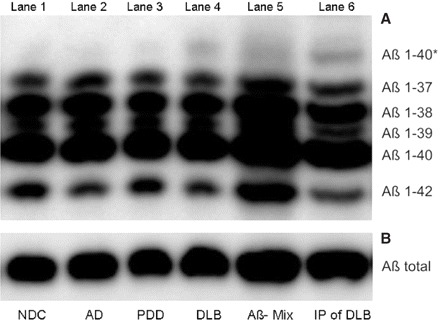
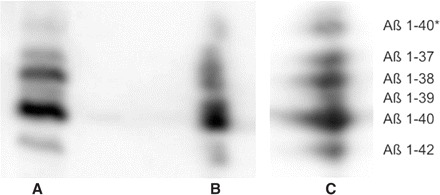
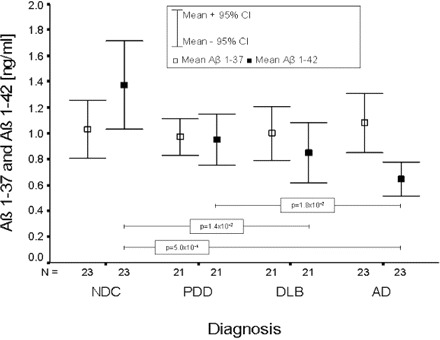
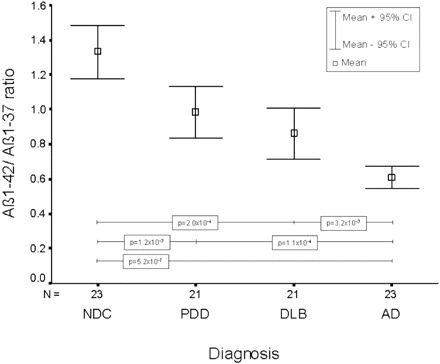
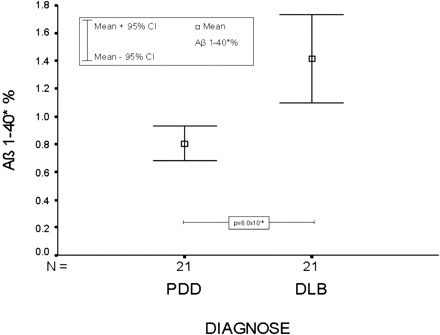
As the differential diagnosis of dementias based on established clinical criteria is often difficult, biomarkers for applicable diagnostic testing are currently under intensive investigation. Amyloid plaques deposited in the brain of patients suffering from Alzheimer's disease, dementia with Lewy bodies (DLB) and Parkinson's disease dementia (PDD) mainly consist of carboxy-terminally elongated forms of amyloid-beta (Abeta) peptides, such as Abeta1-42. Absolute Abeta1-42 levels in CSF have shown diagnostic value for the diagnosis of Alzheimer's disease, but the discrimination among Alzheimer's disease, DLB and PDD was poor. A recently established quantitative urea-based Abeta-sodium-dodecylsulphate-polyacrylamide-gel-electrophoresis with Western immunoblot (Abeta-SDS-PAGE/immunoblot) revealed a highly conserved Abeta peptide pattern of the carboxy-terminally truncated Abeta peptides 1-37, 1-38, 1-39 in addition to 1-40 and 1-42 in human CSF. We used the Abeta-SDS-PAGE/immunoblot to investigate the CSF of 23 patients with Alzheimer's disease, 21 with DLB, 21 with PDD and 23 non-demented disease controls (NDC) for disease-specific alterations of the Abeta peptide patterns in its absolute and relative quantities. The diagnostic groups were matched for age and severity of dementia. The present study is the first attempt to evaluate the meaning of Abeta peptide patterns in CSF for differential diagnosis of the three neurodegenerative diseases--Alzheimer's disease, DLB and PDD. The Abeta peptide patterns displayed disease-specific variations and the ratio of the differentially altered Abeta1-42 to the Abeta1-37 levels subsequently discriminated all diagnostic groups from each other at a highly significant level, except DLB from PDD. Additionally, a novel peptide with Abeta-like immunoreactivity was observed constantly in the CSF of all 88 investigated patients. The pronounced percentage increase of this peptide in DLB allowed a highly significant discrimination from PDD. Using a cut-off point of 0.954%, this marker yielded a diagnostic sensitivity and specificity of 81 and 71%, respectively. From several lines of indication, we consider this peptide to represent an oxidized alpha-helical form of Abeta1-40 (Abeta1-40*). The increased abundance of Abeta1-40* probably reflects a disease-specific alteration of the Abeta1-40 metabolism in DLB. We conclude that Abeta peptide patterns reflect disease-specific pathophysiological pathways of different dementia syndromes as distinct neurochemical phenotypes. Although Abeta peptide patterns failed to fulfil the requirements for a sole biomarker, their combined evaluation with other biomarkers is promising in neurochemical dementia diagnosis. It is noteworthy that DLB and PDD exhibit distinct clinical temporal courses, despite their similar neuropathological appearance. Their distinct molecular phenotypes support the view of different pathophysiological pathways for each of these neurodegenerative diseases.
Figures
References
-
- Andreasen N, Minthon L, Davidsson P, Vanmechelen E, Vanderstichele H, Winblad B, et al Evaluation of CSF-tau and CSF-Aβ42 as diagnostic markers for Alzheimer disease in clinical practice. Arch Neurol 2001; 58: 373–9. - PubMed
-
- Andreasen N, Sjogren M, Blennow K. CSF markers for Alzheimer's disease: total tau, phospho-tau and Abeta42. World J Biol Psychiatry 2003; 4: 147–55. - PubMed
-
- Atwood CS, Martins RN, Smith MA, Perry G. Senile plaque composition and posttranslational modification of amyloid-β peptide and associated proteins. Peptides 2002; 23: 1343–50 - PubMed
-
- Barnham KJ, Ciccotosto GD, Tickler AK, Ali FE, Smith DG, Williamson MA, et al Neurotoxic, redox-competent Alzheimer's β-Amyloid is released from lipid membrane by methionine oxidation. J Biol Chem 2003; 278: 42959–65. - PubMed
-
- Bibl M, Esselmann H, Otto M, Lewczuk P, Cepek L, Rüther E, et al Cerebrospinal fluid amyloid beta peptide patterns in Alzheimer's disease patients and nondemented controls depend on sample pre-treatment: Indication of carrier-mediated epitope masking of amyloid beta peptides. Electrophoresis 2004; 25: 2912–8. - PubMed
Publication types
MeSH terms
Substances
LinkOut - more resources
Full Text Sources
Other Literature Sources
Medical
