. 2006 Jun;12(6):980-7.
doi: 10.1261/rna.11706. Epub 2006 Apr 6.

Nucleobase catalysis in the hairpin ribozyme

Affiliations

Nucleobase catalysis in the hairpin ribozyme

Timothy J Wilson et al. RNA. 2006 Jun.

Abstract

RNA catalysis is important in the processing and translation of RNA molecules, yet the mechanisms of catalysis are still unclear in most cases. We have studied the role of nucleobase catalysis in the hairpin ribozyme, where the scissile phosphate is juxtaposed between guanine and adenine bases. We show that a modified ribozyme in which guanine 8 has been substituted by an imidazole base is active in both cleavage and ligation, with ligation rates 10-fold faster than cleavage. The rates of both reactions exhibit bell-shaped dependence on pH, with pK(a) values of 5.7 +/- 0.1 and 7.7 +/- 0.1 for cleavage and 6.1 +/- 0.3 and 6.9 +/- 0.3 for ligation. The data provide good evidence for general acid-base catalysis by the nucleobases.


Figures
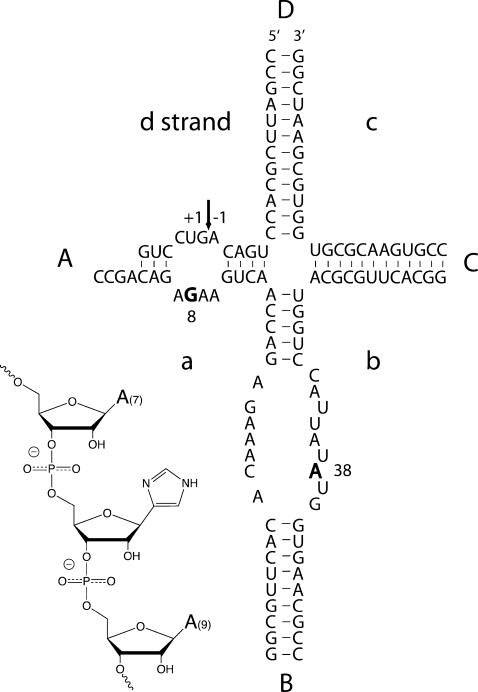
FIGURE 1.
FIGURE 1.
The hairpin ribozyme. The sequence of the hairpin ribozyme in the cleavage form used in these studies. The ribozyme comprises four strands (ad). The cleavage site is marked with an arrow, and the locations of G8 and A38 are highlighted in bold. Coaxially stacked arms A and D are shown in black and C and D in gray to be consistent with the folding scheme shown in Figure 4A. The inset shows the local structure of the imidazole nucleotide (shown in its nonprotonated form) incorporated into the “a” strand at position 8.
FIGURE 2.
FIGURE 2.
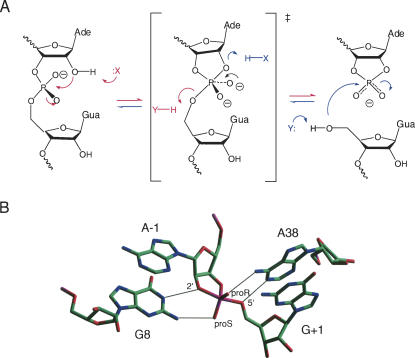
The mechanism and active site of the hairpin ribozyme. (A) The cleavage and ligation reactions. Cleavage is achieved by a transesterification reaction involving SN2 attack of a 2′-O on the adjacent phosphate group, passing through a dianionic oxyphosphorane transition state in which the 2′- and 5′-O atoms are apical. Ligation is the reverse of this, involving attack of the 5′-O on the cyclic phosphate. X and Y are putative participants in general acid–base catalysis. In the cleavage reaction (red), X acts as a base to facilitate removal of the proton from the 2′-O, while Y protonates the 5′-O leaving group. In the ligation reaction (blue), the roles of X and Y reverse, so that X now acts as a general acid to protonate the 2′-O leaving group, while Y removes a proton from the 5′-O nucleophile. (B) The structure of the active site of the hairpin ribozyme in a crystal structure of a vanadate transition state analog (Rupert et al. 2002). G8 and A38 flank the scissile phosphate and form hydrogen bonds to the 2′- and 5′-O, respectively, as well as to the nonbridging O atoms.
FIGURE 3.
FIGURE 3.
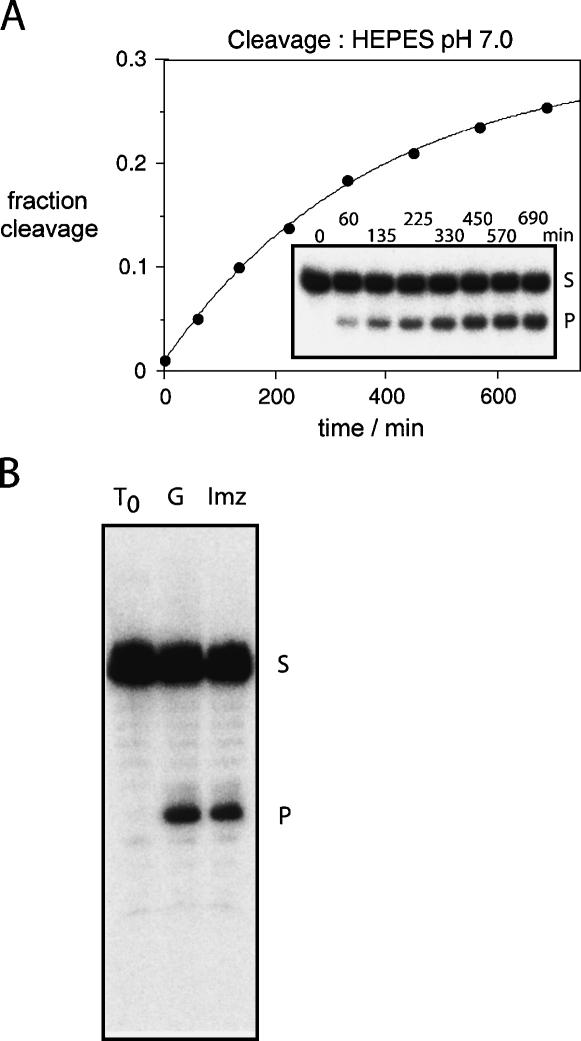
Cleavage reaction by the G8Imidazole hairpin ribozyme. (A) Progress curve for the cleavage reaction of the G8Imidazole hairpin ribozyme in 25 mM HEPES (pH 7.0), 50 mM NaCl, and 10 mM MgCl2 at 25°C. The data were fitted to a single exponential, yielding a cleavage rate of 0.0027 min−1. The corresponding electrophoretic separation of substrate (S) and product (P) is shown as an inset. Reaction time (minutes) is shown above each lane. (B) Analysis of the cleavage product at sequencing-gel resolution. The cleavage products for natural and G8Imidazole hairpin ribozymes were electrophoresed in a 25-cm 20% polyacrylamide gel containing 7 M urea. Reaction times were 1 min for the natural ribozyme (lane G) and 120 min for the G8Imidazole (lane Imz) ribozyme. A relatively short reaction time was used so that hydrolysis of the cyclic phosphate is negligible.
FIGURE 4.
FIGURE 4.
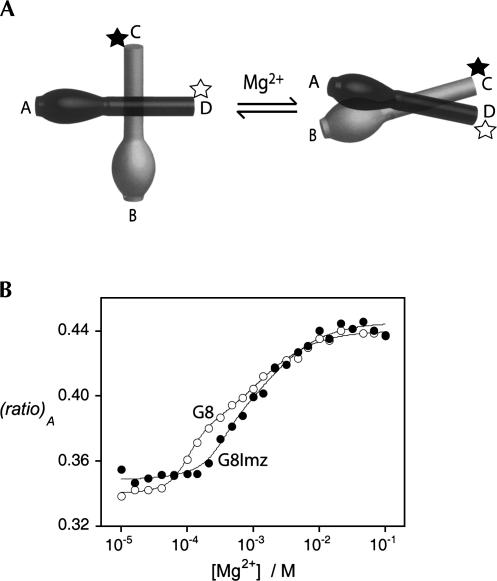
Analysis of ion-induced folding of the natural and substituted hairpin ribozymes using fluorescence resonance energy transfer. (A) Schematic to show the analysis of folding by FRET. Fluorescein (black star) and Cy3 (open star) fluorophores were covalently linked to the 5′ termini of the C and D arms, respectively. Addition of magnesium ions induces a rotation of the stacked helices to allow an intimate interaction between the A and B loops, resulting in a shortening of the interfluorophore distance and hence an increase in FRET efficiency. (B) Plot of the extent of energy transfer, (ratio)A, as a function of Mg2+ concentration for the G8 (○) and G8Imidazole (●) hairpin ribozymes in 10 mM HEPES (pH 7.0), 50 mM NaCl at 4°C. The data were fitted to equation 2, giving estimated [Mg2+]1/2 values of (1.0 ± 0.2) × 10−4 M and (1.1 ± 0.3) × 10−3 M for the G8 ribozyme, and (3.5 ± 0.8) × 10−4 M and (1.5 ± 0.5) × 10−3 M for the G8Imidazole ribozyme.
FIGURE 5.
FIGURE 5.
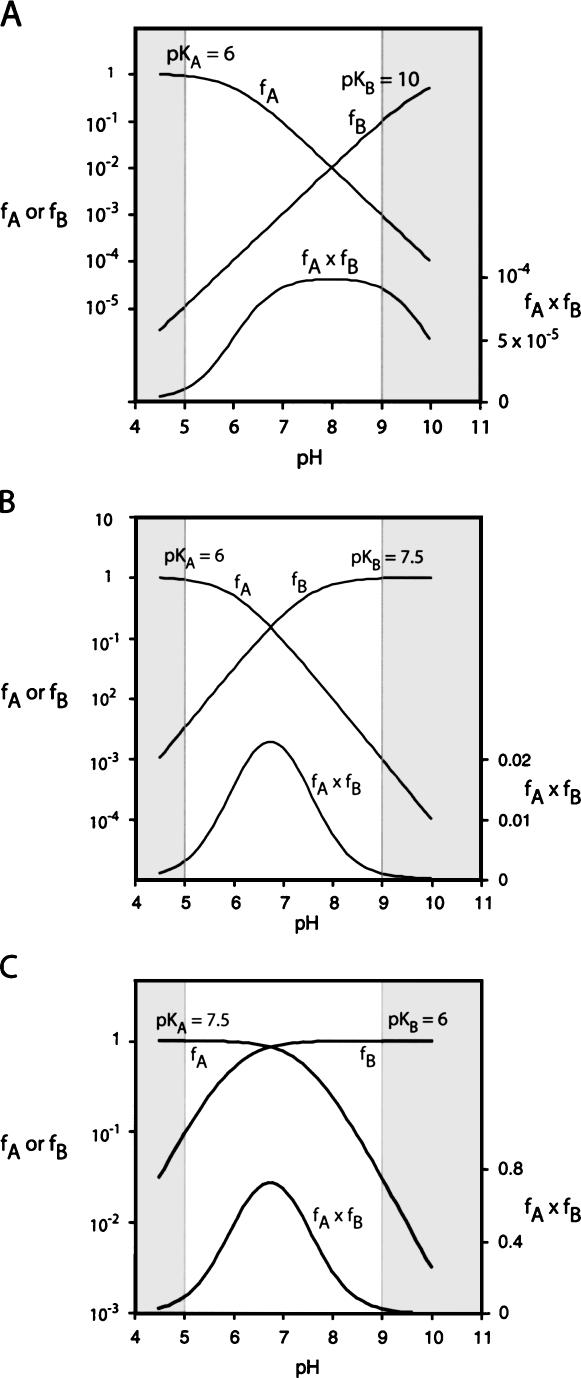
Calculated pH dependence of the cleavage reaction of the hairpin ribozyme as a function of base pKA, assuming general acid–base catalysis. The fractions of protonated acid fA, unprotonated base fB, and their product fA·fB have been calculated and plotted as a function of pH, following the approach of Bevilacqua (2003). The sections shaded in gray are the extreme values of pH not accessible to experimental study. Reaction rate should be proportional to the fraction of ribozyme in the appropriate state of protonation, i.e., fA·fB. Note that in these graphs fA and fB are plotted on a log10 scale (left), while fA·fB is plotted on a linear scale (right). (A) Plot for pKA values of 6 and 10 for the acid and the base, respectively. This corresponds to the natural ribozyme, assuming A38 is the acid and G8 is the base. Reaction rate increases with pH until reaching a plateau value close to neutrality. (B) Plot for pKA values of 6 and 7.5 for the acid and the base, respectively. This corresponds to that expected for a ribozyme in which G8 has been substituted by a base with a pKA of 7.5. A bell-shaped pH dependence is now expected. (C) Plot for pKA values of 7.5 and 6 for the acid and the base, respectively. This corresponds to that expected for a ribozyme in which G8 has been substituted by a base with a pKA of 7.5, now acting as the acid in the reverse reaction. Note that the shape of the pH profile is the same as that for the cleavage reaction.
FIGURE 6.
FIGURE 6.
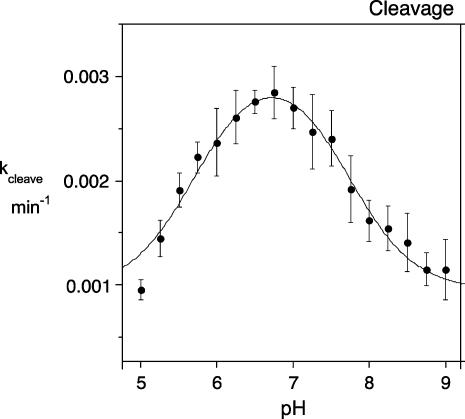
The pH dependence of the cleavage reaction of the G8Imidazole hairpin ribozyme. Plot of cleavage rate as a function of pH. Each point is the average and standard deviation of at least three independent experiments. The data were fitted to equation 1, giving estimated pKA values of 5.7 ± 0.1 and 7.7 ± 0.1.
FIGURE 7.
FIGURE 7.
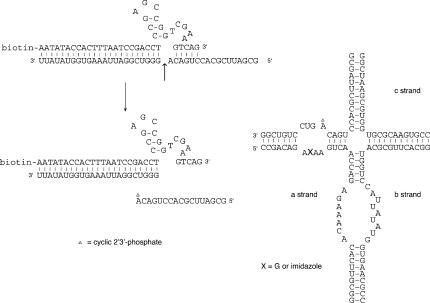
Scheme for the generation of the ligation substrate. The 17-nt 5′ ligation substrate was generated using biotinylated 8–17 DNAzyme. This was hybridized together with the 3′ substrate fragment and strands a, b, and c in the presence of 1.5 mM HEPES (pH 7.5) to generate the ligation-competent hairpin ribozyme.
FIGURE 8.
FIGURE 8.
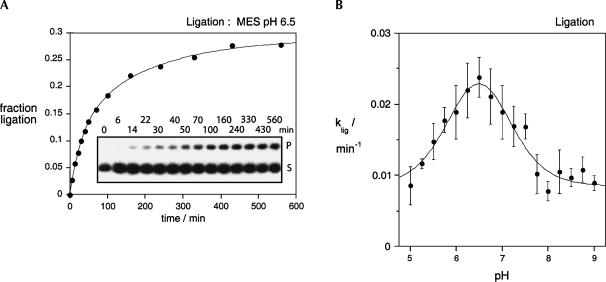
Ligation reaction by the G8Imidazole hairpin ribozyme. (A) The ligation reaction at 25°C in 20 mM MES (pH 6.5) 10 mM MgCl2, 50 mM NaCl together with a residual 0.6 mM HEPES (pH 7.5) from the hybridization. The extent of product formation is plotted as a function of time and fitted to two exponential functions, the faster yielding an observed rate of 0.024 min−1. The corresponding electrophoretic separation of substrate (S) and product (P) is shown as an inset. Reaction time (minutes) is shown above each lane. (B) The pH dependence of ligation rate. Each point is the average and standard deviation of at least three independent experiments. The data were fitted to equation 1, giving estimated pKA values of 6.1 ± 0.3 and 6.9 ± 0.3.

References

    1. Araki L., Harusawa S., Yamaguchi M., Yonezawa S., Taniguchi N., Lilley D.M.J., Zhao Z., Kurihara T. Synthesis of C4-linked imidazole ribonucleoside phosphoramidite with pivaloyloxymethyl (POM) group. Tetrahedron Lett. 2004;45:2657–2661.
    1. Bevilacqua P.C. Mechanistic considerations for general acid-base catalysis by RNA: Revisiting the mechanism of the hairpin ribozyme. Biochemistry. 2003;42:2259–2265. - PubMed
    1. Bevilacqua P.C. Mechanism of catalytic RNA. Biopolymers. 2004;73:69–70. - PubMed
    1. Clegg R.M. Fluorescence resonance energy transfer and nucleic acids. Methods Enzymol. 1992;211:353–388. - PubMed
    1. Fedor M.J. Tertiary structure stabilization promotes hairpin ribozyme ligation. Biochemistry. 1999;38:11040–11050. - PubMed

Publication types

LinkOut - more resources