. 2006 Apr 19;25(8):1669-79.
doi: 10.1038/sj.emboj.7601046. Epub 2006 Apr 6.

Nucleolin is a histone chaperone with FACT-like activity and assists remodeling of nucleosomes

Affiliations

Nucleolin is a histone chaperone with FACT-like activity and assists remodeling of nucleosomes

Dimitar Angelov et al. EMBO J. .

Abstract

Remodeling machines play an essential role in the control of gene expression, but how their activity is regulated is not known. Here we report that the nuclear protein nucleolin possesses a histone chaperone activity and that this factor greatly enhances the activity of the chromatin remodeling machineries SWI/SNF and ACF. Interestingly, nucleolin is able to induce the remodeling by SWI/SNF of macroH2A, but not of H2ABbd nucleosomes, which are otherwise resistant to remodeling. This new histone chaperone promotes the destabilization of the histone octamer, helping the dissociation of a H2A-H2B dimer, and stimulates the SWI/SNF-mediated transfer of H2A-H2B dimers. Furthermore, nucleolin facilitates transcription through the nucleosome, which is reminiscent of the activity of the FACT complex. This work defines new functions for histone chaperones in chromatin remodeling and regulation of transcription and explains how nucleolin could act on transcription.


Figures
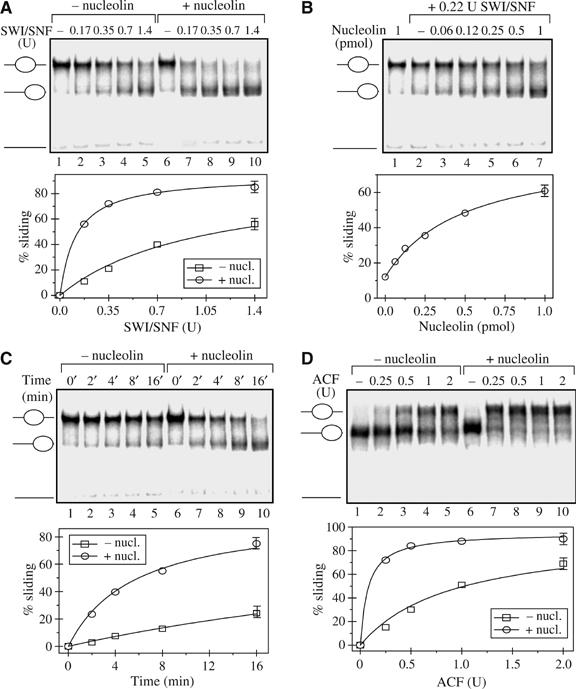
Figure 1
Figure 1
Nucleolin stimulates SWI/SNF and ACF-mediated nucleosome sliding. (A) Centrally positioned nucleosomes at the 601 sequence were incubated for 45 min at 30°C with an increasing amount of SWI/SNF in the absence (lanes 1–5) or presence of 1 pmol of nucleolin (lanes 6–10). SWI/SNF (1 U) was defined as the amount of SWI/SNF required to mobilize 50% of input nucleosomes (50 ng; about 0.2 pmol) at 30°C during 45 min. Reactions were stopped by the addition of competitor DNA and apyrase. Nucleosome positions were then analysed by electrophoresis. The lower part of each panel shows the quantification of the results. (B) Nucleosomes positioned at the central position on the 601 sequence were incubated with 0.22 U of SWI/SNF and increasing amounts of nucleolin. (C) Time course of nucleosome sliding in the absence (lanes 1–5) or presence of nucleolin (lanes 6–10). Nucleosomes positioned at the central position on the 601 sequence were incubated with 0.22 U of SWI/SNF and 1 pmol of nucleolin. (D) Nucleosomes positioned at an end-position of the 601 sequence were incubated with increasing amount of ACF in the absence (lanes 1–5) or presence (lanes 6–10) of 1 pmol of nucleolin. After incubation for 45 min at 30°C, the reaction was stopped by adding competitor DNA and apyrase and positions were analysed by electrophoresis.
Figure 2
Figure 2
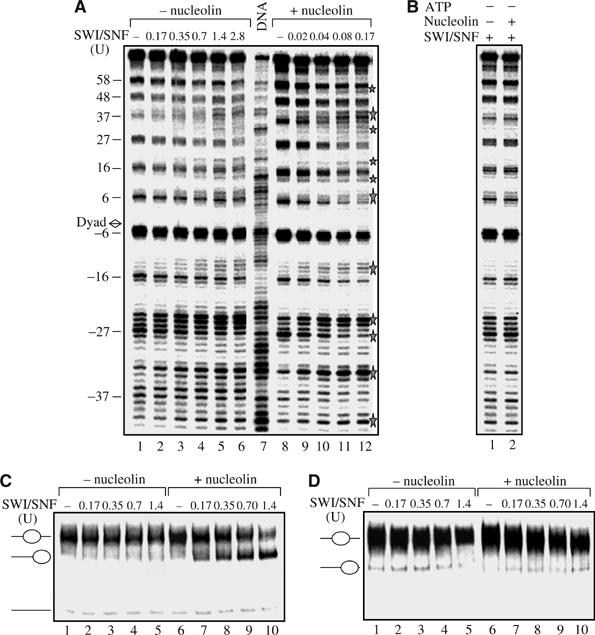
Nucleolin stimulates nucleosome remodeling. (A) Nucleosomes reconstituted on a 32P-end labelled 152 bp 5S DNA fragment were incubated with increasing amount of SWI/SNF in the absence (lanes 1–6) or presence (lanes 8–12) of 1 pmol of nucleolin for 45 min at 30°C. The reaction was stopped by addition of 1μg of competitor DNA and apyrase and the remodeling was visualized by DNAseI footprinting. Lane 7 shows the pattern of DNAse I digestion of free DNA. The stars indicate the major changes within the nucleosome structure. (B) The stimulatory effect of nucleolin on nucleosome remodeling is dependant on the presence of ATP. DNAse I footprinting (in the absence of ATP) in the presence of either 0.7 U of SWI/SNF alone (lane 1) or of 0.7 U of SWI/SNF and 1 pmol of nucleolin (lane 2). No competitor DNA was added prior to DNAse I digestion. Note that nucleolin alone (panel A, lane 8) or in the presence of inactive SWI/SNF (without ATP) has no effect on the DNAse I footprinting pattern of 5S DNA. Panels C, D: Nucleolin stimulates sliding of macroH2A nucleosomes, but not H2ABbd nucleosomes. (C) Nucleosomes were reconstituted on the 248 bp DNA fragment from ribosomal promoter (Langst et al, 1999) with conventional H2B, H3, H4, and macro-H2A histones. Centrally positioned nucleosomes were gel purified and incubated with increasing amount of SWI/SNF in the absence (lanes 1–5) or presence (lanes 6–10) of 1 pmol of nucleolin. (D). Same as in panel C, except that H2ABbd was used for nucleosome reconstitution.
Figure 3
Figure 3
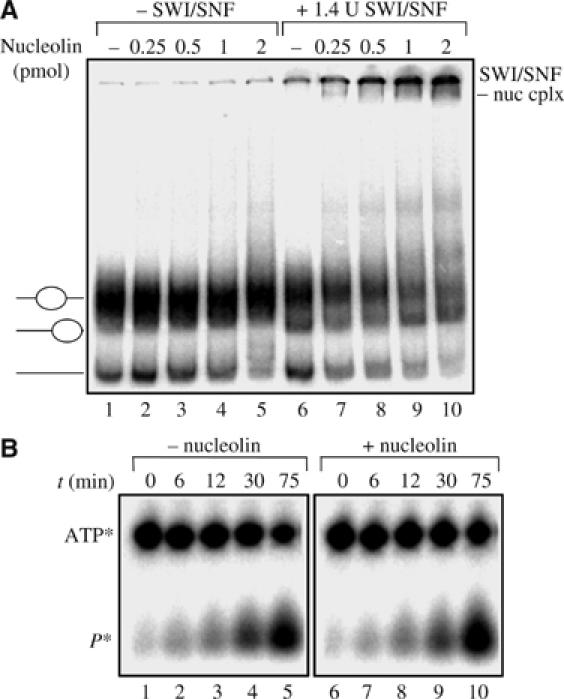
Nucleolin promotes the binding of SWI/SNF to the nucleosome. (A) Nucleosomes were reconstituted on 248 bp ribosomal DNA fragment and incubated with increasing amount of nucleolin in the absence (lanes 1–5) or presence (lanes 6–10) of 1.4 U of SWI/SNF. In these experiments no DNA competitor was added after the sliding reaction in order to detect the interaction of nucleolin and SWI/SNF with the nucleosomal template. (B) Nucleolin does not interfere with the ATPase activity of SWI/SNF. The kinetics of the SWI/SNF ATP hydrolysis were analysed on 15% denaturing polyacrylamide gels in the presence (lanes 6–10) or absence (lanes 1–5) of nucleolin.
Figure 4
Figure 4
Nucleolin stimulates the SWI/SNF-mediated transfer of H2A–H2B dimers. (A) H2B or H2A was radioactively labelled (H2B* and H2A*, indicated by the star on the sketch of the nucleosome) and used to reconstitute centrally positioned nucleosomes on the unlabelled 601 DNA fragment. H3–H4 tetrameric particles were reconstituted using the 147 bp fragment containing the X. borealis 5S gene. H2B* (lanes 1–5) and H2A* (lanes 6–10) nucleosomes were incubated for 60 min at 23°C in the presence of two-fold of tetrameric particles. In the presence of tetramer but without SWI/SNF and nucleolin (lanes 2 and 7), no visible transfer of H2A–H2B* and H2A*–H2B dimers is detectable. In the presence of nucleolin (lanes 3 and 8) or SWI/SNF (0.7 U, lane 4 and 0.35 U, lane 9), a significant amount of H2A–H2B* and H2A*–H2B dimers is transferred to the tetrameric particle. This transfer is higher in the presence of nucleolin and SWI/SNF (lanes 5 and 10); lane 1, control nucleosomes. (B) H2A–H2B* transfer efficiency depends on the amount of nucleolin. H2B*-labelled 601 nucleosomes were incubated with tetrasomes and increasing amount of nucleolin (lanes 2–5); no SWI/SNF was present in the reaction.
Figure 5
Figure 5
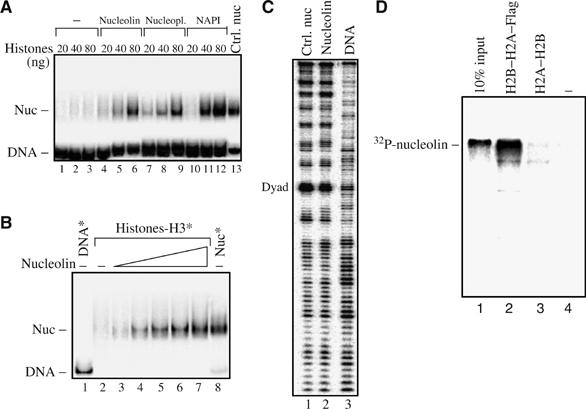
Nucleolin is a histone chaperone. (A) Increasing amount of histones pre-incubated with equimolar amounts of proteins as indicated were incubated with 20 ng of labelled 5S DNA fragment for 1 h at 30°C. In lane 13, nucleosomes reconstituted by dialysis were loaded on the gel to show the migrating position of nucleosome. In lanes 1–3, no exogenous protein was added and low amounts of histones are deposited onto DNA. (B) Nucleosome formation is dependent on the amount of nucleolin. Increasing amounts of nucleolin (lanes 4–7) were pre-incubated with 80 ng of H2A, H2B, H4, and labelled H3, and then unlabelled 5S DNA was added to the reaction misture. Lane 8, nucleosome reconstituted by salt dialysis. (C) DNAse I footprinting shows that the particles formed in the presence of nucleolin are bona fide nucleosomes. Particles formed on the 5S DNA sequence in the presence of nucleolin were digested with DNAse I and separated on a native gel. The bands were excised and the histone–DNA complexes were eluted and analysed by sequencing gel electrophoresis (lane 2). Lanes 1 and 3 show the DNAseI cleavage pattern of nucleosomes reconstituted by salt dialysis and that of naked DNA, respectively. (D) Interaction of nucleolin with the H2A–H2B dimer. Anti-Flag beads were pre-incubated without (lane 4) or with H2A–H2B dimer (lane 3) or with Flag-H2A–H2B dimer (lane 2), then 32P-labelled nucleolin was added to the beads. After three washes, the beads were heated to 95°C, then loaded on a 12% SDS–PAGE. Lane 1 contains 10% of input 32P-labelled nucleolin.
Figure 6
Figure 6
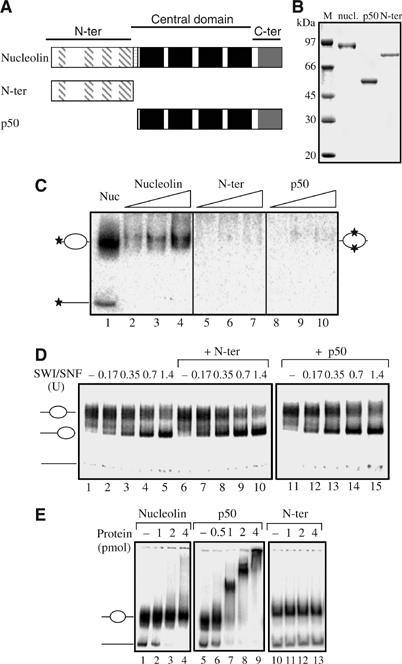
The N-terminal acidic domain of nucleolin is necessary but not sufficient for the histone chaperone activity. (A) Schematic representation of nucleolin domains. Dashed boxes indicate highly acidic regions; black boxes represent each of the four RNA-binding domains, and the C-terminal grey box shows the RGG domain. (B) 12% SDS–PAGE of the purified recombinant proteins. (C) Histone chaperone activity. Same as Figure 5, except that increasing amounts of N-ter (lanes 5–7) and p50 (lanes 8–10) proteins were used. Lane 1, nucleosomes reconstituted onto labelled 5S DNA sequence. (D) Effect of the N-ter and p50 nucleolin domains on nucleosome mobilization. Nucleosomes were reconstituted on the 248 bp DNA fragment from a ribosomal promoter (Langst et al, 1999) with conventional H2A,H2B, H3, H4 histones and incubated with increasing amounts of SWI/SNF in the presence of 1 pmol of N-ter (lanes 6–10) and 1 pmol of p50 (lanes 11–15). (E) Interaction of nucleolin, p50 and N-ter domains with nucleosomes. Nucleosomes were reconstituted onto the 248 bp ribosomal DNA fragment and incubated with increasing amounts of nucleolin (lanes 1–4), p50 (lanes 6–9) or N-ter domain (lanes 11–13). Note the strong binding of p50, but not of nucleolin and N-ter, with the nucleosomes.
Figure 7
Figure 7
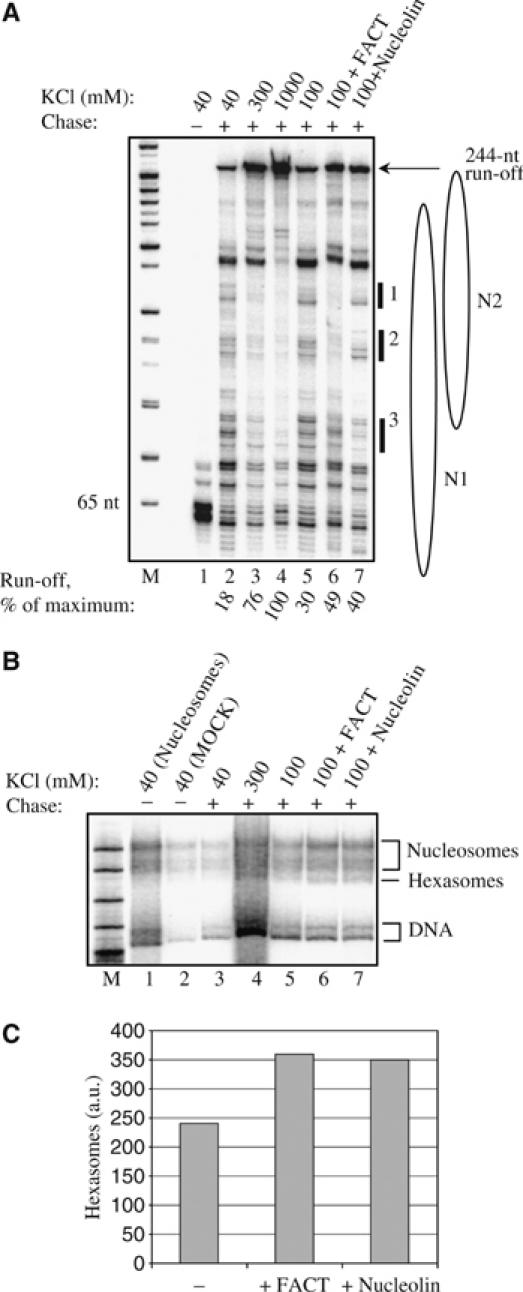
Nucleolin facilitates transcription through the nucleosome and accompanying displacement of one H2A/2B dimer. (A) Analysis of labelled RNA by denaturing PAGE. Preformed stalled elongation complexes containing pulse-labelled RNA (lane 1) were incubated with NTPs at the indicated concentrations of KCl in the presence of FACT (lane 6) or nucleolin (lane 7). Black rectangles indicate the areas of the pausing that are partially relieved in the presence of 300 mM KCl (lane 3) or the protein factors. The positions of the nucleosomes (N1 and N2) are indicated. The efficiencies of formation of the run-off transcripts under the different conditions are indicated below the lanes. M—pBR322-MspI end-labelled markers. (B) Nucleolin facilitates transcription-dependent conversion of the nucleosomes into the hexasomes. Analysis of DNA-labelled nucleosomal templates by native PAGE. The nucleosomal templates were transcribed in the presence of indicated concentrations of KCl and in the presence of FACT (lane 6) or nucleolin (lane 7). Nontranscribed (lane 1) or MOCK-transcribed (with one NTP omitted from the reaction, lane 2) nucleosomes are loaded as controls. The positions of the nucleosomes, hexasomes and DNA are indicated. A higher background of nontranscribed templates is observed at 300 mM KCl (lane 4) because of disruption of the elongation complexes at higher salt (Belotserkovskaya et al, 2003). (C) Quantitative analysis of the hexasomes formed after transcription through the nucleosomes at 100 mM KCl in the presence of FACT or nucleolin (lanes 5–7, Figure 7B). The amount of 32P in each hexasome band (arbitrary units) was normalized to the total amount of radioactivity in the sample.

References

    1. Adkins MW, Howar SR, Tyler JK (2004) Chromatin disassembly mediated by the histone chaperone Asf1 is essential for transcriptional activation of the yeast PHO5 and PHO8 genes. Mol Cell 14: 657–666 - PubMed
    1. Adkins MW, Tyler JK (2006) Transcriptional activators are dispensable for transcription in the absence of spt6-mediated chromatin reassembly of promoter regions. Mol Cell 21: 405–416 - PubMed
    1. Angelov D, Lenouvel F, Hans F, Muller CW, Bouvet P, Bednar J, Moudrianakis EN, Cadet J, Dimitrov S (2004a) The histone octamer is invisible when NF-kappaB binds to the nucleosome. J Biol Chem 279: 42374–42382 - PubMed
    1. Angelov D, Molla A, Perche PY, Hans F, Cote J, Khochbin S, Bouvet P, Dimitrov S (2003) The histone variant macroH2A interferes with transcription factor binding and SWI/SNF nucleosome remodeling. Mol Cell 11: 1033–1041 - PubMed
    1. Angelov D, Verdel A, An W, Bondarenko V, Hans F, Doyen CM, Studitsky VM, Hamiche A, Roeder RG, Bouvet P, Dimitrov S (2004b) SWI/SNF remodeling and p300-dependent transcription of histone variant H2ABbd nucleosomal arrays. EMBO J 23: 3815–3824 - PMC - PubMed

Publication types

MeSH terms