


Fatigue Intervention by Nurses Evaluation--the FINE Trial. A randomised controlled trial of nurse led self-help treatment for patients in primary care with chronic fatigue syndrome: study protocol. [ISRCTN74156610]
- PMID: 16603058
- PMCID: PMC1456982
- DOI: 10.1186/1741-7015-4-9
Fatigue Intervention by Nurses Evaluation--the FINE Trial. A randomised controlled trial of nurse led self-help treatment for patients in primary care with chronic fatigue syndrome: study protocol. [ISRCTN74156610]
Abstract
Background: Chronic fatigue syndrome, also known as ME (CFS/ME), is a condition characterised primarily by severe, disabling fatigue, of unknown origin, which has a poor prognosis and serious personal and economic consequences. Evidence for the effectiveness of any treatment for CFS/ME in primary care, where most patients are seen, is sparse. Recently, a brief, pragmatic treatment for CFS/ME, based on a physiological dysregulation model of the condition, was shown to be successful in improving fatigue and physical functioning in patients in secondary care. The treatment involves providing patients with a readily understandable explanation of their symptoms, from which flows the rationale for a graded rehabilitative plan, developed collaboratively with the therapist. The present trial will test the effectiveness and cost-effectiveness of pragmatic rehabilitation when delivered by specially trained general nurses in primary care. We selected a client-centred counselling intervention, called supportive listening, as a comparison treatment. Counselling has been shown to be as effective as cognitive behaviour therapy for treating fatigue in primary care, is more readily available, and controls for supportive therapist contact time. Our control condition is treatment as usual by the general practitioner (GP).
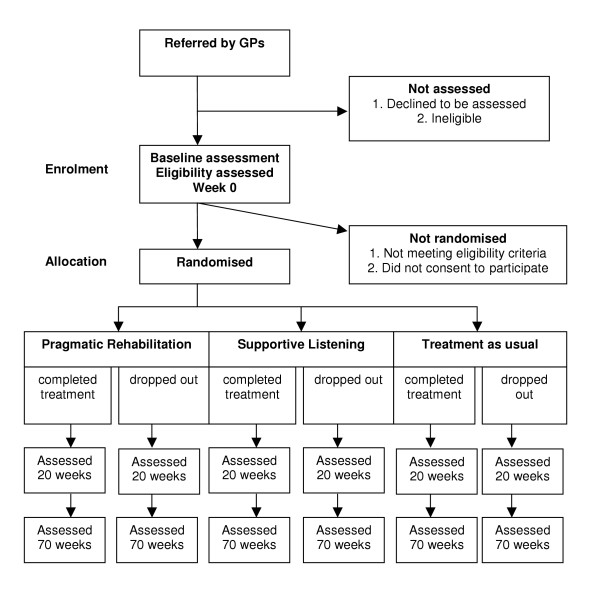
Methods and design: This study protocol describes the design of an ongoing, single-blind, pragmatic randomized controlled trial of a brief (18 week) self-help treatment, pragmatic rehabilitation, delivered by specially trained nurse-therapists in patients' homes, compared with nurse-therapist delivered supportive listening and treatment as usual by the GP. An economic evaluation, taking a societal viewpoint, is being carried out alongside the clinical trial. Three adult general nurses were trained over a six month period to deliver the two interventions. Patients aged over 18 and fulfilling the Oxford criteria for CFS are assessed at baseline, after the intervention, and again one year later. Primary outcomes are self-reported physical functioning and fatigue at one year, and will be analysed on an intention-to-treat basis. A qualitative study will examine the interventions' mechanisms of change, and also GPs' drivers and barriers towards referral.
References
-
- Sharpe M, Archard L, Banatvala J, Borysiewicz L, Clare A, Edwards R, Hawton K, Lambert H, Lane R, McDonald E, Mowbray J, Pearson D, Peto T, Preedy V, Smith A, Smith D, Taylor D, Tyrrell D, Wessely S, White P. A report – chronic fatigue syndrome: guidelines for research. J Royal Soc Med. 1991;84:118–121. - PMC - PubMed
-
- Fukuda K, Straus S, Hickie I, Sharpe M, Dobbins J, Komaroff A, The International Chronic Fatigue Syndrome Study Group The chronic fatigue syndrome: A comprehensive approach to its definition and study. Ann Int Med. 1994;121:953–959. - PubMed
-
- Wessely S, Hotopf M, Sharpe M. Chronic fatigue and its syndromes. Oxford: Oxford University Press; 1998.
-
- Independent Working Group . A Report of the CFS/ME working group Report to the Chief Medical Officer of an Independent Working Group. London: Department of Health; 2002.
Publication types
MeSH terms
Associated data
Grants and funding
LinkOut - more resources
Full Text Sources
Medical
