


A case study in pathway knowledgebase verification
- PMID: 16603083
- PMCID: PMC1522024
- DOI: 10.1186/1471-2105-7-196
A case study in pathway knowledgebase verification
Abstract
Background: Biological databases and pathway knowledge-bases are proliferating rapidly. We are developing software tools for computer-aided hypothesis design and evaluation, and we would like our tools to take advantage of the information stored in these repositories. But before we can reliably use a pathway knowledge-base as a data source, we need to proofread it to ensure that it can fully support computer-aided information integration and inference.
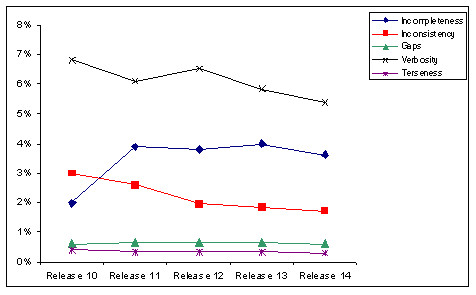
Results: We design a series of logical tests to detect potential problems we might encounter using a particular knowledge-base, the Reactome database, with a particular computer-aided hypothesis evaluation tool, HyBrow. We develop an explicit formal language from the language implicit in the Reactome data format and specify a logic to evaluate models expressed using this language. We use the formalism of finite model theory in this work. We then use this logic to formulate tests for desirable properties (such as completeness, consistency, and well-formedness) for pathways stored in Reactome. We apply these tests to the publicly available Reactome releases (releases 10 through 14) and compare the results, which highlight Reactome's steady improvement in terms of decreasing inconsistencies. We also investigate and discuss Reactome's potential for supporting computer-aided inference tools.
Conclusion: The case study described in this work demonstrates that it is possible to use our model theory based approach to identify problems one might encounter using a knowledge-base to support hypothesis evaluation tools. The methodology we use is general and is in no way restricted to the specific knowledge-base employed in this case study. Future application of this methodology will enable us to compare pathway resources with respect to the generic properties such resources will need to possess if they are to support automated reasoning.
Figures
References
-
- Fedoroff N, Racunas SA, Shrager J. Tools for thought in the age of biological knowledge. The Scientist. 2005;19:20–21.
Publication types
MeSH terms
Substances
LinkOut - more resources
Full Text Sources
