Daclizumab, a humanised monoclonal antibody to the interleukin 2 receptor (CD25), for the treatment of moderately to severely active ulcerative colitis: a randomised, double blind, placebo controlled, dose ranging trial
- PMID: 16603634
- PMCID: PMC1860086
- DOI: 10.1136/gut.2005.089854
Daclizumab, a humanised monoclonal antibody to the interleukin 2 receptor (CD25), for the treatment of moderately to severely active ulcerative colitis: a randomised, double blind, placebo controlled, dose ranging trial
Abstract
Background: An uncontrolled pilot study demonstrated that daclizumab, a humanised monoclonal antibody to the interleukin 2 receptor (CD25), might be effective for the treatment of active ulcerative colitis.
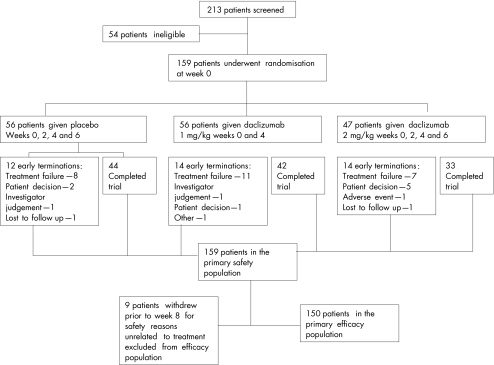
Methods: A randomised, double blind, placebo controlled trial was conducted to evaluate the efficacy of daclizumab induction therapy in patients with active ulcerative colitis. A total of 159 patients with moderate ulcerative colitis were randomised to receive induction therapy with daclizumab 1 mg/kg intravenously at weeks 0 and 4, or 2 mg/kg intravenously at weeks 0, 2, 4, and 6, or placebo. The primary end point was induction of remission at week 8. Remission was defined as a Mayo score of 0 on both endoscopy and rectal bleeding components and a score of 0 or 1 on stool frequency and physician's global assessment components. Response was defined as a decrease from baseline in the Mayo score of at least 3 points.
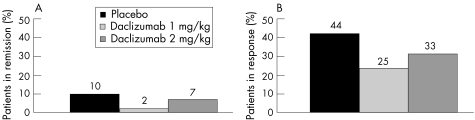
Results: Two per cent of patients receiving daclizumab 1 mg/kg (p = 0.11 v placebo) and 7% of patients receiving 2 mg/kg (p = 0.73) were in remission at week 8, compared with 10% of those who received placebo. Response occurred at week 8 in 25% of patients receiving daclizumab 1 mg/kg (p = 0.04) and in 33% of patients receiving 2 mg/kg (p = 0.30) versus 44% of those receiving placebo. Daclizumab was well tolerated. The most frequently reported adverse events in daclizumab treated patients compared with placebo treated patients were nasopharyngitis (14.6%) and pyrexia (10.7%).
Conclusion: Patients with moderate ulcerative colitis who are treated with daclizumab are not more likely to be in remission or response at eight weeks than patients treated with placebo.
Comment in
-
Interleukin 2 targeted therapy in inflammatory bowel disease.Gut. 2009 Dec;58(12):1705-6. doi: 10.1136/gut.2008.175182. Gut. 2009. PMID: 19923351 No abstract available.
References
-
- Fiocchi C. Inflammatory bowel disease: etiology and pathogenesis. Gastrorenterology 1998115182–205. - PubMed
-
- Lichtiger S, Present D H, Kornbluth A.et al Cyclosporine in severe ulcerative colitis refractory to steroid therapy. N Eng J Med 19943301841–1845. - PubMed
-
- Sandborn W J. A critical review of cyclosporin therapy in inflammatory bowel disease. Inflamm Bowel Dis 1995148–63.
-
- D'Haens G, Lemmens L, Geboes K.et al Intravenous cyclosporine versus intravenous corticosteroids as single therapy for severe attacks of ulcerative colitis. Gastroenterology 20011201323–1329. - PubMed
-
- Willerford D M, Chen J, Ferry J A.et al Interleukin‐2 receptor alpha chain regulates the size and content of the peripheral lymphoid component. Immunity 19953521–530. - PubMed
Publication types
MeSH terms
Substances
LinkOut - more resources
Full Text Sources
Other Literature Sources
Medical
Molecular Biology Databases