Review
. 2006 May;290(5):R1153-67.
doi: 10.1152/ajpregu.00402.2005.

Renal autoregulation: new perspectives regarding the protective and regulatory roles of the underlying mechanisms

Affiliations
Review

Renal autoregulation: new perspectives regarding the protective and regulatory roles of the underlying mechanisms

Rodger Loutzenhiser et al. Am J Physiol Regul Integr Comp Physiol. 2006 May.

Abstract

When the kidney is subjected to acute increases in blood pressure (BP), renal blood flow (RBF) and glomerular filtration rate (GFR) are observed to remain relatively constant. Two mechanisms, tubuloglomerular feedback (TGF) and the myogenic response, are thought to act in concert to achieve a precise moment-by-moment regulation of GFR and distal salt delivery. The current view is that this mechanism insulates renal excretory function from fluctuations in BP. Indeed, the concept that renal autoregulation is necessary for normal renal function and volume homeostasis has long been a cornerstone of renal physiology. This article presents a very different view, at least regarding the myogenic component of this response. We suggest that its primary purpose is to protect the kidney against the damaging effects of hypertension. The arguments advanced take into consideration the unique properties of the afferent arteriolar myogenic response that allow it to protect against the oscillating systolic pressure and the accruing evidence that when this response is impaired, the primary consequence is not a disturbed volume homeostasis but rather an increased susceptibility to hypertensive injury. It is suggested that redundant and compensatory mechanisms achieve volume regulation, despite considerable fluctuations in distal delivery, and the assumed moment-by-moment regulation of renal hemodynamics is questioned. Evidence is presented suggesting that additional mechanisms exist to maintain ambient levels of RBF and GFR within normal range, despite chronic alterations in BP and severely impaired acute responses to pressure. Finally, the implications of this new perspective on the divergent roles of the myogenic response to pressure vs. the TGF response to changes in distal delivery are considered, and it is proposed that in addition to TGF-induced vasoconstriction, vasodepressor responses to reduced distal delivery may play a critical role in modulating afferent arteriolar reactivity to integrate the regulatory and protective functions of the renal microvasculature.


Figures
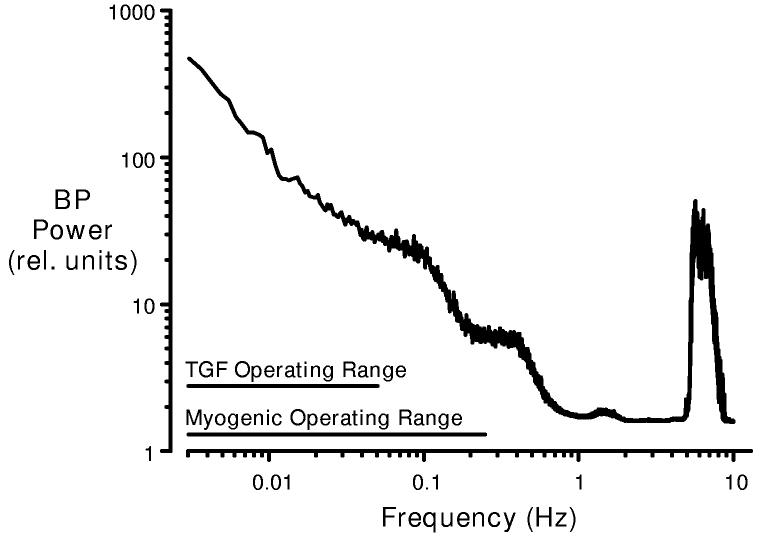
Figure 1
Figure 1
Blood pressure (BP) power spectrum in the conscious rat (mean data, n=10). The BP signal is a complex wave form derived from various fluctuations that oscillate at different frequencies. BP power is proportional to the square of the amplitude of these fluctuations (from the mean BP) and is plotted as a function of oscillation frequency (f). Note the 1/f relationship seen at frequencies below 1 Hz and the natural frequencies of TGF and the myogenic response. A major BP power peak is produced at the heart rate frequency (6 Hz in the rat). By current interpretations, this signal is beyond the myogenic operating range and, accordingly, is handled passively by the renal vasculature.
Figure 2
Figure 2
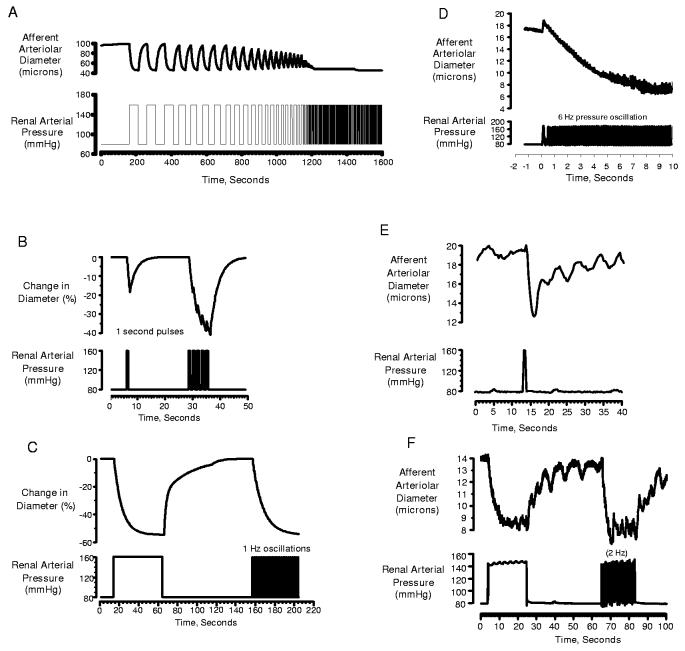
Examples of responses to pressure transients and oscillating pressure signals predicted by mathematical model based on kinetics of afferent arteriole (A-C) and actual responses observed in the hydronephrotic rat kidney (D-F). As shown in panel D, pressure oscillations presented at the rat heart rate (6 Hz) elicit a sustained afferent arteriolar vasoconstriction. Panels B,C,E &F reproduced with permission from reference .
Figure 3
Figure 3
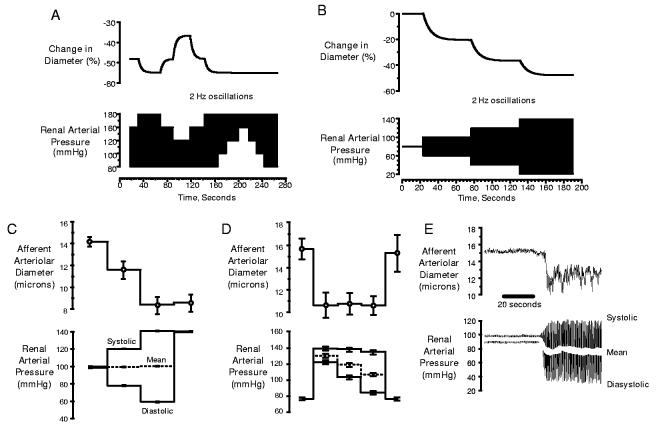
Predicted dependency of myogenic tone on systolic BP signal by mathematical model (A&B) and actual afferent arteriolar responses observed in hydronephrotic rat kidney preparation, confirming this prediction (C, D& E). Reproduced with permission from reference .
Figure 4
Figure 4
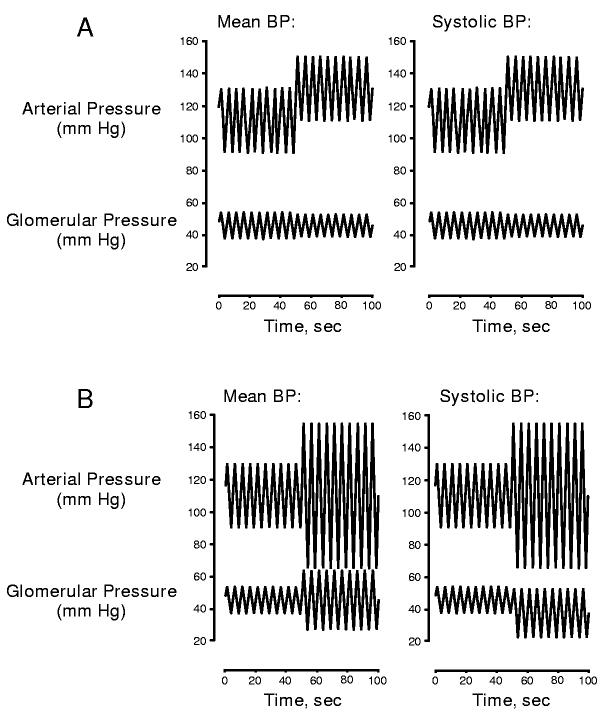
Modeling study illustrating the consequences, in regard to the regulation of glomerular capillary pressure, of two differing myogenic mechanisms, one in which the level of tone is dependent on mean BP (left), the second in which tone is dependent on the systolic BP (right). Note that a similar regulation of PGC is seen when mean and systolic pressure change in concert (A). However, isolated transients in systolic pressure are transmitted to the glomerulus when mean pressure sets myogenic tone, but not when tone is set by the systolic signal (B).
Figure 5
Figure 5
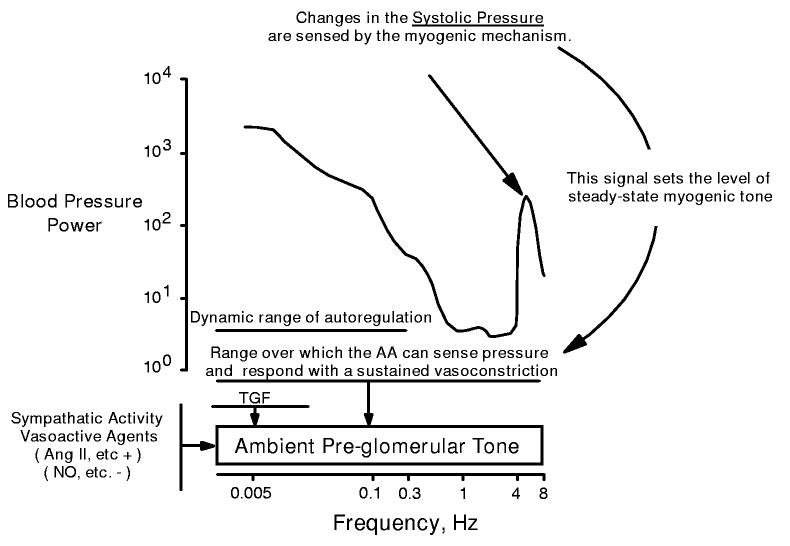
Alternate view of pressure-induced activation of the renal vasculature. Changes in the oscillating systolic pressure are sensed by the myogenic mechanism and it is this signal that sets the level of steady-state myogenic tone. This response provides protection over the full range of BP frequencies by limiting the transmission of pressure transients to the glomerular capillaries (see figure 4). Thus the myogenic response would contribute to a steady-state ambient level of pre-glomerular tone. Dynamic autoregulation of RBF and GFR occur at frequencies below the myogenic operating range as a consequence of this myogenic response and, at lower frequencies, as mediated by TGF.
Figure 6
Figure 6
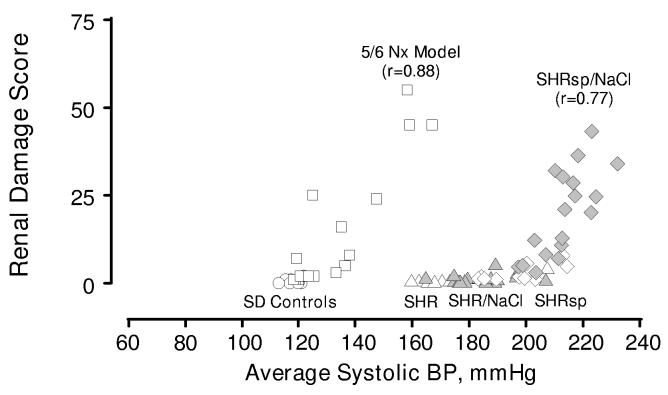
Relationships between renal injury and systolic BP in normotensive Sprague Dawley rats (SD, circles), SHR (triangles), stroke-prone SHR (SHRsp, diamonds) and 5/6 remnant kidney model (squares) and effects of increased dietary salt on SHR (grey triangles) and SHRsp (grey diamonds). Data reproduced with permission from references & . Pattern of injury parallels that of renal autoregulation. Thus, the injury seen in the SHRsp/NaCl occurs at BPs that exceed the myogenic limit. The remnant kidney exhibits impaired autoregulation, and exhibits a much lower BP threshold for hypertensive injury than normal or SHR kidneys. (modified with permission from reference 14).
Figure 7
Figure 7
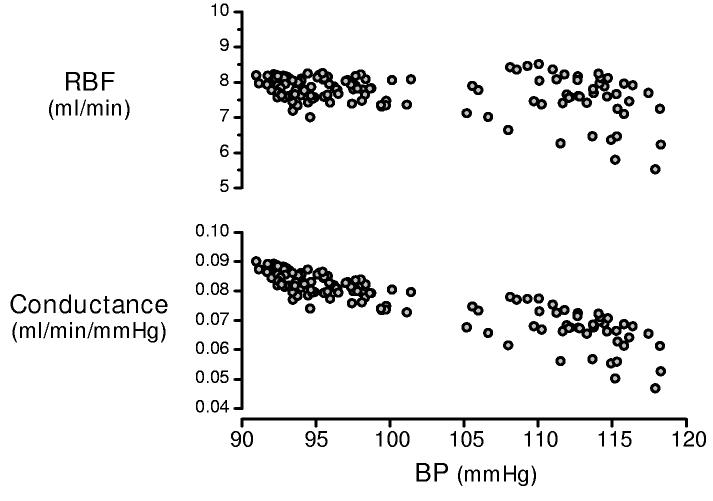
Spontaneous variations in RBF in the conscious unrestrained Sprague Dawley rat over a two hour period (day-time). The RBF and conductance values are 100 second moving averages with 50% overlap of the segments. Note that although autoregulation is evident from the pressure-dependent conductance responses (lower panel), RBF values exhibit marked variability (top).
Figure 8
Figure 8
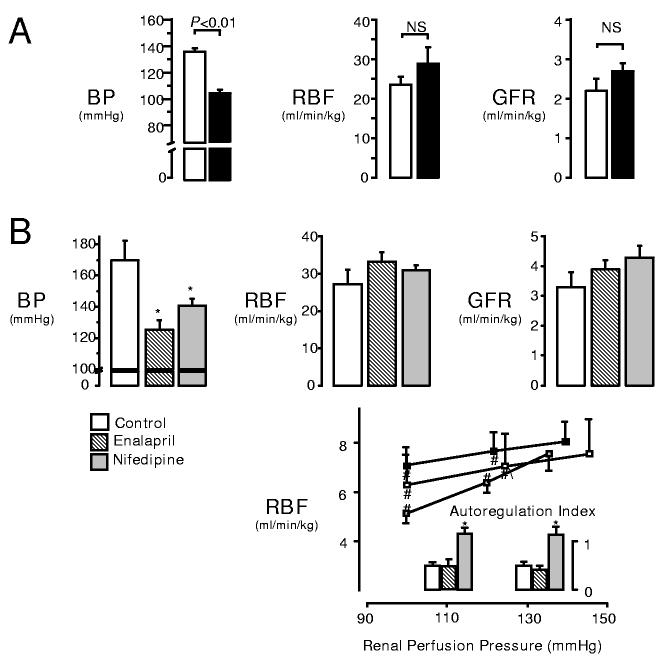
A: Ambient RBF and GFR of CKD “infarction model” (RK-I, white bars) and “surgical excision model” (RK-NX, black bars) remain similar despite significantly different BP and impaired autoregulation. B: Effects of 2 weeks of anti-hypertensive treatment on ambient BP, RBF and GFR in infarction CKD model (RK-I). Lower panel, illustrates impaired autoregulatory capacity (autoregulatory index of 0 or 1 indicate perfect or no autoregulation). Chronic reduction in BP with either enalapril (striped) or nifedipine (solid grey) did not alter ambient GFR or RBF, even though nifedipine completely abolished any residual autoregulatory capacity. *indicates P<0.05 versus control. # indicates P<0.05 versus basal. (Data reproduced with permission from references & 61).
Figure 9
Figure 9
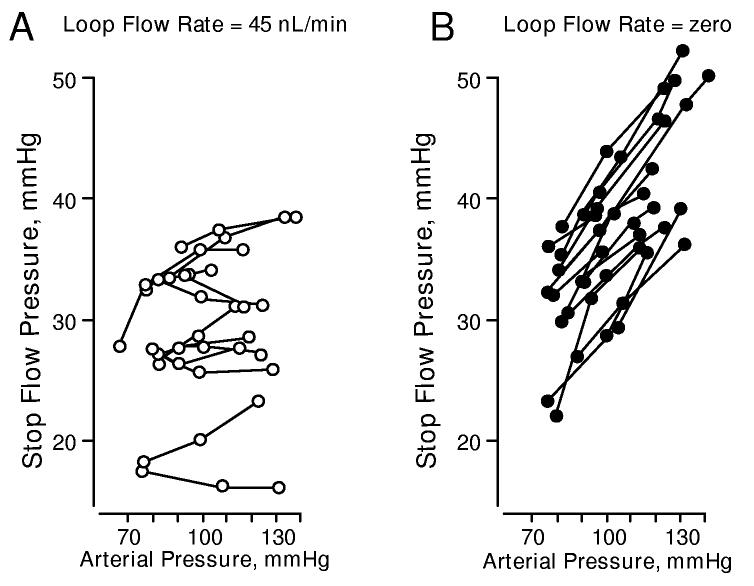
An example of PGC regulation during a constant early distal flow rate of 40 nl/min (A, left) and the disturbance of pressure regulation under zero flow conditions (B, right) in the anesthetized rat. PGC was estimated by micropuncture measurements of early proximal tubule “stop-flow” pressure. Renal perfusion pressure was altered by an aortic clamp placed proximal to the renal artery. Flow rate was altered by microperfusion of the loop of Henle. (data reproduced with permission from reference 131).

References

    1. Abraham WT, Schrier RW. Body fluid volume regulation in health and disease. Adv Intern Med. 1994;39:23–47. - PubMed
    1. Abu-Amarah I, Bidani AK, Hacioglu R, Williamson GA, Griffin KA. Differential effects of salt on renal hemodynamics and potential pressure transmission in stroke-prone and stroke-resistant spontaneously hypertensive rats. Am J Physiol Renal Physiol. 2005 In press. - PubMed
    1. Allison MEM, Wilson CB, Gottschalk CW. Pathophysiology of experimental glomerulonephritis in rats. J Clin Invest. 1974;53:1402–1423. - PMC - PubMed
    1. Anderson S, Rennke HG, Brenner BM. Therapeutic advantage of converting enzyme inhibitors in arresting progressive renal disease with systemic hypertension in the rat. J Clin Invest. 1986;77:1993–2000. - PMC - PubMed
    1. Arendshorst WJ. Altered reactivity of tubuloglomerular feedback. Annu Rev Physiol. 1987;49:295–317. - PubMed

Publication types

LinkOut - more resources