. 2006 Jun;148(3):366-75.
doi: 10.1038/sj.bjp.0706728.

Rosmarinic acid as a downstream inhibitor of IKK-beta in TNF-alpha-induced upregulation of CCL11 and CCR3

Affiliations

Rosmarinic acid as a downstream inhibitor of IKK-beta in TNF-alpha-induced upregulation of CCL11 and CCR3

Jongsung Lee et al. Br J Pharmacol. 2006 Jun.

Abstract

1. Tumor necrosis factor (TNF)-alpha is known to induce the expression of CCL11 and CCR3 via the activation of NF-kappaB. CCL11 (eotaxin), the C-C chemokine, is a potent chemoattractant for eosinophils and Th2 lymphocytes, and CCR3 is the receptor for CCL11. 2. In order to determine the effects of rosmarinic acid on the TNF-alpha-induced upregulation of CCL11 and CCR3 in human dermal fibroblasts, we performed an enzyme-linked immunosorbent assay for CCL11 and a Western blot assay for CCR3. The TNF-alpha-induced expression of CCL11 and CCR3 genes was attenuated by rosmarinic acid. 3. In our NF-kappaB luciferase reporter system, TNF-alpha-induced NF-kappaB activation was observed to be reduced by rosmarinic acid. In accordance with this result, rosmarinic acid also inhibited TNF-alpha-induced phosphorylation and degradation of IkappaB-alpha, as well as nuclear translocation of NF-kappaB heterodimer induced by TNF-alpha. This suggests that rosmarinic acid downregulates the expression of CCL11 and CCR3 via the inhibition of NF-kappaB activation signaling. 4. Using the NF-kappaB luciferase reporter system, Western blot analysis, and IKK-beta activity assay, we determined that rosmarinic acid inhibits IKK-beta activity in NF-kappaB signaling, which upregulates the expression of CCL11 and CCR3. Additionally, TNF-alpha-induced secretion of soluble intercellular adhesion molecule-1 and soluble vascular cell adhesion molecule-1 molecules was found to be attenuated by rosmarinic acid. 5. Our results show that rosmarinic acid inhibits the expression of CCL11 and CCR3 by suppressing the IKK-beta activity in NF-kappaB activation signaling. Further, these results suggest that rosmarinic acid might inhibit the expression of NF-kappaB promoter-related genes.


Figures
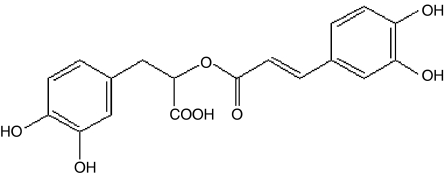
Figure 1
Figure 1
Structure of rosmarinic acid (α-o-caffeoyl-3,4-dihydroxyphenyl lactic acid).
Figure 2
Figure 2
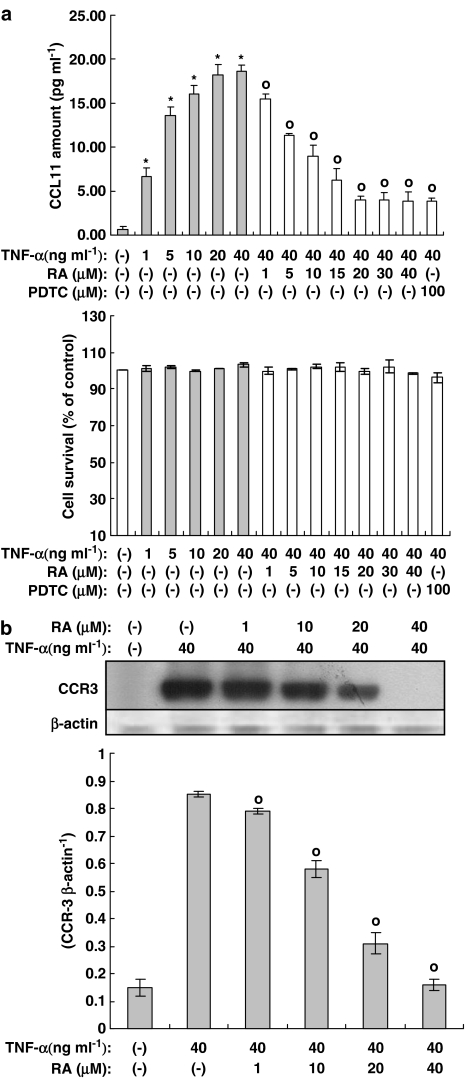
Rosmarinic acid inhibits expression of the CCL11 and CCR3 genes induced by TNF-α in human dermal fibroblast cells. Human dermal fibroblast cells were incubated in the presence or absence of TNF-α, along with indicated concentrations of rosmarinic acid for 14 h. (a) The concentration of CCL11 in the culture medium was measured by a sandwich immunoassay kit (upper panel). The cell survival curve is shown in the lower panel. Results were confirmed by three independent experiments. Data are expressed as the means±s.e.m. *P<0.05, compared with untreated controls. °P<0.05 versus TNF-α (40 ng ml−1) only. RA: rosmarinic acid; PDTC: pyrollidone dithiocarbamate (100 μM). (b) The cultured human dermal fibroblast cells were subjected to Western blot analysis using anti-CCR3 and β-actin antibodies. RA: rosmarinic acid. Bands were visualized by an ECL method and quantified using a densitometer. Similar results were obtained in three independent experiments. Data are expressed as means±s.e.m. of three independent experiments (bar graph). °P<0.05 versus TNF-α (40 ng ml−1) only.
Figure 3
Figure 3
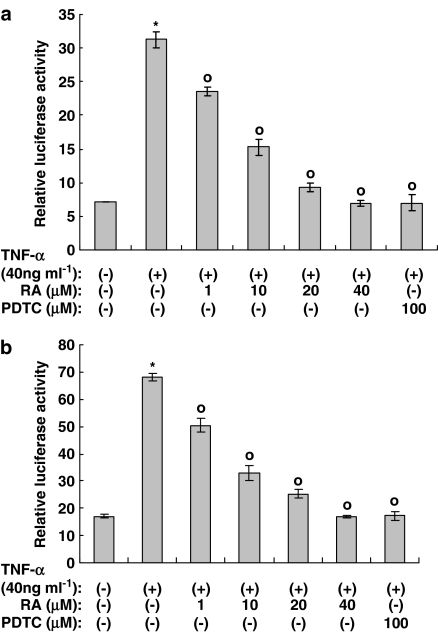
Rosmarinic acid inhibits NF-κB activation induced by TNF-α in (a) NIH3T3 cells and (b) human dermal fibroblast cells. NIH3T3 cells and human dermal fibroblast cells were transfected with NF-κB-Luc reporters, along with Renilla luciferase expression vector driven by the thymidine kinase promoter using Superfect™ reagent. After 24 h of incubation, cells were treated with rosmarinic acid in the presence or absence of TNF-α (40 ng ml−1) for 14 h. The cells were then harvested and assayed. Renilla luciferase vector was employed as a control for transfection efficiency and the reporter data were processed using the dual luciferase method, as described in Methods. Results were confirmed by three independent transfections. Data are expressed as the means±s.e.m. *P<0.05 compared with untreated controls. °P<0.05 versus TNF-α (40 ng ml−1) only. RA: rosmarinic acid; PDTC: pyrollidone dithiocarbamate (100 μM).
Figure 4
Figure 4
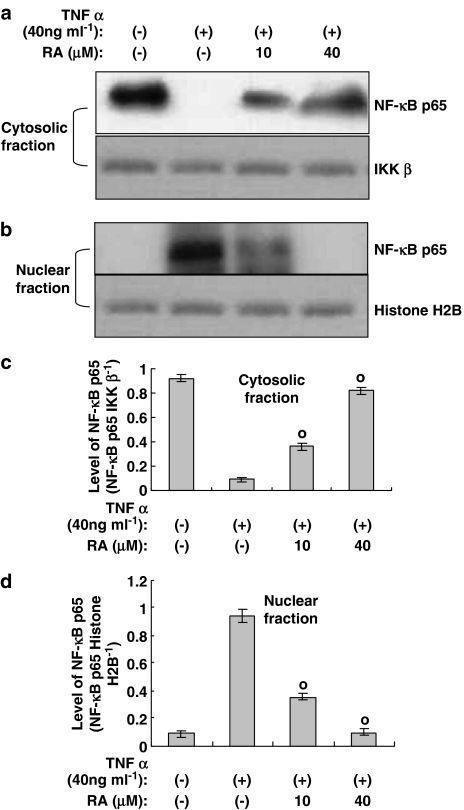
The nuclear translocation of NF-κB heterodimer induced by TNF-α is attenuated by rosmarinic acid. Human dermal fibroblast cells were stimulated using control vehicle, TNF-α (40 ng ml−1), or TNF-α plus rosmarinic acid for 30 min, followed by the isolation of nuclei and cytosol, as described in the Methods. Cytosolic (a) and nuclear (b) fractions were subjected to immunoblotting using anti-NF-κB p65, IKK-β, or histone H2B antibodies. Bands were visualized by an ECL method and quantified using a densitometer (c and d). Similar results were obtained in three independent experiments. Data are expressed as means±s.e.m. of three independent experiments (bar graph). °P<0.05 versus TNF-α (40 ng ml−1) only.
Figure 5
Figure 5
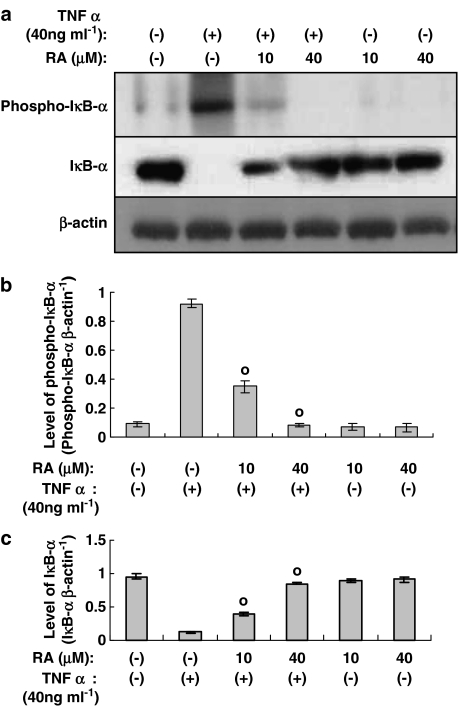
Rosmarinic acid inhibits the phosphorylation and degradation of IκB-α induced by TNF-α in human dermal fibroblast cells. Human dermal fibroblast cells were incubated in the presence or absence of TNF-α, along with the indicated concentrations of rosmarinic acid, for 30 min. The cultured human dermal fibroblast cells were subjected to Western blotting using antiphospho-IκB-α (Ser32/36) Ab or anti-IκB-α Ab (a). RA: rosmarinic acid. Bands were visualized by an ECL method and quantified using a densitometer (b and c). Similar results were obtained in three independent experiments. Data are expressed as means±s.e.m. of three independent experiments (bar graph). °P<0.05 versus TNF-α (40 ng ml−1) only.
Figure 6
Figure 6
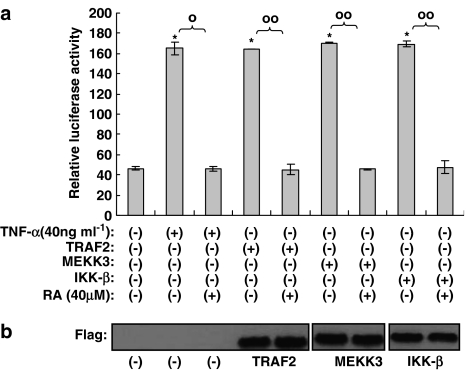
A hierarchy of rosmarinic acid that operates in the NF-κB activation pathway. Human dermal fibroblast cells were transfected with NF-κB-Luc reporters or indicated genes, such as TRAF2, MEKK3, and IKK-β, along with Renilla luciferase expression. After 24 h of incubation, the cells were incubated with 40 μM rosmarinic acid for 14 h, after which they were harvested and lysed. Supernatants were assayed for luciferase activity. Luciferase activity was determined using a Dual Luciferase Assay system and a LB953 luminometer; the luciferase activity was expressed as the ratio of the NF-κB-dependent firefly luciferase activity divided by control thymidine kinase Renilla luciferase activity (a). Results were confirmed by three independent transfections. Data are expressed as the means±s.e.m. *P<0.05, compared with the untreated controls. °P<0.05, °°P<0.05 versus TNF-α (40 ng ml−1) only or transfected controls. RA: rosmarinic acid. Western blots using antibody against Flag M1 for Flag-tagged TRAF2, MEKK3, or IKK-β show that each of the genes was transcribed and translated following transfection into cells (b).
Figure 7
Figure 7
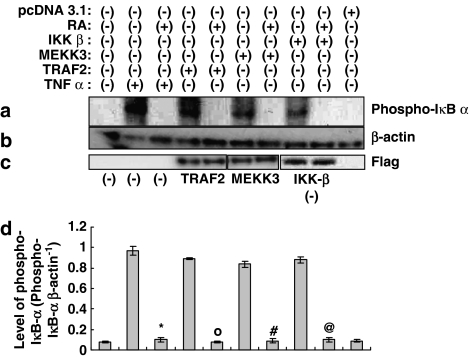
Rosmarinic acid operates downstream of IKK-β in NF-κB activation signaling. Human dermal fibroblast cells were transfected with TRAF2, MEKK3, or IKK-β, and were then incubated for 24 h. At that time, the human fibroblast cells were treated with 40 μM rosmarinic acid for 14 h. The cultured human dermal fibroblast cells were subjected to Western blot analysis using mouse monoclonal antibody (phospho-IκB-α (Ser32/36)) (a) and β-actin antibody (b). Bands were visualized by an ECL method and quantified using a densitometer (d). Similar results were obtained in three independent experiments. Data are expressed as means±s.e.m. of three independent experiments (bar graph). *P<0.05 versus TNF-α-treated control, °P<0.05 versus TRAF2-transfected control, #P<0.05 versus MEKK3-transfected control, @P<0.05 versus IKK-β-transfected control. Western blots using antibody against Flag M1 for Flag-tagged TRAF2, MEKK3, or IKK-β show that each of the genes was transcribed and translated following transfection into cells (c).
Figure 8
Figure 8
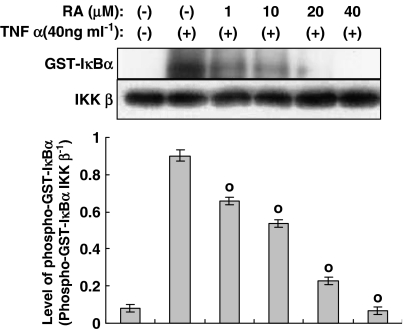
Effect of rosmarinic acid on IκB kinase (IKK)-β activity induced by TNF-α in human dermal fibroblast cells. IKK-β was immunoprecipitated from cells incubated in either the presence or absence of TNF-α (40 ng ml−1), along with the indicated concentrations of rosmarinic acid, for 30 min; the kinase assay was then performed (top row). Western blotting was performed to evaluate the total IKK-β level (bottom row). Bands were visualized by an ECL method and quantified using a densitometer. Similar results were obtained in three independent experiments. Data are expressed as means±s.e.m. of three independent experiments (bar graph). °P<0.05 versus TNF-α (40 ng ml−1) only.
Figure 9
Figure 9
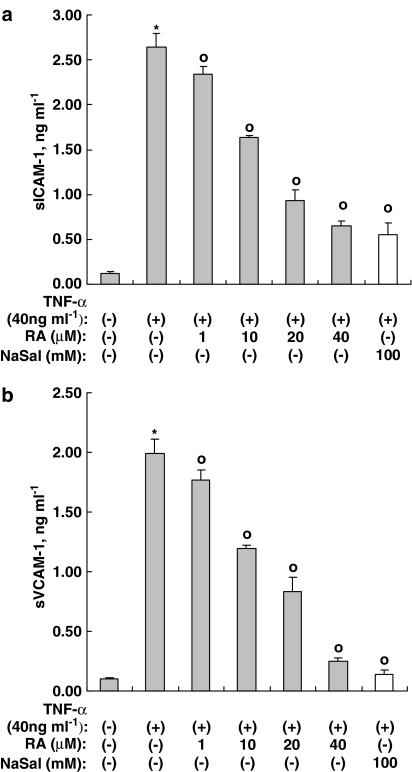
Rosmarinic acid inhibits the expression of VCAM-1 and ICAM-1 genes induced by TNF-α in human dermal fibroblast cells. Human dermal fibroblast cells were incubated in the presence or absence of TNF-α, along with indicated concentrations of rosmarinic acid, for 14 h. The concentration of sICAM-1 (a) and sVCAM-1 (b) in the culture medium was measured by a sandwich immunoassay kit (upper panel). Results were confirmed by three independent experiments. Data are expressed as the means±s.e.m. *P<0.05, compared with untreated controls. °P<0.05 versus TNF-α (40 ng ml−1) only. RA: rosmarinic acid; NaSal: sodium salicylate (20 mM).

References

    1. AL-SEREITI M.R., ABU-AMER K.M., SEN P. Pharmacology of rosemary (Rosmarinus officinalis Linn.) and its therapeutic potentials. Ind. J. Expo. Biol. 1999;37:124–130. - PubMed
    1. ATASOY U., CURRY S.L., LOPEZ DE SILANES I. Regulation of eotaxin gene expression by TNF-alpha and IL-4 through mRNA stabilization: involvement of the RNA-binding protein HuR. J. Immunol. 2003;171:4369–4378. - PubMed
    1. BAGGIOLINI M., DEWALD B., MOSER B. Human chemokines: an update. Annu. Rev. Immunol. 1997;15:675–705. - PubMed
    1. BARNES P.J., KARIN M. Nuclear factor-kappaB: a pivotal transcription factor in chronic inflammatory diseases. N. Engl. J. Med. 1997;336:1066–1071. - PubMed
    1. BELTRANI V.S.The clinical manifestation of atopic dermatitis Atopic Dermatitis. From Pathogenesis to Treatment 1996Heidelberg: Springer-Verlag; 1–35.ed. Leung, D.Y.M., pp

Publication types

MeSH terms