. 2006 Apr;2(4):e49.
doi: 10.1371/journal.pgen.0020049. Epub 2006 Apr 7.

Dynamic reprogramming of DNA methylation at an epigenetically sensitive allele in mice

Affiliations

Dynamic reprogramming of DNA methylation at an epigenetically sensitive allele in mice

Marnie E Blewitt et al. PLoS Genet. 2006 Apr.

Abstract

There is increasing evidence in both plants and animals that epigenetic marks are not always cleared between generations. Incomplete erasure at genes associated with a measurable phenotype results in unusual patterns of inheritance from one generation to the next, termed transgenerational epigenetic inheritance. The Agouti viable yellow (A(vy)) allele is the best-studied example of this phenomenon in mice. The A(vy) allele is the result of a retrotransposon insertion upstream of the Agouti gene. Expression at this locus is controlled by the long terminal repeat (LTR) of the retrotransposon, and expression results in a yellow coat and correlates with hypomethylation of the LTR. Isogenic mice display variable expressivity, resulting in mice with a range of coat colours, from yellow through to agouti. Agouti mice have a methylated LTR. The locus displays epigenetic inheritance following maternal but not paternal transmission; yellow mothers produce more yellow offspring than agouti mothers. We have analysed the DNA methylation in mature gametes, zygotes, and blastocysts and found that the paternally and maternally inherited alleles are treated differently. The paternally inherited allele is demethylated rapidly, and the maternal allele is demethylated more slowly, in a manner similar to that of nonimprinted single-copy genes. Interestingly, following maternal transmission of the allele, there is no DNA methylation in the blastocyst, suggesting that DNA methylation is not the inherited mark. We have independent support for this conclusion from studies that do not involve direct analysis of DNA methylation. Haplo-insufficiency for Mel18, a polycomb group protein, introduces epigenetic inheritance at a paternally derived A(vy) allele, and the pedigrees reveal that this occurs after zygotic genome activation and, therefore, despite the rapid demethylation of the locus.


Conflict of interest statement

Competing interests. The authors have declared that no competing interests exist.

Figures
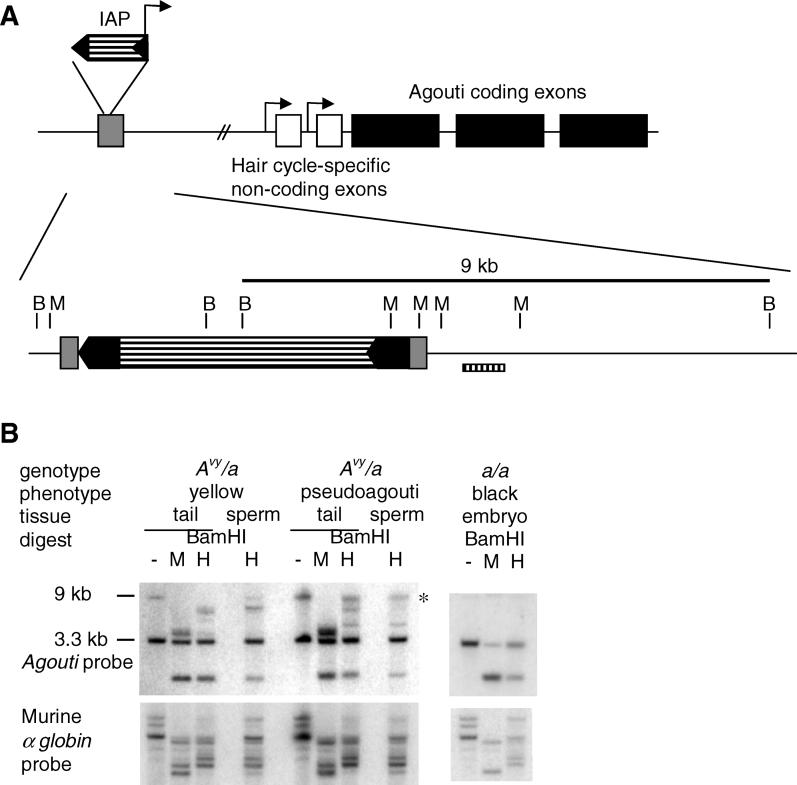
Figure 1
Figure 1. Methylation of the Avy Allele in Mature Sperm
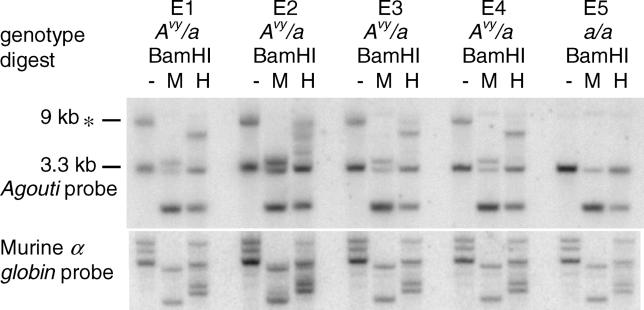
(A) Expression of the Avy allele is controlled by an IAP, inserted into pseudoexon 1a (grey box). A cryptic promoter within the 3′ LTR of the IAP (black arrows) directs transcription of the agouti coding exons. The BamHI (B) and MspI (M) sites are shown in the region of the unique 400-bp probe B. Tail and mature sperm from a yellow and a pseudoagouti male were collected. DNA was prepared and samples digested with BamHI followed by MspI or its isoschizomer HpaII, transferred and hybridised with the agouti probe [3]. The Avy allele produces a 9-kb BamHI band, while the a allele produces a 3.3-kb band. Membranes were stripped and rehybridised with a murine α-globin probe to check for equal digestion within the tissue samples (shown in [B]). These results represent experiments performed on sperm and tail DNA from seven yellow and five pseudoagouti males, a further one of each are shown in Figure S1. Mature sperm were isolated from both epididymes of the male (each sample contained in the order of 106 to 107 spermatocytes). Sperm samples were checked by light microscopy and found to be greater than 95% spermatocytes. The methylation state of the tissues is indicated by the ratio of the 9-kb BamHI band to the 7-kb band remaining after HpaII digestion. The 9-kb band is marked by an asterisk. The methylation state of the sperm reflects the phenotype of the father rather than the range of phenotypes seen in the offspring.
Figure 2
Figure 2. Methylation of the Avy Allele following Paternal Transmission
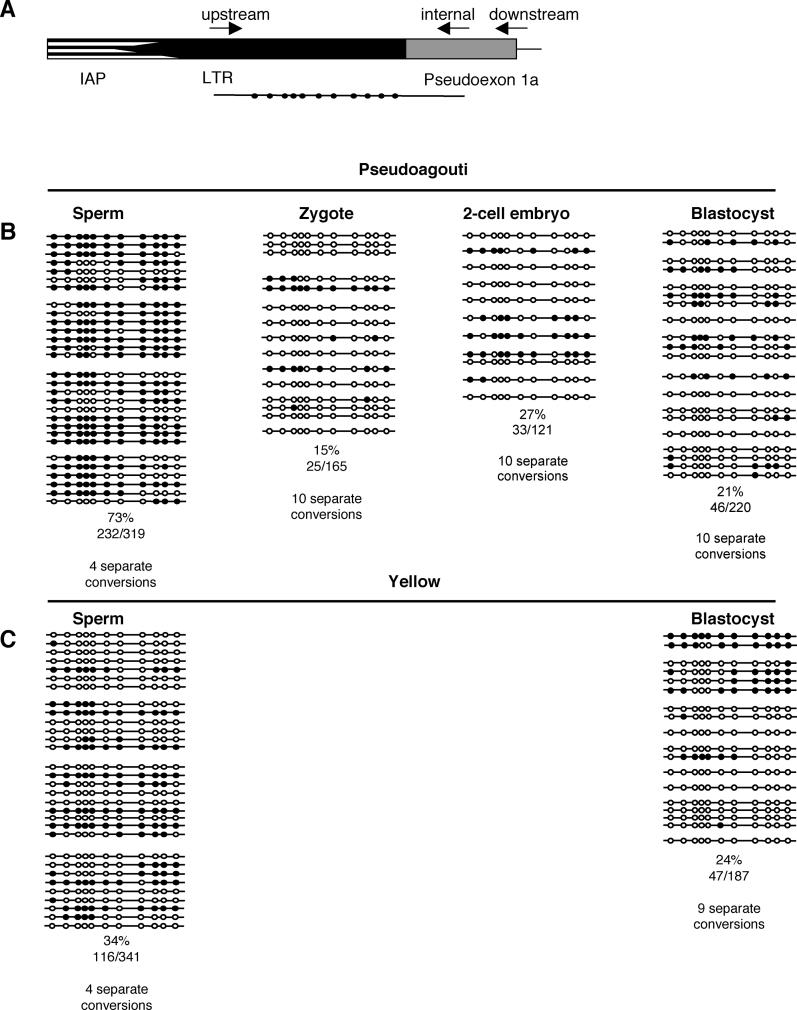
The methylation status of each CpG dinucleotide was determined by sequencing PCR clones of bisulfite-converted DNA [4]. Each line represents an individual clone, theoretically from one cell, and each circle an individual CpG. Open circles indicate an unmethylated CpG, and closed circles a methylated CpG. Each block of lines represents the clones derived from the sperm of one adult male mouse, one set of ten zygotes, ten two-cell embryos or one blastocyst. The percentage of methylation in each dataset is shown (calculated from the number of methylated CpGs divided by the total CpGs sequenced, multiplied by 100). The position of each circle is representative of the relative location along the length of the PCR product. Any clones with greater than 5% non-CpG methylation were excluded from the dataset, and these clones made up less than 5% of all clones sequenced. These clones tended to have very high levels of non-CpG methylation, an indication of incomplete bisulfite conversion. Zygotes, two-cell embryos, or blastocysts were collected from yellow or pseudoagouti Avy/a sires mated to a/a dams, as indicated. Clones were only included in the zygote or blastocyst samples if they could be distinguished from others in the sample by CpG or low-level non-CpG methylation. (A) The IAP LTR pseudoexon 1a junction shown in detail. The bisulfite sequencing primers are shown [4]. The PCR product contains 11 CpG dinucleotides, depicted as circles, all of which are in the LTR. (B) Data obtained from the sperm of four pseudoagouti males, and 10 × 10 zygotes, 10 × 10 two-cell embryos or 10 × 1 blastocysts collected from pseudoagouti Avy/a sires mated to a/a dams. (C) Data obtained from the sperm of four yellow male and 9 × 1 blastocysts collected from yellow Avy/a sires mated to a/a dams. These data indicate that the Avy allele is subject to rapid demethylation immediately postfertilisation following paternal transmission.
Figure 3
Figure 3. Methylation of the Avy Allele in 12.5-dpc Embryos following Paternal Transmission
The 12.5-dpc embryos produced from an Avy/a sire mated with an a/a dam. Samples were digested and subjected to Southern transfer as described in Figure 1. A range of methylation states were observed, evidenced by the varying amounts of the 9-kb BamHI band remaining after HpaII digestion. This indicates that the methylation is likely to be reset by this stage of development.
Figure 4
Figure 4. Methylation of the Avy Allele following Maternal Transmission
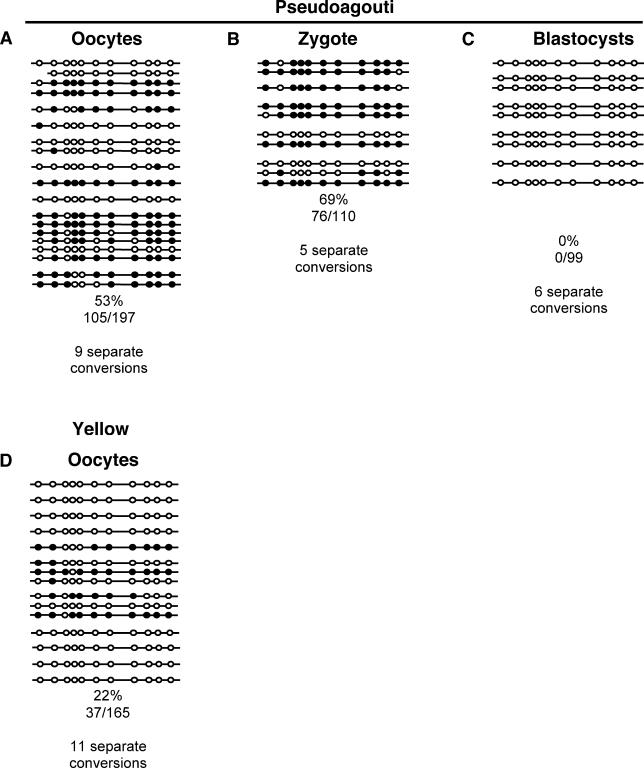
The methylation status of each CpG dinucleotide was determined by sequencing PCR clones of bisulfite-converted DNA, as described in Figure 2 [4]. Each block of lines represents the clones derived from one bisulfite conversion of ten cells (oocytes or zygotes). The percentage of methylation in each dataset is shown (calculated from the number of methylated CpGs divided by the total CpGs sequenced, multiplied by 100). Clones were only included in the samples if they could be distinguished from others in the sample by CpG or non-CpG methylation. Any clones with higher than 5% non-CpG methylation (an indication of incomplete bisulfite conversion) were excluded from the dataset, and these clones made up less than 5% of all clones sequenced. (A) and (D) Unfertilised oocytes from pseudoagouti or yellow Avy/a females, respectively. DNA methylation at the Avy allele does not appear to have been reset during oogenesis. (B) Zygotes from pseudoagouti Avy/a dams mated to a/a sires. (C) Blastocysts from pseudoagouti Avy/a dams mated to a/a sires. The Avy allele is not subject to rapid demethylation immediately postfertilisation following maternal inheritance, but is completely cleared of DNA methylation before blastocyst formation.
Figure 5
Figure 5. Pedigrees of Crosses between Mel18+/− and Mice Carrying the Avy Allele
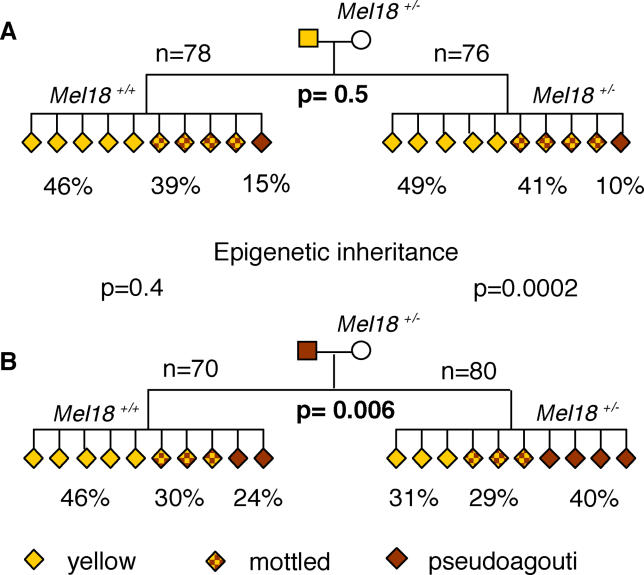
Avy/a C57BL/6J sires of the indicated phenotype were mated with Mel18+/− C57BL/6J dams. Data were produced from at least five different mating pairs in each case. Offspring not carrying the Avy allele have been omitted. All coat colour phenotypes were scored by one observer, before the analysis of Mel18 genotype. (A) There was no significant shift in the proportion of phenotypes observed between Mel18+/− and Mel18+/+ littermates from yellow sires. (B) There was a significant shift towards the pseudoagouti phenotype in Mel18+/− compared with Mel18+/+ littermates from pseudoagouti sires (p = 0.006). This shift produced a statistically significant difference in the range of Mel18+/− offspring observed from yellow and pseudoagouti sires (p = 0.0002); the Mel18+/− offspring of pseudoagouti sires are more likely to be pseudoagouti than those of yellow sires, i.e., transgenerational epigenetic inheritance is observed. Epigenetic inheritance was not observed in the Mel18+/+ littermates.

References

    1. Morgan HD, Santos F, Green K, Dean W, Reik W. Epigenetic reprogramming in mammals. Hum Mol Genet 14 (Spec 1): R47–R58. 2005. - PubMed
    1. Chong S, Whitelaw E. Epigenetic germline inheritance. Curr Opin Genet Dev. 2004;14:692–696. - PubMed
    1. Morgan HD, Sutherland HG, Martin DI, Whitelaw E. Epigenetic inheritance at the agouti locus in the mouse. Nat Genet. 1999;23:314–318. - PubMed
    1. Rakyan VK, Chong S, Champ ME, Cuthbert PC, Morgan HD, et al. Transgenerational inheritance of epigenetic states at the murine Axin(Fu) allele occurs after maternal and paternal transmission. Proc Natl Acad Sci U S A. 2003;100:2538–2543. - PMC - PubMed
    1. Lane N, Dean W, Erhardt S, Hajkova P, Surani A, et al. Resistance of IAPs to methylation reprogramming may provide a mechanism for epigenetic inheritance in the mouse. Genesis. 2003;35:88–93. - PubMed

Publication types

LinkOut - more resources