. 2006 Apr;6(4):779-82.
doi: 10.1021/nl0601076.

Fast DNA sequencing via transverse electronic transport

Affiliations

Fast DNA sequencing via transverse electronic transport

Johan Lagerqvist et al. Nano Lett. 2006 Apr.

Abstract

A rapid and low-cost method to sequence DNA would usher in a revolution in medicine. We propose and theoretically show the feasibility of a protocol for sequencing based on the distributions of transverse electrical currents of single-stranded DNA while it translocates through a nanopore. Our estimates, based on the statistics of these distributions, reveal that sequencing of an entire human genome could be done with very high accuracy in a matter of hours without parallelization, that is, orders of magnitude faster than present techniques. The practical implementation of our approach would represent a substantial advancement in our ability to study, predict, and cure diseases from the perspective of the genetic makeup of each individual.


Figures
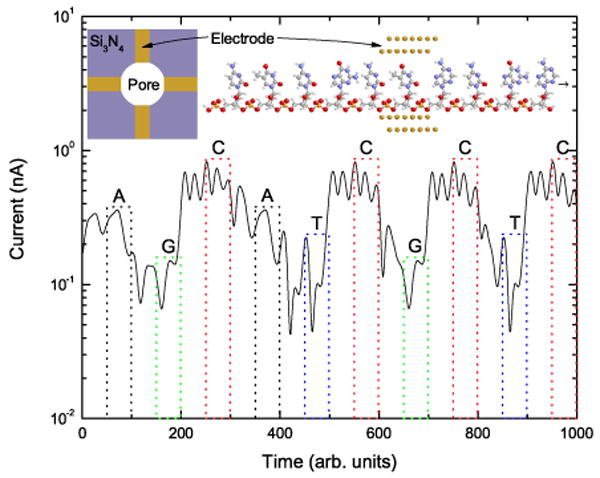
FIG. 1
FIG. 1
Transverse current versus time (in arbitrary units) of a highly idealized single strand of DNA translocating through a nanopore with a constant motion. The sequence of the single strand is AGCATCGCTC. The left inset shows a top-view schematic of the pore cross section with four electrodes (represented by gold rectangles). The right inset shows an atomistic side view of the idealized single strand of DNA and one set of gold electrodes across which electrical current is calculated. The boxes show half the time each nucleotide spends in the junction. Within each box, a unique signal from each of the bases can be seen.
FIG. 2
FIG. 2
Currents as a function of time for a poly(dC)15 translocating through a nanopore. Blue (red) curve indicates the current, for a bias of 1 V, between the right and left (front and back) electrodes represented in gray in the snapshots (the fourth electrode is located behind the field of view and is hence not visible in the snapshots). During approximately the first half of the translocation, the two currents follow each other, indicating no bases are aligned with either electrode pair. Left snapshot indicates the case in which a nucleotide is aligned with a pair of electrodes; the right snapshot when the nucleotide is not aligned between either pair of electrodes. In the snapshots, solution atoms are not shown and red colors are a guide for the eye only.
FIG. 3
FIG. 3
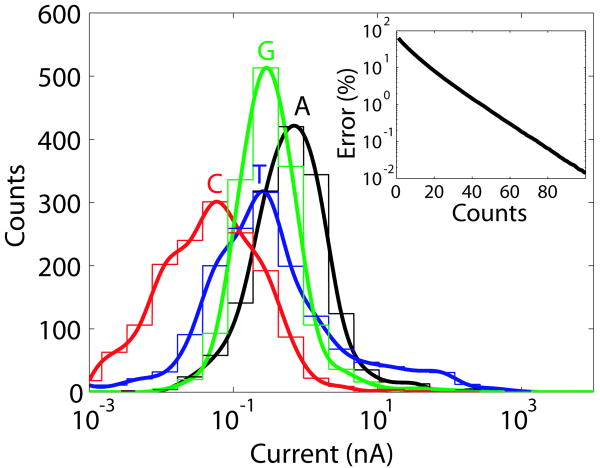
Probability distributions of currents at a bias of 1 V for poly(dX)15, where X is Adenine/Thymine/Cytosine/Guanine for the black/blue/red/green curve, respectively. The thin lines show the actual current intervals used for the count, while the thick lines are an interpolation. The inset shows the exponentially decaying ratio of falsely identified bases versus number of independent counts (measurements) of the current averaged over the four bases.

References

    1. Li J, Stein D, McMullan C, Branton D, Aziz MJ, Golovchenko JA. Nature. 2001;412:166. - PubMed
    1. Storm AJ, Chen JH, Ling XS, Zandbergen HW, Dekker C. Nature Mat. 2003;2:537. - PubMed
    1. Harrell CC, Lee SB, Martin CR. Anal Chem. 2003;75:6861. - PubMed
    1. Li N, Yu S, Harrell CC, Martin CR. Anal Chem. 2004;76:2025. - PubMed
    1. Lemay SG, van den Broek DM, Storm AJ, Krapf D, Smeets RMM, Heering HA, Dekker C. Anal Chem. 2005;77:1911. - PubMed

Publication types

MeSH terms