Unstudied infants: outcomes of moderately premature infants in the neonatal intensive care unit
- PMID: 16611647
- PMCID: PMC2672722
- DOI: 10.1136/adc.2005.087031
Unstudied infants: outcomes of moderately premature infants in the neonatal intensive care unit
Abstract
Background: Newborns of 30-34 weeks gestation comprise 3.9% of all live births in the United States and 32% of all premature infants. They have been studied much less than very low birthweight infants.
Objective: To measure in-hospital outcomes and readmission within three months of discharge of moderately premature infants.
Design: Prospective cohort study including retrospective chart review and telephone interviews after discharge.
Setting: Ten birth hospitals in California and Massachusetts.
Patients: Surviving moderately premature infants born between October 2001 and February 2003.
Main outcome measures: (a) Occurrence of assisted ventilation during the hospital stay after birth; (b) adverse in-hospital outcomes-for example, necrotising enterocolitis; (c) readmission within three months of discharge.
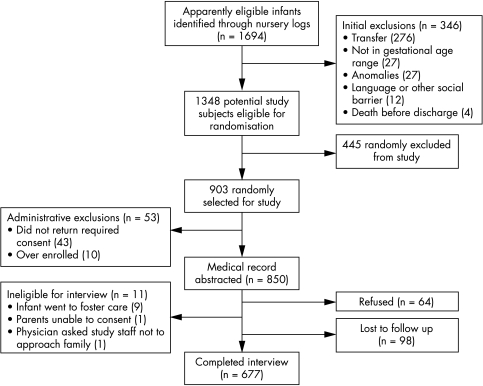
Results: With the use of prospective cluster sampling, 850 eligible infants and their families were identified, randomly selected, and enrolled. A total of 677 families completed a telephone interview three months after hospital discharge. During the birth stay, these babies experienced substantial morbidity: 45.7% experienced assisted ventilation, and 3.2% still required supplemental oxygen at 36 weeks. Readmission within three months occurred in 11.2% of the cohort and was higher among male infants and those with chronic lung disease.
Conclusions: Moderately premature infants experience significant morbidity, as evidenced by high rates of assisted ventilation, use of oxygen at 36 weeks, and readmission. Such morbidity deserves more research.
Conflict of interest statement
Competing interests: none declared
References
-
- Hack M, Fanaroff A A. Outcomes of children of extremely low birthweight and gestational age in the 1990s. Semin Neonatol 2000589–106. - PubMed
-
- Kramer M S, Demissie K, Yang H.et al The contribution of mild and moderate preterm birth to infant mortality. Fetal and Infant Health Study Group of the Canadian Perinatal Surveillance System. JAMA 2000284843–849. - PubMed
-
- Blair E, Stanley F J. Cerebral palsy in low‐birthweight infants: implications for perinatal care. Pediatr Perinat Epidemiol 19926298–310. - PubMed
-
- Cummins S K, Nelson K B, Grether J K.et al Cerebral palsy in four northern California counties, births 1983 through 1985. J Pediatr 1993123230–237. - PubMed
-
- Hagberg B, Hagberg G, Beckung E.et al Changing panorama of cerebral palsy in Sweden. VIII. Prevalence and origin in the birth year period 1991–94. Acta Paediatr 200190271–277. - PubMed
Publication types
MeSH terms
Grants and funding
LinkOut - more resources
Full Text Sources
Medical