


Uric acid and inflammatory markers
- PMID: 16611671
- PMCID: PMC2668163
- DOI: 10.1093/eurheartj/ehi879
Uric acid and inflammatory markers
Abstract
Aims: The role of uric acid (UA) in the process of atherosclerosis and atherotrombosis is controversial. Epidemiological studies have recently shown that UA may be a risk factor for cardiovascular diseases and a negative prognostic marker for mortality in subjects with pre-existing heart failure.
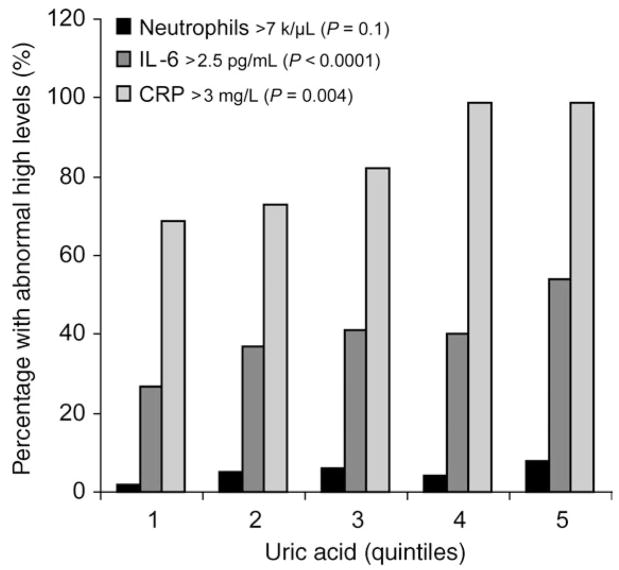
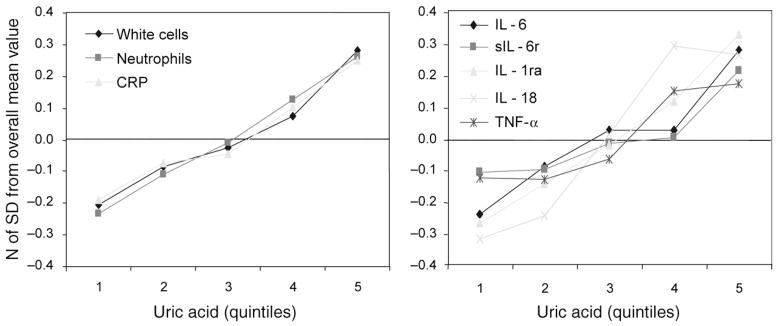
Methods and results: We evaluate a relationship between UA levels and several inflammatory markers in 957 subjects, free of severe renal failure, from a representative Italian cohort of persons aged 65-95. Plasma levels of UA and white blood cell (WBC) and neutrophil count, C-reactive protein, interleukin-1 receptor antagonist (IL-1ra), interleukin-6 (IL-6), soluble IL-6 receptor (sIL-6r), interleukin-18 (IL-18), and tumor necrosis factor-alpha (TNF-alpha) were measured. Complete information on potential confounders was collected using standard methods. WBC (P=0.0001), neutrophils (P<0.0001), C-reactive protein (P<0.0001), IL-1ra (P<0.0001), IL-6 (P=0.0004), sIL-6r (P=0.002), IL-18 (P<0.0001), TNF-alpha (P=0.0008), and the percentage of subjects with abnormally high levels of C-reactive protein (P=0.004) and IL-6 (P=<0.0001) were significantly higher across UA quintiles. After adjustment for age, sex, behaviour- and disease-related confounders, results were virtually unchanged. In subjects with UA within the normal range, UA was significantly and independently associated with neutrophils count, C-reactive protein, IL-6, IL-1ra, IL-18, and TNF-alpha, whereas non-significant trends were observed for WBC (P=0.1) and sIL-6r (P=0.2).
Conclusion: A positive and significant association between UA and several inflammatory markers was found in a large population-based sample of older persons and in a sub-sample of participants with normal UA. Accordingly, the prevalence of abnormally high levels of C-reactive protein and IL-6 increased significantly across UA quintiles.
Conflict of interest statement
Figures
Comment in
-
Significance of uric acid for the heart and vessels.Eur Heart J. 2006 Aug;27(15):1886. doi: 10.1093/eurheartj/ehl105. Epub 2006 Jun 14. Eur Heart J. 2006. PMID: 16774981 No abstract available.
References
-
- Wu XW, Muzny DM, Lee CC, Caskey CT. Two independent mutational events in the loss of urate oxidase during hominoid evolution. J Mol Evol. 1992;34:78–84. - PubMed
-
- Hediger MA, Johnson RJ, Miyazaki H, Endou H. Molecular physiology of urate transport. Physiology. 2005;20:125–133. - PubMed
-
- Nieto FJ, Iribarren C, Gross MD, Comstock GW, Cutler RG. Uric acid and serum antioxidant capacity: a reaction to atherosclerosis? Atherosclerosis. 2000;148:131–139. - PubMed
-
- Glantzounis GK, Tsimoyiannis EC, Kappas AM, Galaris DA. Uric acid and oxidative stress. Curr Pharm Des. 2005;11:4145–4151. - PubMed
MeSH terms
Substances
Grants and funding
LinkOut - more resources
Full Text Sources
Other Literature Sources
Medical
Research Materials
Miscellaneous
