Widening spectrum of a reversible splenial lesion with transiently reduced diffusion
Affiliations
- PMID: 16611774
- PMCID: PMC8133957
Item in Clipboard
Widening spectrum of a reversible splenial lesion with transiently reduced diffusion
AJNR Am J Neuroradiol.
2006 Apr.
Abstract
Four patients with encephalitis/encephalopathy and parenchymal lesions accompanying reversible splenial lesions were retrospectively evaluated. In 3 patients, reversible lesions with transiently reduced diffusion were seen in the splenium and symmetrically in the peripheral frontoparietal white matter, clinical signs and symptoms were mild, and recovery was complete. These and previous observations suggest a less severe course and outcome for patients with reversible lesions isolated to the splenium or to the splenium and peripheral frontoparietal white matter.
Figures
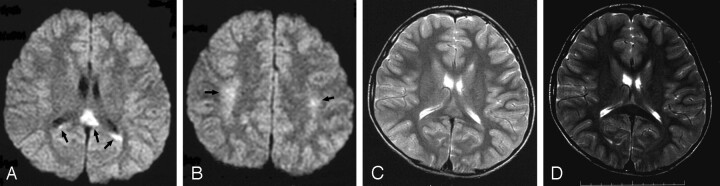
Diffusion-weighted and T2-weighted images of patient 2 on day 5 showed high-signal-intensity lesions in the central portion of the splenium of the corpus callosum (SCC) and symmetric frontoparietal peripheral white matter (A–C, arrows). Follow-up study on day 12 showed no lesions on any sequences (T2-weighted image, D).
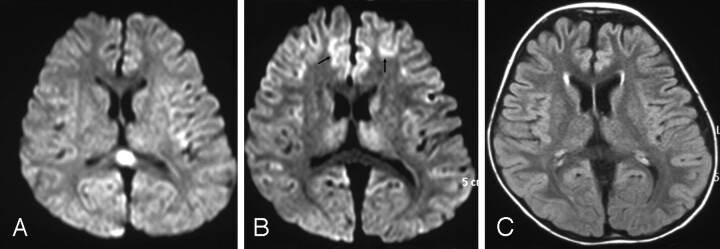
Diffusion-weighted image (DWI) of patient 4 on day 2 showed an oval shaped splenial lesion (A). DWI on day 7 showed no splenial lesion, but frontal cortical lesions with reduced diffusion (B, arrows), followed by cortical T2 prolongation and atrophy on day 70 (fluid-attenuated inversion recovery, C).
References
-
- Kim SS, Chang K-H, Kim ST, et al. Focal lesion in the splenium of the corpus callosum in epileptic patients: antiepileptic drug toxicity? AJNR Am J Neuroradiol 1999;20:125–29 - PubMed
-
- Mirsattari SM, Lee DH, Jones MW, et al. Transient lesion in the splenium of the corpus callosum in an epileptic patient. Neurology 2003;60:1838–41 - PubMed
-
- Tada H, Takanashi J, Barkovich AJ, et al. Clinically mild encephalitis/encephalopathy with a reversible splenial lesion. Neurology 2004;63:1854–58 - PubMed
-
- Kobuchi N, Tsukahara H, Kawamura Y, et al. Reversible diffusion-weighted MR findings of Salmonella enteritidis–associated encephalopathy. Eur Neurol 2003;49:182–84 - PubMed
MeSH terms
LinkOut - more resources
Full Text Sources
Medical