. 2006 May;80(9):4521-7.
doi: 10.1128/JVI.80.9.4521-4527.2006.

Differential chemokine expression following respiratory virus infection reflects Th1- or Th2-biased immunopathology

Affiliations

Differential chemokine expression following respiratory virus infection reflects Th1- or Th2-biased immunopathology

Fiona J Culley et al. J Virol. 2006 May.

Abstract

Respiratory syncytial virus (RSV) is a major viral pathogen of infants that also reinfects adults. During RSV infection, inflammatory host cell recruitment to the lung plays a central role in determining disease outcome. Chemokines mediate cell recruitment to sites of inflammation and are influenced by, and influence, the production of cytokines. We therefore compared chemokine production in a mouse model of immunopathogenic RSV infection in which either Th1 or Th2 immunopathology is induced by prior sensitization to individual RSV proteins. Chemokine expression profiles were profoundly affected by the nature of the pulmonary immunopathology: "Th2" immunopathology in BALB/c mice was associated with increased and prolonged expression of CCL2 (MCP-1), CXCL10 (IP-10), and CCL11 (eotaxin) starting within 24 h of challenge. C57BL/6 mice with "Th2" pathology (enabled by a deficiency of CD8+ cells) also showed increased CCL2 production. No differences in chemokine receptor expression were detected. Chemokine blockers may therefore be of use for children with bronchiolitis.


Figures
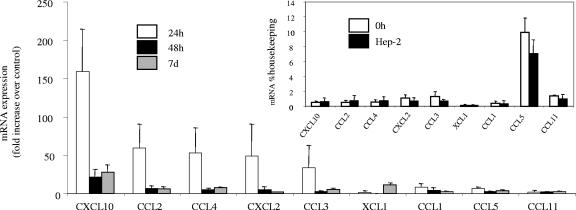
FIG. 1.
FIG. 1.
Chemokine expression following RSV infection. Groups of four birth-cohorted BALB/c mice were challenged with 2 × 10⁶ PFU RSV, and 24 h, 48 h, and 7 days later, levels of chemokine mRNA in whole lungs were assessed by an RNase protection assay. (Inset) Baseline expression in uninfected mice (0 h) and in mice that had been challenged with Hep-2 cell lysates (the cells in which RSV stocks were grown). Data are shown as n-fold increase over control data ± standard error. Data are representative of three similar studies.
FIG. 2.
FIG. 2.
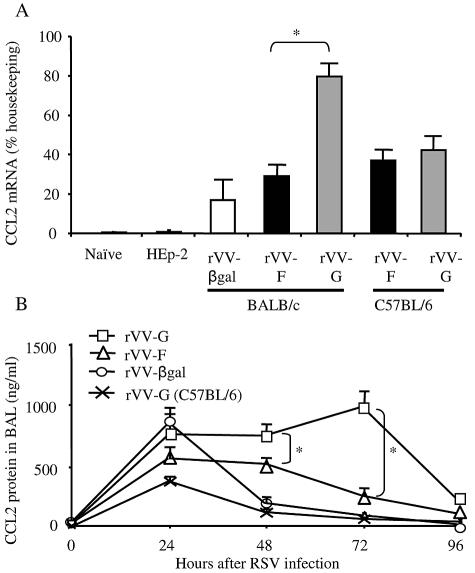
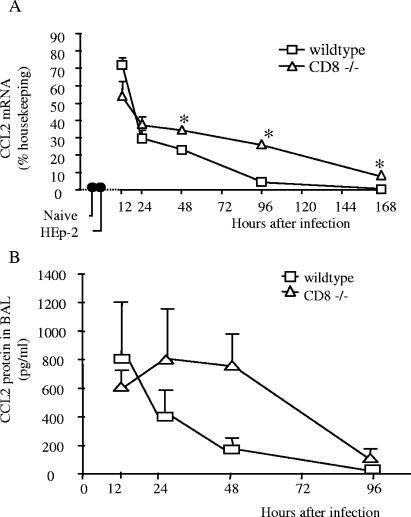
CCL2 expression reflects the immunopathological response to RSV infection. (A) Levels of CCL2 mRNA were assessed by RNase protection assays in whole lungs of BALB/c or C57BL/6 mice 24 h following RSV infection. Each mouse was tested individually (n = 4 per group). Some mice had been primed 2 to 3 weeks earlier with either rVV-F, rVV-G, or the control rVV-βgal. Results are expressed as protected band intensity and are percentages of the intensity of the housekeeping genes L32 and GAPDH. (B) In similar experiments, CCL2 protein levels were assessed in cell-free BAL fluids by ELISAs at different time points following RSV infection. *, P < 0.05 for comparison of rVV-G- and rVV-F-primed BALB/c mice.
FIG. 3.
FIG. 3.
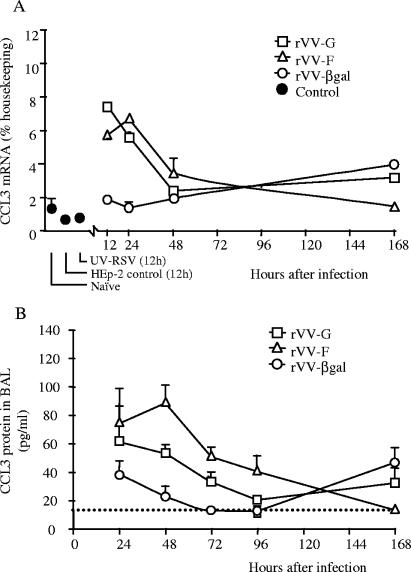
CCL3 expression in response to RSV infection. (A) Levels of CCL3 mRNA in whole lungs of BALB/c mice were assessed by RNase protection assays. Each mouse was tested individually (n = 4 per group). Some groups of mice had been primed 2 to 3 weeks earlier with either rVV-F, rVV-G, or rVV-βgal. Results are expressed as protected band intensity and are percentages of the intensity of the housekeeping genes L32 and GAPDH. Each data point is the mean for four animals. Error bars, standard errors. (B) CCL3 protein levels in cell-free BAL fluids from rVV-G- or rVV-F-primed and RSV-infected BALB/c mice were assessed by ELISA. The limit of detection is 15 pg/ml (dotted line).
FIG. 4.
FIG. 4.
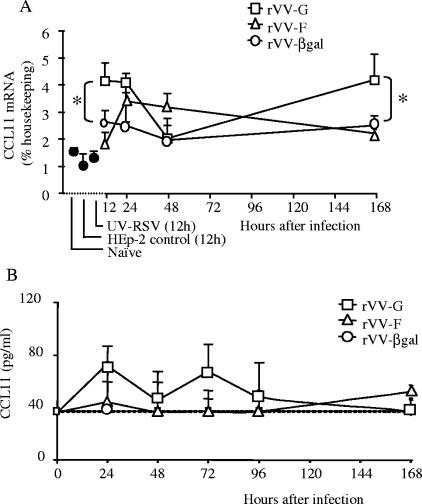
CCL11 expression in response to RSV infection. (A) Levels of CCL11 mRNA in whole lungs of BALB/c mice following RSV infection were assessed by RNase protection assays. Some mice had been primed 2 to 3 weeks earlier with rVV-G, rVV-F, or rVV-βgal. Results are expressed as protected band intensity and are percentages of the intensity of the housekeeping genes L32 and GAPDH. *, P < 0.05 for comparison of rVV-G- and rVV-F-primed BALB/c mice. (B) CCL11 protein levels in cell-free BAL fluids from rVV-primed and RSV-infected BALB/c mice were assessed by ELISA. The limit of detection was 37.5 pg/ml (broken line).
FIG. 5.
FIG. 5.
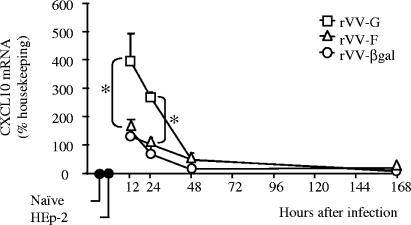
CXCL10 expression in response to RSV infection. Levels of CXCL10 mRNA in whole lungs of BALB/c mice following RSV infection were assessed by RNase protection assays. Some groups of mice (n = 4) had been primed 2 to 3 weeks earlier with rVV-G, rVV-F, or rVV-βgal. Results are expressed as protected band intensity and are percentages of the intensity of the housekeeping genes L32 and GAPDH. Each data point is the mean for four animals. Error bars, standard errors. *, P < 0.05 for comparison of rVV-G- and rVV-F-primed BALB/c mice.
FIG. 6.
FIG. 6.
(A) CCL2 mRNA expression is increased in rVV-G-primed CD8-deficient mice. Levels of CCL2 mRNA were assessed by RNase protection assays in whole lungs of wild-type and CD8−/− C57BL/6 mice primed with rVV-G and challenged 2 weeks later with RSV. Results are expressed as protected band intensity and are percentages of the intensity of the housekeeping genes L32 and GAPDH. Controls are mRNA levels after rVV scarification prior to RSV infection and 24 h after intranasal inoculation of a Hep-2 cell lysate. *, P < 0.05 for comparison of wild-type and CD8−/− mice. (B) CCL2 protein levels in cell-free BAL fluids from wild-type and CD8−/− RSV-infected C57BL/6 mice were assessed by ELISA. The limit of detection is 37.5 pg/ml. In both panels, each data point is the mean for four animals. Error bars, standard errors.
FIG. 7.
FIG. 7.
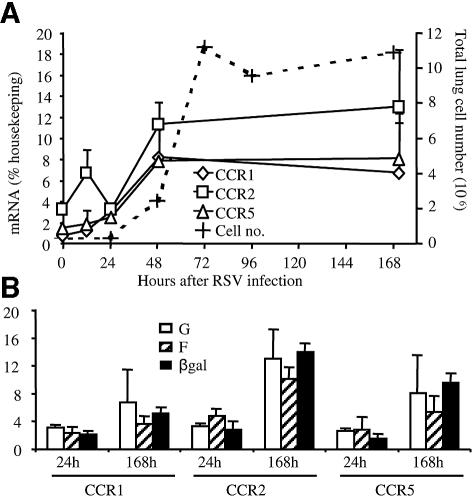
Chemokine receptor expression following RSV infection. Expression of chemokine receptor CCR1, CCR2, and CCR5 mRNAs in whole lungs of BALB/c mice was assessed by RNase protection assays. (A) Primary RSV infection. (B) Mice primed with rVV and challenged 2 weeks later with RSV. Results are expressed as percentages of the intensity of the housekeeping genes L32 and GAPDH. Each data point is the mean for four animals. Error bars, standard errors.

References

    1. Alwan, W. H., W. J. Kozlowska, and P. J. M. Openshaw. 1994. Distinct types of lung disease caused by functional subsets of antiviral T cells. J. Exp. Med. 179:81-89. - PMC - PubMed
    1. Baggiolini, M. 1996. Eotaxin: a VIC (very important chemokine) of allergic inflammation? J. Clin. Investig. 97:587. - PMC - PubMed
    1. Bangham, C. R. M., M. J. Cannon, D. T. Karzon, and B. A. Askonas. 1985. Cytotoxic T-cell response to respiratory syncytial virus in mice. J. Virol. 56:55-59. - PMC - PubMed
    1. Chensue, S. W., K. Warmington, J. H. Ruth, N. Lukacs, and S. L. Kunkel. 1997. Mycobacterial and schistosomal antigen-elicited granuloma formation in IFN-γ and IL-4 knockout mice: analysis of local and regional cytokine and chemokine networks. J. Immunol. 159:3565-3573. - PubMed
    1. Fung-Leung, W. P., M. W. Schilham, A. Rahemtulla, T. M. Kundig, M. Vollenweider, J. Potter, W. Van Ewijk, and T. W. Mak. 1991. CD8 is needed for development of cytotoxic T cells but not helper T cells. Cell 65:443-449. - PubMed

Publication types

MeSH terms