Review
. 2006 Feb 28;361(1466):301-17.
doi: 10.1098/rstb.2005.1795.

The evolutionary outcome of sexual conflict

Affiliations
Review

The evolutionary outcome of sexual conflict

C M Lessells. Philos Trans R Soc Lond B Biol Sci. .

Abstract

Inter-locus sexual conflict occurs by definition when there is sexually antagonistic selection on a trait so that the optimal trait value differs between the sexes. As a result, there is selection on each sex to manipulate the trait towards its own optimum and resist such manipulation by the other sex. Sexual conflict often leads additionally to the evolution of harmful behaviour and to self-reinforcing and even perpetual sexually antagonistic coevolution. In an attempt to understand the determinants of these different outcomes, I compare two groups of traits-those related to parental investment (PI) and to mating-over which there is sexual conflict, but which have to date been explored by largely separate research traditions. A brief review suggests that sexual conflict over PI, particularly over PI per offspring, leads less frequently to the evolution of manipulative behaviour, and rarely to the evolution of harmful behaviour or to the rapid evolutionary changes which may be symptomatic of sexually antagonistic coevolution. The chief determinants of the evolutionary outcome of sexual conflict are the benefits of manipulation and resistance, the costs of manipulation and resistance, and the feasibility of manipulation. All three of these appear to contribute to the differences in the evolutionary outcome of conflicts over PI and mating. A detailed dissection of the evolutionary changes following from sexual conflict exposes greater complexity than a simple adaptation-counter-adaptation cycle and clarifies the role of harm. Not all of the evolutionary changes that follow from sexual conflict are sexually antagonistic, and harm is not necessary for sexually antagonistic coevolution to occur. In particular, whereas selection on the trait over which there is conflict is by definition sexually antagonistic, collateral harm is usually in the interest of neither sex. This creates the opportunity for palliative adaptations which reduce collateral harm. Failure to recognize that such adaptations are in the interest of both sexes can hinder our understanding of the evolutionary outcome of sexual conflict.


Figures
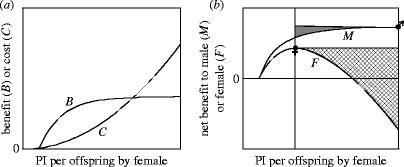
Figure 1
Figure 1
Conflict load in sexual conflict over PI per offspring by the female when there is uniparental maternal care of a brood containing a single offspring. (a) As the amount of PI by the female increases, the fitness benefit, B, through the offspring increases, but with diminishing returns, while the female also pays a fitness cost, C, in reduced survival or future reproduction which increases at an accelerating rate at higher levels of PI. (Here, it is assumed that all costs are paid after the offspring becomes independent; cf. §4c and figure 3.) (b) The net fitness gain to the female, F, is the fitness benefit minus the fitness cost, and peaks at an intermediate value of PI. This is the female's optimum for the amount of PI that she makes and is indicated by a filled female symbol. The male receives the same fitness benefit through the offspring as the female, but pays no cost, so his net benefit, M, is the benefit through the offspring. This peaks where the benefit through the offspring reaches an asymptote (or the maximum level of PI of which the female is capable, whichever is lower). This is the male's optimum for the amount of PI by the female and is indicated by a filled male symbol. Conflict load for each sex (cross-hatching for females; shading for males) is the reduction in fitness experienced because the trait value is not at the respective sex's optimum. Conflict load is not shown below the female's optimum value for her PI because selection is not sexually antagonistic in this region.
Figure 2
Figure 2
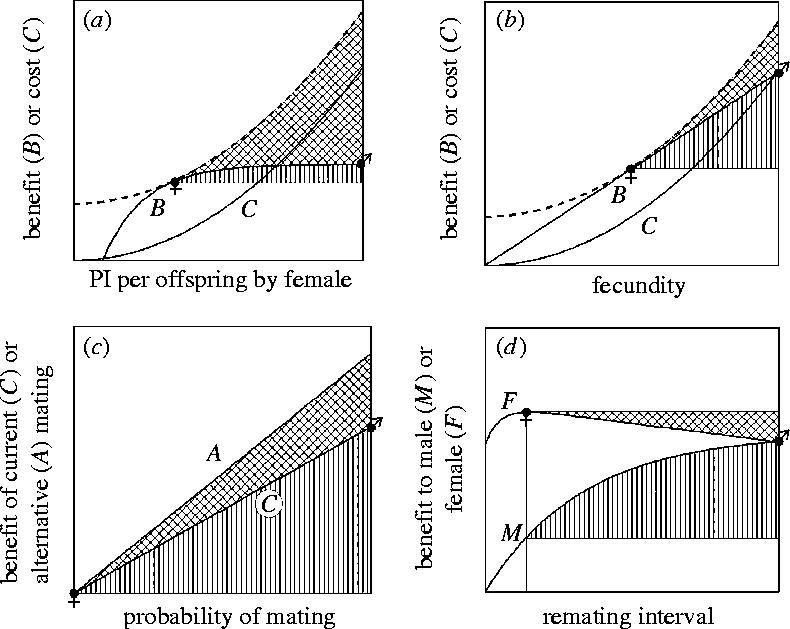
Benefits of manipulation and resistance in sexual conflict over (a) PI per offspring, (b) fecundity, (c) mating probability and (d) remating interval. Filled male and female symbols indicate the male's and female's optima, respectively. The vertically hatched areas are the benefit of manipulation to the male, and cross-hatched areas the benefit of resistance to the female. The following assumptions are made in the models: (i) females care for broods of a single offspring in a species with uniparental care; (ii) there is no parental care, so the fitness of each offspring is independent of fecundity and (iii) the only cost of mating to either sex is an opportunity cost to females of forgoing alternative matings with males of higher mate value. In (a) and (b), the benefit curve is for fitness gained through the offspring, and the cost curve is the cost to the female of her PI. The optimal PI is found where the cost curve is a tangent to the benefit curve. In (c), both of the curves are the fitness gained through a mating of the kind indicated. In (d), the curves are the fitness gains to each sex through the offspring produced by the female over the remainder of her lifespan.
Figure 3
Figure 3
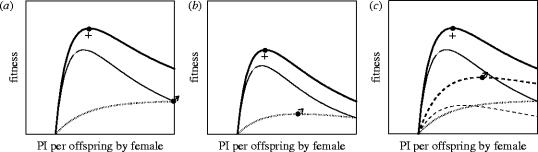
Sexual conflict over parental investment by the female in a species with uniparental maternal care when there are (a) no current costs of investment, and no future costs for the male, (b) current costs of investment, but no future costs for the male and (c) no current costs of investment, but future costs for the male. Filled male and female symbols indicate the optimal investment by females for the male and female, respectively. Curves shown are the expected fitness from the current brood (dotted line; which in (a) and (b) is also the male's expected remaining-lifetime fitness with the female), the expected future fitness of the female (thin solid line) or male (thin dashed line), and the expected total remaining-lifetime fitness of the female (thick solid line) or male (thick dashed line in (c)). Values and functions assumed in the figures are: b(x)=1exp(1x), s(x)=1x/10 and p=0.7. Model: the curves shown are based on a model in which a female produces one brood per year and invests x in the brood. As a consequence of this investment, the female survives with a probability of s(x) to the start of the following breeding season, and, provided that she survives until the young are independent, b(x) young from the brood survive to maturity. Females are assumed not to senesce, so that the same functions b(x) and s(x) govern the female's productivity and survival throughout her lifespan. This also means that her optimal investment xf* is independent of her age. If she invests the same each year throughout her life, at the start of each season the expected further number of seasons in which she attempts to breed (including the current one) is 1/(1−s(x)). (a) If the survival costs of reproduction are paid after the current brood is independent, the fitness that she accrues from the current brood is b(x) and her expected fitness from future broods is b(x)((1/(1s(x)))1), summing to a total fitness over her remaining lifespan of b(x)(1/(1s(x)). Her optimal investment, xf*, is found by setting the partial derivative of her total remaining-lifetime fitness equal to zero and solving for x=xf*, and is given by s(xf*)/(1s(xf*))=b(xf*)/b(xf*), where primes denote the partial derivate with respect to x. If pairs breed together in only one year, a male's expected lifetime fitness with the current female is b(x), and his optimal investment by the female, xm*, then occurs at the maximum of this function. If b(x) increases monotonically with x, then his optimum is the maximum value of x of which the female is capable. (b) If the survival costs of reproduction are paid entirely before the current brood is independent, the fitness from the current brood is b(x)s(x), the female's expected fitness from future broods is b(x)s(x)((1/(1s(x)))1), and her total expected remaining-lifetime fitness b(x)s(x)(1/(1s(x)). Her optimal investment, xf*, is then given by s(xf*)/(s(xf*)(1s(xf*)))=b(xf*)/b(xf*). If pairs breed together in only 1 year, the male's optimal investment by the female, xm*, is that which gives maximum fitness from the current brood, and is given by s(xm*)/s(xm*)=b(xm*)/b(xm*). (c) If the survival costs of reproduction are paid (as in (a)) after the current brood is independent, but either of the pair benefit from the survival of the mate, the optimal investment of that sex may change. Here, I assume somewhat implausibly, but for the purposes of illustration, that pairs breed together provided that they are still alive, that the female can remate costlessly if her mate dies, and that males are polygynous and the rate at which they acquire additional mates and the breeding success of all their mates is unaffected by their harem size. Under these conditions the fitness and optimal investment for the female is unchanged. However, the expected remaining-lifetime fitness of a male with a female is now b(x)(1/(1ps(x))), where p is his annual survival and is independent of the female's investment, and the female's investment is the same each year. His optimal investment by the female, xm* is now given by ps(xm*)/(1ps(xm*))=b(xm*)/b(xm*).
Figure 4
Figure 4
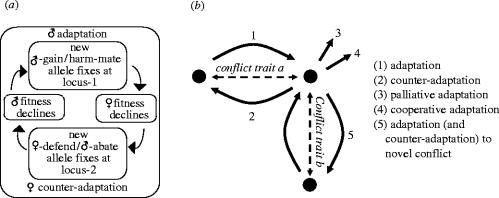
Evolutionary outcome of sexual conflict. (a) Rice and colleagues (Rice & Holland 1997; Rice 1998, 2000) have stressed the reciprocal nature of selection in males and females and given equal status to male gain and harm in sexually antagonistic selection. (Reproduced with permission from Rice (2000). Copyright (2000) National Academy of Sciences, USA.) (b) A dissection of the evolutionary changes in response to sexual conflict. Sexual conflict over a trait (trait a) can lead to (1) adaptations and (2) counter-adaptations that manipulate the value of that trait, (3) palliative adaptations to collateral harm, (4) cooperative adaptations enabled by novel trait states, and (5) adaptation (and counter-adaptation) to novel sexual conflicts.

References

    1. Aguadé M. Different forces drive the evolution of the Acp26Aa and Acp26Ab accessory gland genes in the Drosophila melanogaster species complex. Genetics. 1998;150:1079–1089. - PMC - PubMed
    1. Aguadé M, Miyashita N, Langley C.H. Polymorphism and divergence in the Mst26A male accessory gland gene region in Drosophila. Genetics. 1992;132:755–770. - PMC - PubMed
    1. Alatalo R.V, Carlson A, Lundberg A, Ulfstrand S. The conflict between male polygamy and female monogamy: the case of the pied flycatcher Ficedula hypoleuca. Am. Nat. 1981;117:738–753. - DOI
    1. Andersson J, Borg-Karlson A.K, Wiklund C. Sexual cooperation and conflict in butterflies: a male-transferred anti-aphrodisiac reduces harassment of recently mated females. Proc. R. Soc. B. 2000;267:1271–1275. - DOI - PMC - PubMed
    1. Arnqvist G, Nilsson T. The evolution of polyandry: multiple mating and female fitness in insects. Anim. Behav. 2000;60:145–164. - DOI - PubMed