


Frequency-current relationships of rat hindlimb alpha-motoneurones
- PMID: 16613880
- PMCID: PMC1779753
- DOI: 10.1113/jphysiol.2006.107292
Frequency-current relationships of rat hindlimb alpha-motoneurones
Abstract
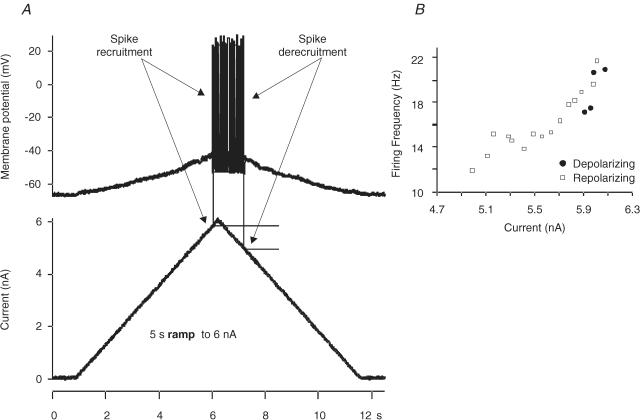
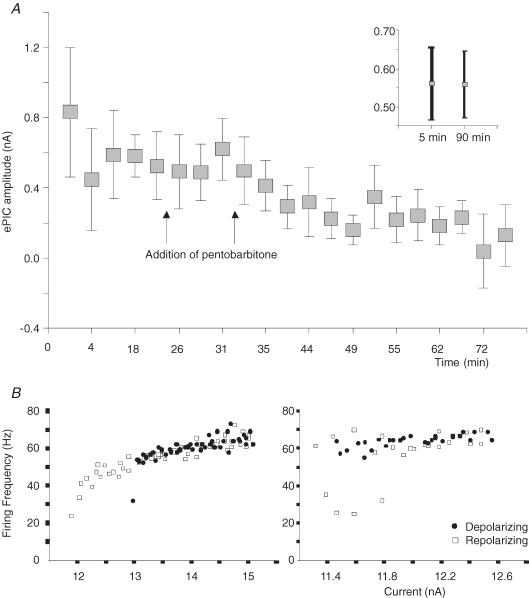
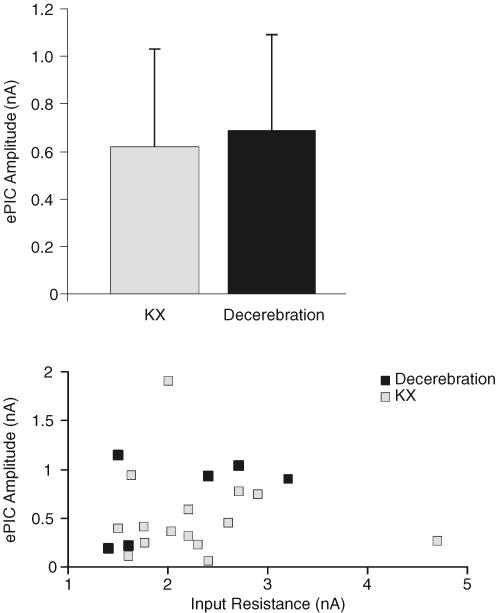
The purpose of this study was to describe the frequency-current (f-I) relationships of hindlimb alpha-motoneurones (MNs) in both anaesthetized and decerebrate rats in situ. Sprague-Dawley rats (250-350 g) were anaesthetized with ketamine and xylazine (KX) or subjected to a precollicular decerebration prior to recording electrophysiological properties from sciatic nerve MNs. Motoneurones from KX-anaesthetized rats had a significantly (P < 0.01) hyperpolarized resting membrane potential and voltage threshold (Vth), increased rheobase current, and a trend (P = 0.06) for a smaller after-hyperpolarization (AHP) amplitude compared to MNs from decerebrate rats. In response to 5 s ramp current injections, MNs could be categorized into four f-I relationship types: (1) linear; (2) adapting; (3) linear + sustained; and (4) late acceleration. Types 3 and 4 demonstrated self-sustained firing owing to activation of persistent inward current (PIC). We estimated the PIC amplitude by subtracting the current at spike derecruitment from the current at spike recruitment. Neither estimated PIC nor f-I slopes differed between fast and slow MNs (slow MNs exhibited AHP half-decay times > 20 ms) or between MNs from KX-anaesthetized and decerebrate rats. Motoneurones from KX-anaesthetized rats had significantly (P < 0.02) hyperpolarized ramp Vth values and smaller and shorter AHP amplitudes and decay times compared to MNs from decerebrate rats. Pentobarbitone decreased the estimated PIC amplitude and almost converted the f-I relationship from type 3 to type 1. In summary, MNs of animals subjected to KX anaesthesia required more current for spike initiation and rhythmic discharge but retained large PICs and self-sustained firing. The KX-anaesthestized preparation enables direct recording of PICs in MNs from intact animals.
Figures




References
-
- Alaburda A, Perrier JF, Hounsgaard J. Mechanisms causing plateau potentials in spinal motoneurones. Adv Exp Med Biol. 2002;508:219–226. - PubMed
-
- Beaumont E, Gardiner PF. Endurance training alters the biophysical properties of hindlimb motoneurons in rats. Muscle Nerve. 2003;27:228–236. - PubMed
-
- Bennett DJ, Li Y, Siu M. Plateau potentials in sacrocaudal motoneurons of chronic spinal rats, recorded in vitro. J Neurophysiol. 2001;86:1955–1971. - PubMed
-
- Brownstone RM, Jordan LM, Kriellaars DJ, Noga BR, Shefchyk SJ. On the regulation of repetitive firing in lumbar motoneurones during fictive locomotion in the cat. Exp Brain Res. 1992;90:441–455. - PubMed
Publication types
MeSH terms
Substances
LinkOut - more resources
Full Text Sources
Medical
