Prognosis of status epilepticus: role of aetiology, age, and consciousness impairment at presentation
- PMID: 16614020
- PMCID: PMC2117456
- DOI: 10.1136/jnnp.2005.080887
Prognosis of status epilepticus: role of aetiology, age, and consciousness impairment at presentation
Abstract
Background: Identification of outcome-predictive factors could lower risk of under- or over-treatment in status epilepticus (SE). Older age and acute symptomatic aetiology have been shown to predict mortality, but other variables are controversial and level of consciousness has received relatively little attention. The objective of this study was to assess variables predictive of mortality, particularly those available at presentation.
Methods: The discharge database (1997-2004) of two university hospitals was screened for adult patients with EEG confirmed SE, excluding cerebral anoxia. Outcome at discharge (mortality, return to baseline clinical conditions) was analysed in relation to demographics, clinical features, and aetiology. Aetiologies were also classified based on whether or not they were potentially fatal independently of SE.
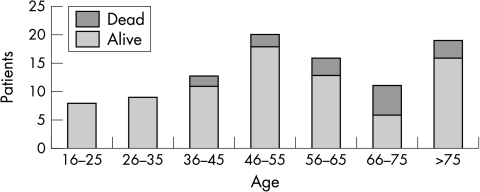
Results: Mortality was 15.6% among 96 patients with a first SE episode, 10 of whom also experienced recurrent SE during the study period. Eleven other patients had only recurrent SE. Mortality was 4.8% among these 21 patients with recurrent SE. Return to baseline condition was more frequent after recurrent than incident SE (p=0.02). For the first SE episode, death was associated with potentially fatal aetiology (p=0.01), age>or=65 (p=0.02), and stupor or coma at presentation (p=0.04), but not with gender, history of epilepsy, SE type, or time to treatment>or=1 h.
Conclusions: At initial evaluation, older age and marked impairment of consciousness are predictive of death. Surviving a first SE episode could lower the mortality and morbidity of subsequent episodes, suggesting that underlying aetiology, rather than SE per se, is the major determinant of outcome.
Conflict of interest statement
Competing interests: none declared
References
-
- De Lorenzo R J, Hauser W A, Towne A R.et al A prospective, population‐based epidemiologic study of status epilepticus in Richmond, Virginia. Neurology 1996461029–1035. - PubMed
-
- Logroscino G, Hesdorffer D C, Cascino G D.et al Short‐term mortality after a first episode of status epilepticus. Epilepsia 1997381344–1349. - PubMed
-
- Coeytaux A, Jallon P, Galobardes B.et al Incidence of status epilepticus in French‐speaking Switzerland (EPISTAR). Neurology 200055693–697. - PubMed
-
- Knake S, Rosenow F, Vescovi M.et al Incidence of status epilepticus in adults in Germany: a prospective population‐based study. Epilepsia 200142714–718. - PubMed
-
- Vignatelli L, Tonon C, D'Alessandro R. Incidence and short‐term prognosis of status epilepticus in adults in Bologna, Italy. Epilepsia 200344964–968. - PubMed
Publication types
MeSH terms
LinkOut - more resources
Full Text Sources