Review
doi: 10.3346/jkms.2006.21.2.374.
A case of Pfeiffer syndrome
Affiliations
- PMID: 16614535
- PMCID: PMC2734025
- DOI: 10.3346/jkms.2006.21.2.374
Item in Clipboard
Review
A case of Pfeiffer syndrome
J Korean Med Sci.
2006 Apr.
Abstract
Pfeiffer Syndrome is as rare as Apert syndrome in the Western population. This condition is very rare in the Asian population and has not been previously reported in Korea. The authors report with a review of literature the case of a newborn baby with Pfeiffer syndrome, manifested by bicoronal craniosynostosis, broad thumbs, and big toes. The infant also had bilateral syndactyly of the fingers and toes, mild proptosis, choanal hypoplasia and maxillary hypoplasia.
Figures
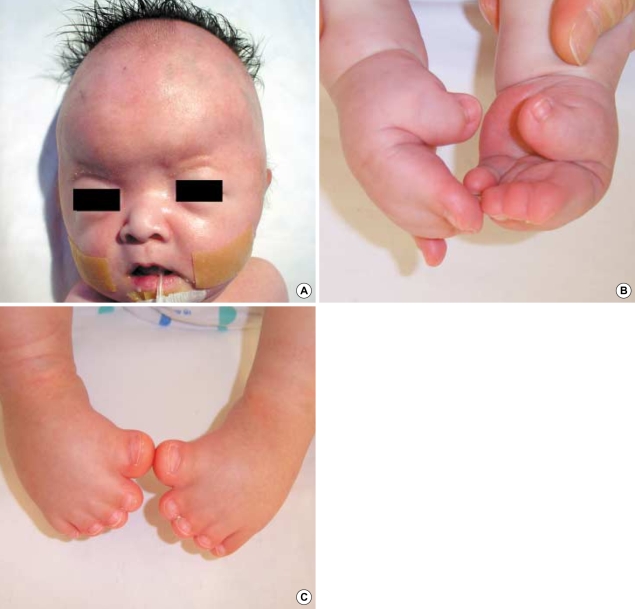
(A) Head photography of 2 week-old girl shows a brachicephalic head as a result of bilateral coronal synostosis, and regressed small mid-face with mild proptosis. (B) Hand photography shows bilateral syndactyly of 2nd, 3rd, and 4th fingers with broad and radially-deviated thumbs. (C) Feet photography reveals bilateral syndactyly of all 5 toes with broad big toes.
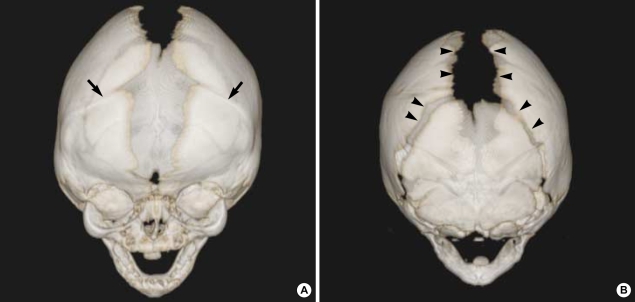
(A) Three-dimensional anterior view reconstruction CT shows the bilaterally fused coronal sutures (arrows). (B) Three-dimensional posterior view reconstruction CT shows bilaterally over-separated sagittal and lambdoid sutures (arrow heads).
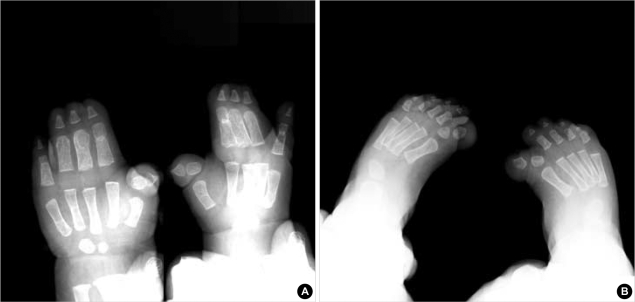
Plain radiographs of her hands and feet show no bony fusion between phalanges.
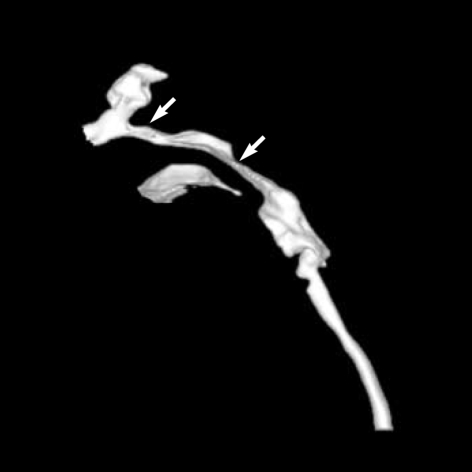
Three-dimensional CT image of choanal air airway shows small and narrow airway of choanal space (arrows).
References
-
- Pfeiffer RA. Dominant hereditary acrocephalosyndactylia. Z Kinderheilkd. 1964;90:301–320. - PubMed
-
- Martsolf JT, Cracco JB, Carpenter GG, O'Hara AE. Pfeiffer syndrome: an unusual type of acrocephalosyndactyly with broad thumbs and great toes. Am J Dis Child. 1971;121:257–262. - PubMed
-
- Moore MH, Cantrell SB, Trott JA, David DJ. Pfeiffer syndrome: A clinical review. Cleft Palate-Craniofac J. 1995;32:62–70. - PubMed
-
- Muenke M, Schell U, Hehr A, Robin NH, Losken HW, Schinzel A, Pulleyn LJ, Rutland P, Reardon W, Malcolm S, Winter RM. A common mutation in the fibroblast growth factor receptor 1 gene in Pfeiffer syndrome. Nat Genet. 1994;8:269–274. - PubMed
-
- Robin NH, Scott JA, Arnold JE, Goldstein JA, Shilling BB, Marion RW, Cohen MM., Jr Favorable prognosis for children with Pfeiffer syndrome types 2 and 3: implications for classification. Am J Med Genet. 1998;75:240–244. - PubMed
Publication types
MeSH terms
LinkOut - more resources
Full Text Sources