


Hemispheric asymmetries in the time course of recognition memory
- PMID: 16615318
- PMCID: PMC2682548
- DOI: 10.3758/bf03206434
Hemispheric asymmetries in the time course of recognition memory
Abstract
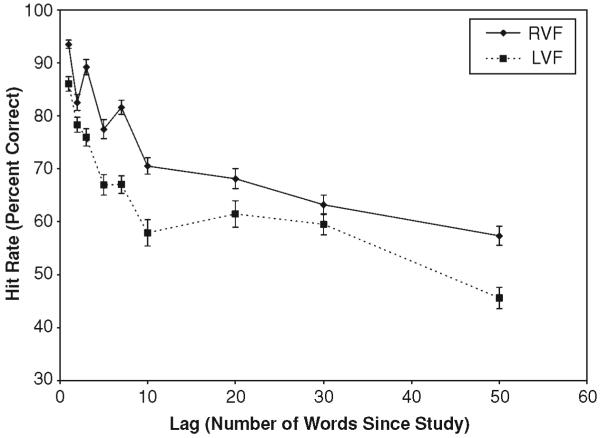
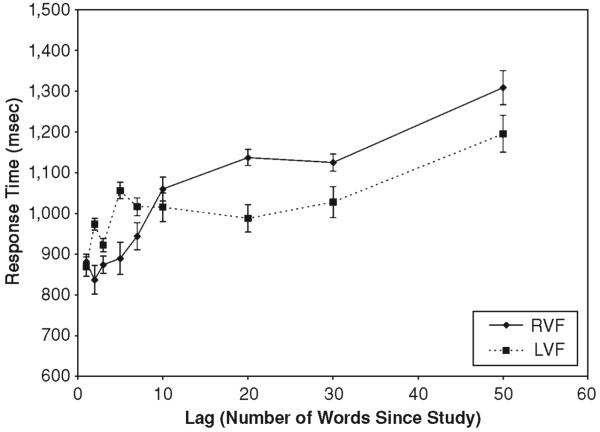
Hemispheric specialization has been studied extensively within subfields ranging from perception to language comprehension. However, the study of asymmetries for basic memory functions--an area that holds promise for bridging these low- and high-level cognitive domains--has been sporadic at best. We examined each hemisphere's tendency to retain verbal information over time, using a continuous recognition memory task with lateralized study items and central test probes. We found that the ubiquitous advantage of the left hemisphere for the processing and retention of verbal information is attenuated and perhaps even reversed over long retention intervals. This result is consistent with theories that propose differences in the degree to which the hemispheres maintain veridical versus semantically transformed representations of the input they receive.
Figures
References
-
- Abelson R, Tukey J. Efficient utilization of non-numerical information in quantitative analysis: General theory and the case of simple order. Annals of Mathematical Statistics. 1963;34:1347–1369.
-
- Baynes K, Eliassen JC. The visual lexicon: Its access and organization in commissurotomy patients. In: Beeman M, Chiarello C, editors. Right hemisphere language comprehension: Perspectives from cognitive neuroscience. Erlbaum; Mahwah, NJ: 1998. pp. 79–104.
-
- Beeman M. Semantic processing in the right hemisphere may contribute to drawing inferences from discourse. Brain & Language. 1993;44:80–120. - PubMed
-
- Beeman M. Coarse semantic coding and discourse comprehension. In: Beeman M, Chiarello C, editors. Right hemisphere language comprehension: Perspectives from cognitive neuroscience. Erlbaum; Mahwah, NJ: 1998. pp. 255–284.
-
- Bevilacqua L, Capitani E, Luzzatti C, Spinnler HR. Does the hemisphere stimulated play a specific role in delayed recognition of complex abstract patterns? A tachistoscopic study. Neuropsychologia. 1979;17:93–97. - PubMed
MeSH terms
Grants and funding
LinkOut - more resources
Full Text Sources
Medical