. 2006 May;18(5):1177-87.
doi: 10.1105/tpc.105.039990. Epub 2006 Apr 14.

The molecular basis of temperature compensation in the Arabidopsis circadian clock

Affiliations

The molecular basis of temperature compensation in the Arabidopsis circadian clock

Peter D Gould et al. Plant Cell. 2006 May.

Abstract

Circadian clocks maintain robust and accurate timing over a broad range of physiological temperatures, a characteristic termed temperature compensation. In Arabidopsis thaliana, ambient temperature affects the rhythmic accumulation of transcripts encoding the clock components TIMING OF CAB EXPRESSION1 (TOC1), GIGANTEA (GI), and the partially redundant genes CIRCADIAN CLOCK ASSOCIATED1 (CCA1) and LATE ELONGATED HYPOCOTYL (LHY). The amplitude and peak levels increase for TOC1 and GI RNA rhythms as the temperature increases (from 17 to 27 degrees C), whereas they decrease for LHY. However, as temperatures decrease (from 17 to 12 degrees C), CCA1 and LHY RNA rhythms increase in amplitude and peak expression level. At 27 degrees C, a dynamic balance between GI and LHY allows temperature compensation in wild-type plants, but circadian function is impaired in lhy and gi mutant plants. However, at 12 degrees C, CCA1 has more effect on the buffering mechanism than LHY, as the cca1 and gi mutations impair circadian rhythms more than lhy at the lower temperature. At 17 degrees C, GI is apparently dispensable for free-running circadian rhythms, although partial GI function can affect circadian period. Numerical simulations using the interlocking-loop model show that balancing LHY/CCA1 function against GI and other evening-expressed genes can largely account for temperature compensation in wild-type plants and the temperature-specific phenotypes of gi mutants.


Figures
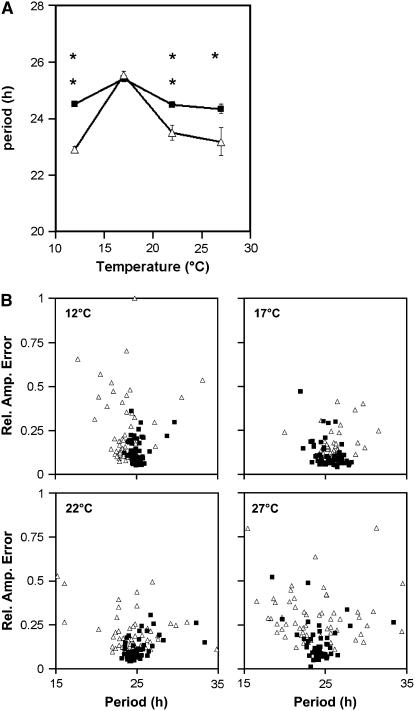
Figure 1.
Figure 1.
Temperature Compensation of Leaf Movement Rhythms for Wassilewskija (Ws) Wild Type and Ws gi-11. Seedlings were entrained under 12L:12D cycles for 7 d, after which they were transferred to constant light at 12, 17, 22, or 27°C, at which rhythms of leaf movement were assayed. For each temperature, 25 to 30 wild-type plants and 25 to 30 gi mutant plants were assayed, corresponding to 50 to 60 leaf movement rhythms. (A) Variable-weighted mean of period estimates plotted against temperature. Closed squares, wild type; open triangles, gi-11. Error bars represent variance-weighted se. Asterisks indicate t test P values: * P < 0.05, ** P < 0.01. (B) Period estimates for individual leaves plotted against their relative amplitude errors (Rel. Amp. Error). Closed squares, wild type (n = 50 to 60); open triangles, gi-11 (n = 50 to 60). This experiment was performed independently three times at each of the four temperatures; the results shown are representative.
Figure 2.
Figure 2.
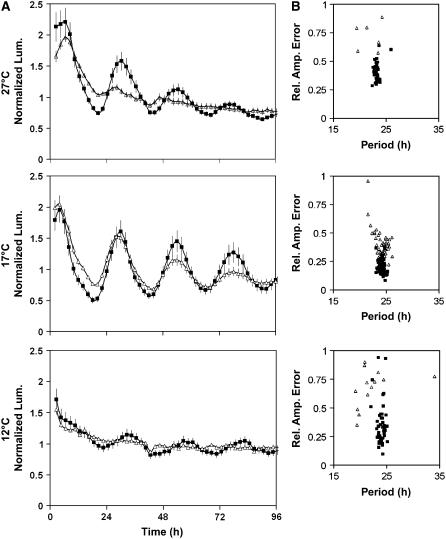
GI Is Required for the Rhythmicity of CAB at 12 and 27°C. Transgenic seedlings carrying the CAB:LUC reporter gene were entrained under 12L:12D cycles for 7 d, after which the seedlings were transferred to 12, 17, or 27°C and constant red and blue light. Luminescence was monitored in the wild-type Ws (closed squares) and gi-11 (open triangles). For both the wild type and gi-11, expression was monitored in at least three independently transformed lines. (A) Plots represent the normalized average expression of 8 to 27 single seedlings of one representative transformed line. Error bars indicate se. (B) Summary of the mathematical analysis of the expression rhythms of the seedlings, represented by plots of period estimates plotted against the respective relative amplitude errors (Rel. Amp. Error) for wild-type Ws and gi-11. At 27°C, wild-type n = 31, gi-11 n = 26; at 17°C, wild-type n = 116, gi-11 n = 51; at 12°C, wild-type n = 52, gi-11 n = 43.
Figure 3.
Figure 3.
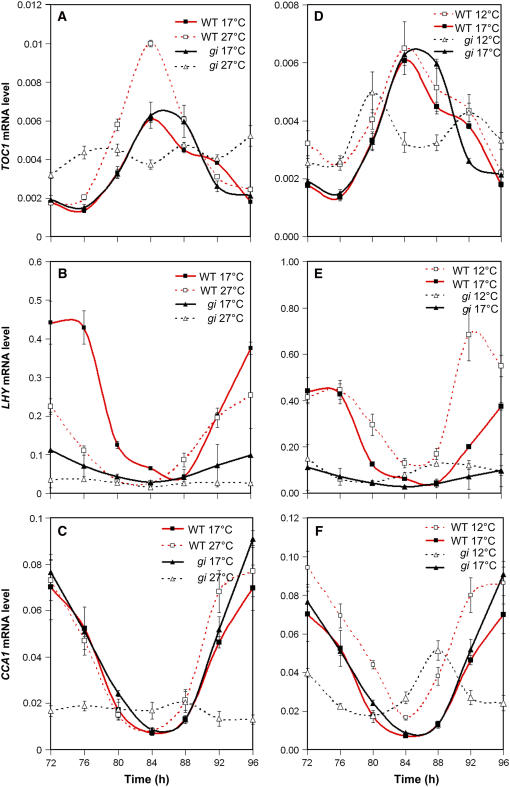
The Clock Components TOC1, LHY, and CCA1 Have Altered Amplitudes in Response to Temperature and GI Function. Seedlings were grown at 22°C in 12L:12D conditions for 7 d; the seedlings were then transferred to constant light and 12, 17, or 27°C. They were harvested after 72 h and every 4 h thereafter for the next 24 h. Total RNA was assayed by real-time quantitative PCR, and the accumulation of TOC1 ([A] and [D]), LHY ([B] and [E]), and CCA1 ([C] and [F]) was measured relative to an internal UBIQUITIN (UBQ) control. The plots compare the accumulation of mRNAs at 27°C (open symbols) with that at 17°C (closed symbols) ([A] to [C]) or at 17°C (closed symbols) with that at 12°C (open symbols) ([D] to [F]). Expression in the gi-11 background is represented by triangles, and that in the wild type is represented by squares. Error bars indicate se. Each point represents the average of three biological repeats, with each biological repeat made up of three technical repeats.
Figure 4.
Figure 4.
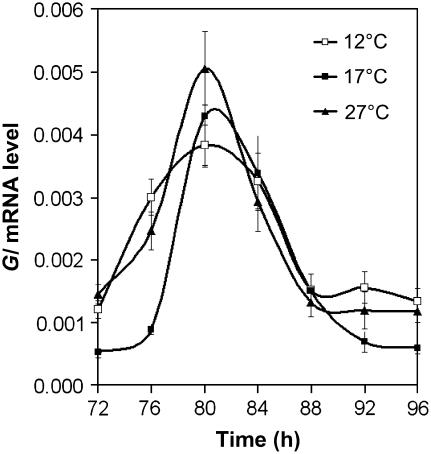
GI mRNA Expression Is Weakly Temperature-Regulated. Wild-type seedlings were grown at 22°C in 12L:12D conditions for 7 d, and the seedlings were then transferred to constant light and 12°C (open squares), 17°C (closed squares), or 27°C (closed triangles). They were harvested after 72 h and every 4 h thereafter for the next 24 h. Total RNA was assayed by real-time quantitative PCR, and the accumulation of GI was measured relative to an internal UBQ control. Error bars indicate se. Each point represents the average of three biological repeats, with each biological repeat made up of three technical repeats.
Figure 5.
Figure 5.
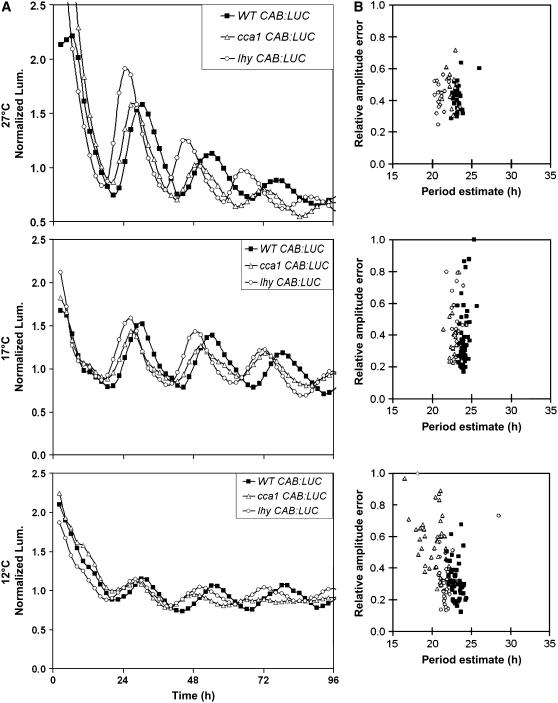
The lhy Mutant Is Compromised in Its Ability to Buffer the Clock against Increases in Temperature, and the cca1 Mutant Is Compromised in Its Buffering Capacity at Lower Temperatures. Transgenic seedlings carrying the CAB:LUC reporter gene were entrained under 12L:12D cycles for 7 d, after which the seedlings were transferred to 12, 17, or 27°C and constant red and blue light. Luminescence was monitored over the subsequent 96 h. (A) Plots represent average normalized expression of CAB in wild-type Ws (closed squares), the cca1 mutant (open triangles), and the lhy mutant (open circles) at 12, 17, or 27°C. Mutant and wild-type expression was monitored in at least four independently transformed lines, and the plots show average expression in representative CAB:LUC lines. (B) Summary of the mathematical analysis of the expression rhythms of the seedlings, represented by plots of period estimates plotted against the respective relative amplitude errors for wild-type Ws (closed squares), cca1 (open triangles), and lhy (open circles).

References

    1. Alabadi, D., Oyama, T., Yanovsky, M.J., Harmon, F.G., Mas, P., and Kay, S.A. (2001). Reciprocal regulation between TOC1 and LHY/CCA1. Science 293 880–883. - PubMed
    1. Alabadi, D., Yanovsky, M.J., Mas, P., Harmer, S.L., and Kay, S.A. (2002). Critical role for CCA1 and LHY in maintaining circadian rhythmicity in Arabidopsis. Curr. Biol. 12 757–761. - PubMed
    1. Araki, T., and Komeda, Y. (1993). Analysis of the role of the late-flowering locus, GI, in the flowering of Arabidopsis thaliana. Plant J. 3 231–239.
    1. Czechowski, T., Bari, R.P., Stitt, M., Scheible, W.R., and Udvardi, M.K. (2004). Real-time RT-PCR profiling of over 1400 Arabidopsis transcription factors: Unprecedented sensitivity reveals novel root- and shoot-specific genes. Plant J. 38 366–379. - PubMed
    1. David, K.M., Armbruster, U., Tama, N., and Putterill, J. (2006). Arabidopsis GIGANTEA protein is post-transcriptionally regulated by light and dark. FEBS Lett. 580 1193–1197. - PubMed

Publication types

MeSH terms