. 2006 Apr 25;103(17):6653-8.
doi: 10.1073/pnas.0508235103. Epub 2006 Apr 14.

Kruppel-like factor 2 (KLF2) regulates proinflammatory activation of monocytes

Affiliations

Kruppel-like factor 2 (KLF2) regulates proinflammatory activation of monocytes

Hiranmoy Das et al. Proc Natl Acad Sci U S A. .

Abstract

The mechanisms regulating activation of monocytes remain incompletely understood. Herein we provide evidence that Kruppel-like factor 2 (KLF2) inhibits proinflammatory activation of monocytes. In vitro, KLF2 expression in monocytes is reduced by cytokine activation or differentiation. Consistent with this observation, KLF2 expression in circulating monocytes is reduced in patients with chronic inflammatory conditions such as coronary artery disease. Adenoviral overexpression of KLF2 inhibits the LPS-mediated induction of proinflammatory factors, cytokines, and chemokines and reduces phagocytosis. Conversely, short interfering RNA-mediated reduction in KLF2 increased inflammatory gene expression. Reconstitution of immunodeficient mice with KLF2-overexpressing monocytes significantly reduced carrageenan-induced acute paw edema formation. Mechanistically, KLF2 inhibits the transcriptional activity of both NF-kappaB and activator protein 1, in part by means of recruitment of transcriptional coactivator p300/CBP-associated factor. These observations identify KLF2 as a novel negative regulator of monocytic activation.


Conflict of interest statement

Conflict of interest statement: No conflicts declared.

Figures
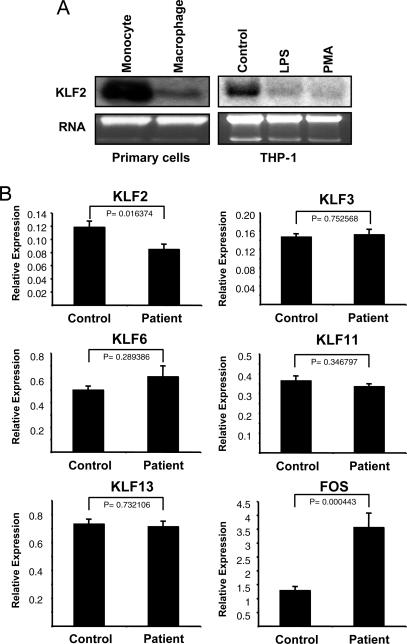
Fig. 1.
Fig. 1.
KLF2 expression in activated monocytes in vitro and in vivo. (A) KLF2 mRNA is reduced with monocyte differentiation and activation. Northern blot analysis was performed with 10 μg of total RNA per lane from human monocytes and macrophages (Left). A similar analysis was performed with 20 μg of total RNA from THP-1 cells cultured in FBS-free for 36 h thereafter and an additional 6-h stimulation with LPS or 12-O-tetradecanoylphorbol-13-acetate (Right). (B) KLF2 expression is reduced in monocytes from patients with atherosclerosis. Quantitative real-time RT-PCR was performed with the monocytes isolated from 14 patients (Patient) and 14 healthy age-matched controls (Control). Levels of specified genes expression were normalized with the control gene eukaryotic translation initiation factor.
Fig. 2.
Fig. 2.
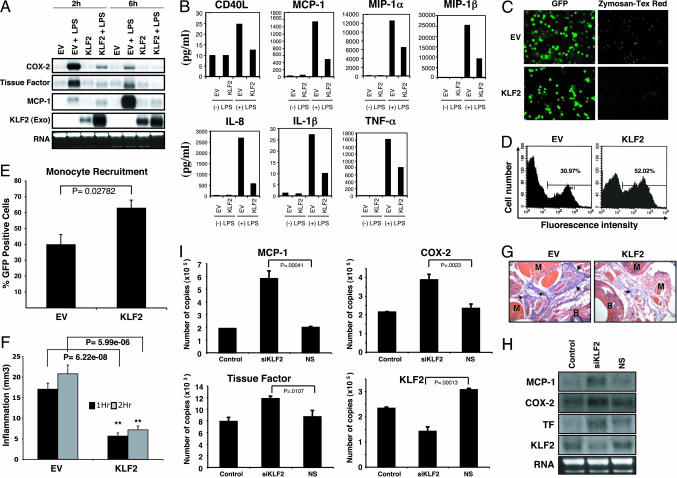
KLF2 overexpression inhibits monocyte activation. (A) KLF2 overexpression inhibits inflammatory gene expression. Northern blot analysis was performed for indicated factors with 10 μg of total RNA per lane from THP-1 overexpressed with Ad-KLF2 (KLF2) or EV as a control after stimulation with LPS for various time points as indicated. (B) KLF2 overexpression inhibits cytokine/chemokine elaboration. One million THP-1 cells per milliliter were infected with EV or KLF2 adenovirus for 24 h followed by LPS stimulation for an additional 2 h or 6 h. After stimulation, culture supernatants were harvested and assessed by SearchLight Proteome Arrays/multiplex sandwich ELISA. Each sample was evaluated in duplicate, and two independent experiments were evaluated for a panel of biological markers. A similar result was observed with different experiments. (C) KLF2 inhibits phagocytosis. EV- and KLF2-infected THP-1 cells were stimulated with LPS (25 ng/ml), and a phagocytosis assay was performed as described in Materials and Methods. (D and E) KLF2 does not inhibit monocytic recruitment. In D, a representative flow cytometric analysis of GFP-positive cells recruited to the peritoneal cavity after i.p. thioglycolate injection is shown. The gated bar indicates the percentage of GFP-positive cells in the analysis. In E the summary results from n = 5 mice per group are provided. (F) Reconstitution of immunodeficient mice as described in Materials and Methods with KLF2-overexpressed J774a cells reveals reduced edema in both 1-h and 2-h periods of carrageenan-induced inflammation. Data are expressed in ± SEM (n = 4). (G) KLF2 reduces tissue edema. Cross sections of the carrageenan-injected paws (×100 magnification) were stained with hematoxylin and eosin. Paws from mice reconstituted with KLF2-overexpressed monocytes show reduced extravasated fluid marked with arrows. Landmarks such as muscles (M) and bones (B) are indicated. (H and I) Knockdown of KLF2 increases proinflammatory gene expression. J774a cells were transfected with nonspecific (NS) or siRNA to KLF2 (siKLF2) for 48-h target genes assessed by Northern blot analysis (H) and quantitative real-time PCR analysis (I). Graphs in I represent combined data from three experiments.
Fig. 3.
Fig. 3.
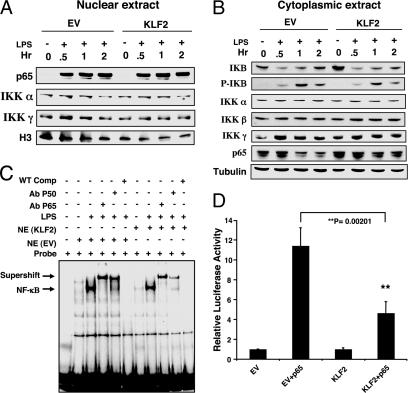
KLF2 inhibits NF-κB transcriptional activity. (A and B) KLF2 does not alter expression of components of the NF-κB pathway. THP-1 cells were infected with the adenovirus (EV or KLF2), stimulated with LPS for 30 min, 1 h, or 2 h, and assessed for expression of the indicated factors by Western blot analysis using nuclear and cytoplasmic extracts. (C) KLF2 does not affect NF-κB DNA binding. THP-1 cells were infected with the adenovirus (EV or KLF2) and stimulated with LPS for 1 h, and nuclear extracts were used for gel-shift assays. The NF-κB band is designated by an arrow. Specificity was verified by competition and supershift studies. (D) KLF2 inhibits p65-mediated transactivation of the NF-κB concatemer. Transient transfection studies were performed in RAW264.7 cells with the indicated constructs. These experiments were performed in triplicate and repeated at least three times.
Fig. 4.
Fig. 4.
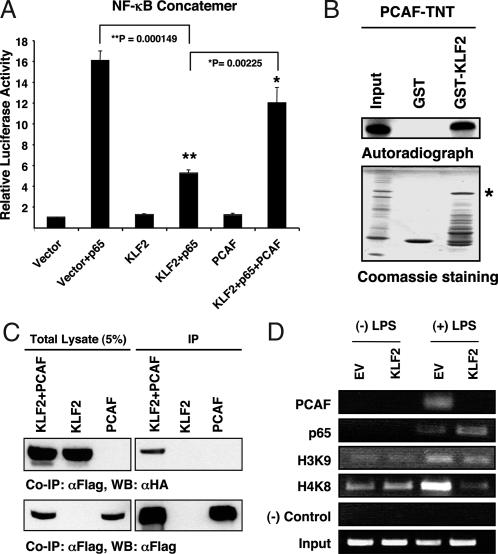
KLF2 interacts directly with PCAF. (A) PCAF overexpression rescues KLF2-mediated inhibition of NF-κB transcriptional activity. Transient transfection studies with the indicated plasmids were performed in RAW264.7 cells as previously described (n = 9–12 per group). (B) KLF2 interacts with PCAF in a cell-free system. Binding experiments were performed by using in vitro transcribed and translated products (TNT) of PCAF and GST-KLF2. Autoradiograph data (Upper) and Coomassie staining of the gel (Lower) indicate loading amount and PCAF protein (∗). Input is 2% of the PCAF-TNT. (C) KLF2 and PCAF interact in cells. COS-7 cells were transfected with the indicated constructs, and immunoprecipitation studies were performed as described in Materials and Methods. (D) KLF2 reduces PCAF recruitment. THP-1 cells were infected with Ad-KLF2 or EV containing virus and stimulated with LPS, and ChIP assays were performed for the indicated factors on the COX-2 promoter (see Materials and Methods for details).

References

    1. Lawrence T., Willoughby D. A., Gilroy D. W. Nat. Rev. Immunol. 2002;2:787–795. - PubMed
    1. Bieker J. J. DNA Cell Biol. 1996;15:347–352. - PubMed
    1. Feinberg M. W., Lin Z., Fisch S., Jain M. K. Trends Cardiovasc. Med. 2004;14:241–246. - PubMed
    1. Miller I. J., Bieker J. J. Mol. Cell. Biol. 1993;13:2776–2786. - PMC - PubMed
    1. Feng W. C., Southwood C. M., Bieker J. J. J. Biol. Chem. 1994;269:1493–1500. - PubMed

Publication types

MeSH terms