


Analysis of 10,000 ESTs from lymphocytes of the cynomolgus monkey to improve our understanding of its immune system
- PMID: 16618371
- PMCID: PMC1522023
- DOI: 10.1186/1471-2164-7-82
Analysis of 10,000 ESTs from lymphocytes of the cynomolgus monkey to improve our understanding of its immune system
Abstract
Background: The cynomolgus monkey (Macaca fascicularis) is one of the most widely used surrogate animal models for an increasing number of human diseases and vaccines, especially immune-system-related ones. Towards a better understanding of the gene expression background upon its immunogenetics, we constructed a cDNA library from Epstein-Barr virus (EBV)-transformed B lymphocytes of a cynomolgus monkey and sequenced 10,000 randomly picked clones.
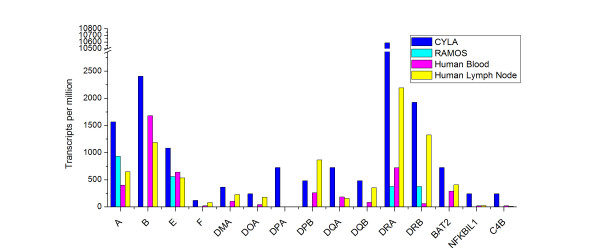
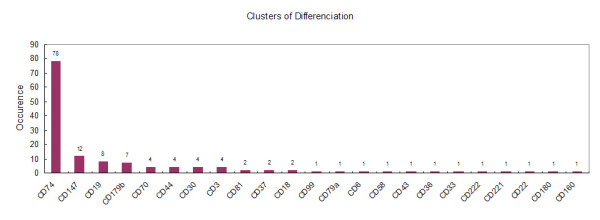
Results: After processing, 8,312 high-quality expressed sequence tags (ESTs) were generated and assembled into 3,728 unigenes. Annotations of these uniquely expressed transcripts demonstrated that out of the 2,524 open reading frame (ORF) positive unigenes (mitochondrial and ribosomal sequences were not included), 98.8% shared significant similarities (E-value less than 1e-10) with the NCBI nucleotide (nt) database, while only 67.7% (E-value less than 1e-5) did so with the NCBI non-redundant protein (nr) database. Further analysis revealed that 90.0% of the unigenes that shared no similarities to the nr database could be assigned to human chromosomes, in which 75 did not match significantly to any cynomolgus monkey and human ESTs. The mapping regions to known human genes on the human genome were described in detail. The protein family and domain analysis revealed that the first, second and fourth of the most abundantly expressed protein families were all assigned to immunoglobulin and major histocompatibility complex (MHC)-related proteins. The expression profiles of these genes were compared with that of homologous genes in human blood, lymph nodes and a RAMOS cell line, which demonstrated expression changes after transformation with EBV. The degree of sequence similarity of the MHC class I and II genes to the human reference sequences was evaluated. The results indicated that class I molecules showed weak amino acid identities (<90%), while class II showed slightly higher ones.
Conclusion: These results indicated that the genes expressed in the cynomolgus monkey could be used to identify novel protein-coding genes and revise those incomplete or incorrect annotations in the human genome by comparative methods, since the old world monkeys and humans share high similarities at the molecular level, especially within coding regions. The identification of multiple genes involved in the immune response, their sequence variations to the human homologues, and their responses to EBV infection could provide useful information to improve our understanding of the cynomolgus monkey immune system.
Figures
References
-
- Putkonen P, Warstedt K, Thorstensson R, Benthin R, Albert J, Lundgren B, Oberg B, Norrby E, Biberfeld G. Experimental infection of cynomolgus monkeys (Macaca fascicularis) with simian immunodeficiency virus (SIVsm) J Acquir Immune Defic Syndr. 1989;2:359–365. - PubMed
-
- Leong YK, Awang A. Experimental group A rotaviral infection in cynomolgus monkeys raised on formula diet. Microbiol Immunol. 1990;34:153–162. - PubMed
-
- Lees DN, Baskerville A, Cropper LM, Brown DW. Herpesvirus simiae (B virus) antibody response and virus shedding in experimental primary infection of cynomolgus monkeys. Lab Anim Sci. 1991;41:360–364. - PubMed
Publication types
MeSH terms
Substances
LinkOut - more resources
Full Text Sources
Other Literature Sources
Medical
Research Materials
