


An endangered oasis of aquatic microbial biodiversity in the Chihuahuan desert
- PMID: 16618921
- PMCID: PMC1458923
- DOI: 10.1073/pnas.0601434103
An endangered oasis of aquatic microbial biodiversity in the Chihuahuan desert
Abstract
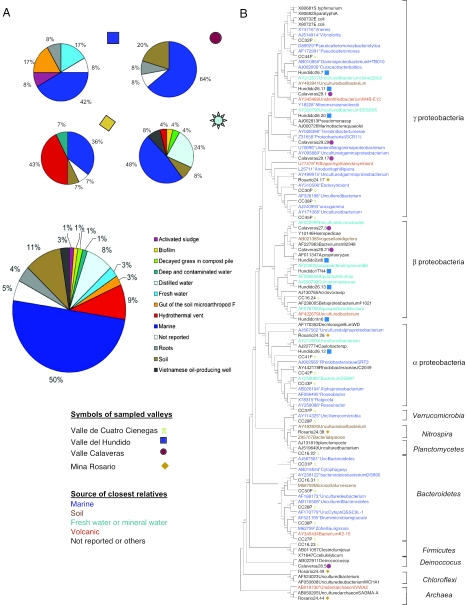
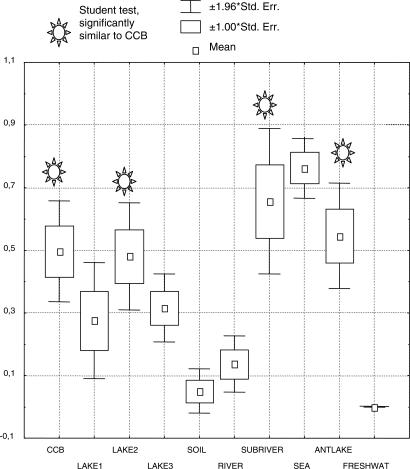
The Cuatro Cienegas basin in the Chihuahuan desert is a system of springs, streams, and pools. These ecosystems support >70 endemic species and abundant living stromatolites and other microbial communities, representing a desert oasis of high biodiversity. Here, we combine data from molecular microbiology and geology to document the microbial biodiversity of this unique environment. Ten water samples from locations within the Cuatro Cienegas basin and two neighboring valleys as well as three samples of wet sediments were analyzed. The phylogeny of prokaryotic populations in the samples was determined by characterizing cultured organisms and by PCR amplification and sequencing of 16S rRNA genes from total community DNA. The composition of microbial communities was also assessed by determining profiles of terminal restriction site polymorphisms of 16S rRNA genes in total community DNA. There were 250 different phylotypes among the 350 cultivated strains. Ninety-eight partial 16S rRNA gene sequences were obtained and classified. The clones represented 38 unique phylotypes from ten major lineages of Bacteria and one of Archaea. Unexpectedly, 50% of the phylotypes were most closely related to marine taxa, even though these environments have not been in contact with the ocean for tens of millions of years. Furthermore, terminal restriction site polymorphism profiles and geological data suggest that the aquatic ecosystems of Cuatro Cienegas are hydrologically interconnected with adjacent valleys recently targeted for agricultural intensification. The findings underscore the conservation value of desert aquatic ecosystems and the urgent need for study and preservation of freshwater microbial communities.
Conflict of interest statement
Conflict of interest statement: No conflicts declared.
Figures
References
-
- Postel S. L., Daily G. C., Ehrlich P. R. Science. 1996;271:785–788.
-
- Gleick P. H. Annu. Rev. Environ. Resour. 2003;28:275–314.
-
- Jackson R. B., Carpenter S. R., Dahm C. N., McKnight D. M., Naiman R. J., Postel S. L., Running S. W. Ecol. Appl. 2001;11:1027–1045.
-
- Naiman R. J., Turner M. G. Ecol. Appl. 2000;10:958–970.
-
- Contreras S., Lozano M. L. Conserv. Biol. 1994;8:379–387.
Publication types
MeSH terms
Substances
Associated data
- Actions
- Actions
- Actions
- Actions
- Actions
- Actions
- Actions
- Actions
- Actions
- Actions
- Actions
- Actions
- Actions
- Actions
- Actions
- Actions
- Actions
- Actions
- Actions
- Actions
- Actions
- Actions
- Actions
- Actions
- Actions
- Actions
- Actions
- Actions
- Actions
- Actions
- Actions
- Actions
- Actions
- Actions
- Actions
- Actions
- Actions
- Actions
LinkOut - more resources
Full Text Sources
Other Literature Sources
Molecular Biology Databases
