


Differences in neuromuscular strategies between landing and cutting tasks in female basketball and soccer athletes
- PMID: 16619097
- PMCID: PMC1421490
Differences in neuromuscular strategies between landing and cutting tasks in female basketball and soccer athletes
Abstract
Context: High school female athletes are most likely to sustain a serious knee injury during soccer or basketball, 2 sports that often involve a rapid deceleration before a change of direction or while landing from a jump.
Objective: To determine if female high school basketball and soccer players show neuromuscular differences during landing and cutting tasks and to examine neuromuscular differences between tasks and between dominant and nondominant sides.
Design: A 3-way mixed factorial design investigating the effects of sport (basketball, soccer), task (jumping, cutting), and side (dominant, nondominant).
Setting: Laboratory.
Patients or other participants: Thirty high school female athletes who listed either basketball or soccer as their only sport of participation (basketball: n = 15, age = 15.1 +/- 1.7 years, experience = 6.9 +/- 2.2 years, height = 165.3 +/- 7.9 cm, mass = 61.8 +/- 9.3 kg; soccer: n = 15, age = 14.8 +/- 0.8 years, experience = 8.8 +/- 2.5 years, height = 161.8 +/- 4.1 cm, mass = 54.6 +/- 7.6 kg).
Main outcome measure(s): Ground reaction forces, stance time, valgus angles, and valgus moments were assessed during (1) a drop vertical jump with an immediate maximal vertical jump and (2) an immediate side-step cut at a 45 degrees angle.
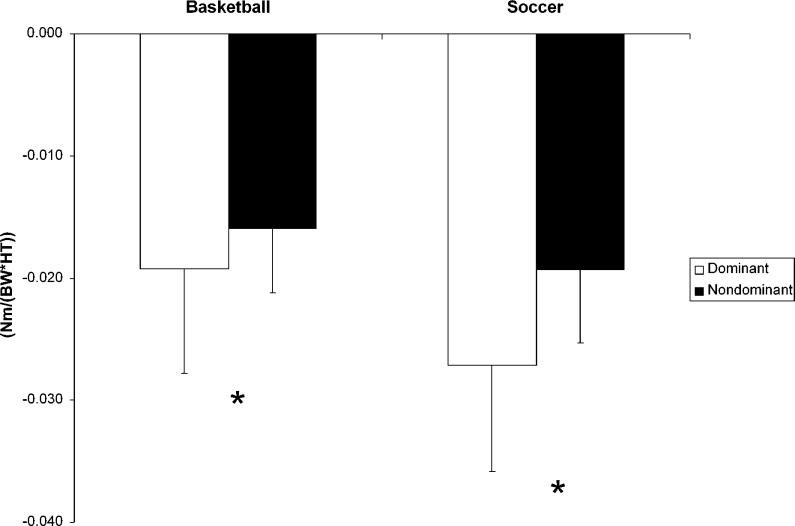
Results: Basketball athletes had greater ground reaction forces (P < .001) and decreased stance time (P < .001) during the drop vertical jump, whereas soccer players had greater ground reaction forces (P <.001) and decreased stance time (P < .001) during the cut. Subjects in both sports had greater valgus angles (initial contact and maximum, P = .02 and P = .012, respectively) during cutting than during the drop vertical jump. Greater valgus moments (P = .006) were noted on the dominant side during cutting.
Conclusions: Our subjects demonstrated differences in ground reaction forces and stance times during 2 movements associated with noncontact anterior cruciate ligament injuries. Knee valgus moment and angle were significantly influenced by the type of movement performed. Sport-specific neuromuscular training may be warranted, with basketball players focusing on jumping and landing and soccer players focusing on unanticipated cutting maneuvers.
Figures


References
-
- Kelm J, Ahlhelm F, Anagnostakos K. Gender-specific differences in school sports injuries. Sportverletz Sportschaden. 2004;18:179–184. et al. - PubMed
-
- Arendt E, Dick R. Knee injury patterns among men and women in collegiate basketball and soccer. NCAA data and review of literature. Am J Sports Med. 1995;23:694–701. - PubMed
-
- Malone TR, Hardaker WT, Garrett WE, Feagin JA, Bassett FH. Relationship of gender to anterior cruciate ligament injuries in intercollegiate basketball players. J South Orthop Assoc. 1993;2:36–39.
-
- Hewett TE, Lindenfeld TN, Riccobene JV, Noyes FR. The effect of neuromuscular training on the incidence of knee injury in female athletes: a prospective study. Am J Sports Med. 1999;27:699–706. - PubMed
Grants and funding
LinkOut - more resources
Full Text Sources
Other Literature Sources