


Automated surveillance for adverse drug events at a community hospital and an academic medical center
- PMID: 16622159
- PMCID: PMC1513675
- DOI: 10.1197/jamia.M2069
Automated surveillance for adverse drug events at a community hospital and an academic medical center
Abstract
Objectives: To compare the rates and nature of ADEs at an academic medical center and a community hospital using a single computerized ADE surveillance system.
Design: Prospective cohort study of patients admitted to two tertiary care hospitals. Outcome Measure Adverse drug events identified by automated surveillance and voluntary reporting.
Methods: We implemented an automated surveillance system across an academic medical center and a community hospital. Potential events identified by the computer were reviewed in detail by medication safety pharmacists and scored for causality and severity. Findings were compared between the two hospitals, and with voluntary reports from nurses and pharmacists.
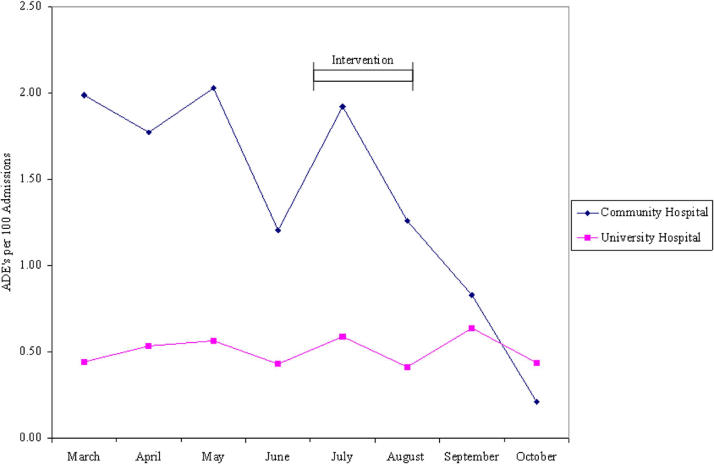
Results: Over the 8 month study period, 25,177 patients were admitted to the university hospital and 8,029 to the community hospital. There were 1,116 ADEs in 900 patients at the university hospital for an overall rate of 4.4 ADEs per 100 admissions. At the community hospital, 399 patients experienced 501 ADEs for a rate of 6.2 events per 100 admissions. Rates of antibiotic-associated colitis, drug-induced hypoglycemia, and anticoagulation-related ADEs were significantly higher at the community hospital compared with the university hospital. Computerized surveillance detected ADEs at a rate 3.6 times that of voluntary reporting at the university hospital and 12.3 times that at the community hospital.
Conclusions: Operation of a common automated ADE surveillance system across hospitals permits meaningful comparison of ADE rates in different inpatient settings. Automated surveillance detects ADEs at rates far higher than voluntary reporting, and the difference may be greater in the community hospital setting. Community hospitals may experience higher rates of certain types of ADEs compared with academic medical centers.
Figures
References
-
- Jick H. The discovery of drug-induced illness N Engl J Med 1977;296(9):481-485. - PubMed
-
- Leape LL, Brennan TA, Laird N, et al. The nature of adverse events in hospitalized patientsResults of the Harvard Medical Practice Study II. N Engl J Med 1991;324(6):377-384. - PubMed
-
- Thomas EJ, Studdert DM, Burstin HR, et al. Incidence and types of adverse events and negligent care in Utah and Colorado Med Care 2000;38(3):261-271. - PubMed
-
- Brennan TA, Leape LL, Laird NM, et al. Incidence of adverse events and negligence in hospitalized patientsResults of the Harvard Medical Practice Study I. N Engl J Med 1991;324(6):370-376. - PubMed
Publication types
MeSH terms
Grants and funding
LinkOut - more resources
Full Text Sources
Medical
