


Levels of plasma immunoglobulin G with specificity against the cysteine-rich interdomain regions of a semiconserved Plasmodium falciparum erythrocyte membrane protein 1, VAR4, predict protection against malarial anemia and febrile episodes
- PMID: 16622225
- PMCID: PMC1459698
- DOI: 10.1128/IAI.74.5.2867-2875.2006
Levels of plasma immunoglobulin G with specificity against the cysteine-rich interdomain regions of a semiconserved Plasmodium falciparum erythrocyte membrane protein 1, VAR4, predict protection against malarial anemia and febrile episodes
Abstract
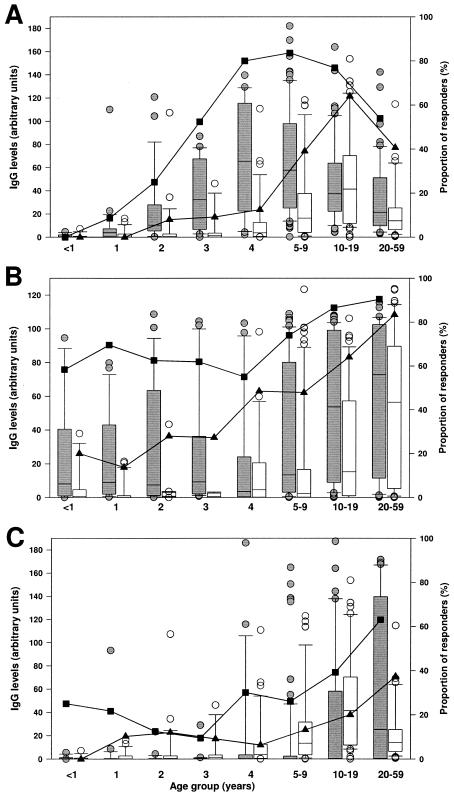
Antibodies to variant surface antigen have been implicated as mediators of malaria immunity in studies measuring immunoglobulin G (IgG) binding to infected erythrocytes. Plasmodium falciparum erythrocyte membrane protein 1 (PfEMP1) is an important target for these antibodies, but no study has directly linked the presence of PfEMP1 antibodies in children to protection. We measured plasma IgG levels to the cysteine-rich interdomain region 1alpha (CIDR1alpha) of VAR4 (VAR4-CIDR1alpha), a member of a semiconserved PfEMP1 subfamily, by enzyme-linked immunosorbent assay in 561 Tanzanian individuals, who were monitored clinically for 7 months. The participants resided in Mkokola (a high-transmission village where malaria is holoendemic) or Kwamasimba (a moderate-transmission village). For comparison, plasma IgG levels to two merozoite surface protein 1 (MSP1) constructs, MSP1-19 and MSP1 block 2, and a control CIDR1 domain were measured. VAR4-CIDR1alpha antibodies were acquired at an earlier age in Mkokola than in Kwamasimba, but after the age of 10 years the levels were comparable in the two villages. After controlling for age and other covariates, the risk of having anemia at enrollment was reduced in VAR4-CIDR1alpha responders for Mkokola (adjusted odds ratio [AOR], 0.49; 95% confidence interval [CI], 0.29 to 0.88; P = 0.016) and Kwamasimba (AOR, 0.33; 95% CI, 0.16 to 0.68; P = 0.003) villages. The risk of developing malaria fever was reduced among individuals with a measurable VAR4-CIDR1alpha response from Mkokola village (AOR, 0.51; 95% CI, 0.29 to 0.89; P = 0.018) but not in Kwamasimba. Antibody levels to the MSP1 constructs and the control CIDR1alpha domain were not associated with morbidity protection. These data strengthen the concept of developing vaccines based on PfEMP1.
Figures


References
-
- Berendt, A. R., D. L. Simmons, J. Tansey, C. I. Newbold, and K. Marsh. 1989. Intercellular adhesion molecule-1 is an endothelial cell adhesion receptor for Plasmodium falciparum. Nature 341:57-59. - PubMed
-
- Bodker, R., J. Akida, D. Shayo, W. Kisinza, H. A. Msangeni, E. M. Pedersen, and S. W. Lindsay. 2003. Relationship between altitude and intensity of malaria transmission in the Usambara Mountains, Tanzania. J. Med. Entomol. 40:706-717. - PubMed
-
- Branch, O. H., V. Udhayakumar, A. W. Hightower, A. J. Oloo, W. A. Hawley, B. L. Nahlen, P. B. Bloland, D. C. Kaslow, and A. A. Lal. 1998. A longitudinal investigation of IgG and IgM antibody responses to the merozoite surface protein-1 19-kilodalton domain of Plasmodium falciparum in pregnant women and infants: associations with febrile illness, parasitemia, and anemia. Am. J. Trop. Med. Hyg. 58:211-219. - PubMed
-
- Bruce-Chwatt, L. J. 1963. A longitudinal survey of natural malaria infection in a group of West African adults. West Afr. Med. J. 12:199-217. - PubMed
Publication types
MeSH terms
Substances
LinkOut - more resources
Full Text Sources
Medical
Research Materials
