. 2006 May;74(5):2996-3001.
doi: 10.1128/IAI.74.5.2996-3001.2006.

Mixed strain infections and strain-specific protective immunity in the rodent malaria parasite Plasmodium chabaudi chabaudi in mice

Affiliations

Mixed strain infections and strain-specific protective immunity in the rodent malaria parasite Plasmodium chabaudi chabaudi in mice

Sandra Cheesman et al. Infect Immun. 2006 May.

Abstract

Important to malaria vaccine design is the phenomenon of "strain-specific" immunity. Using an accurate and sensitive assay of parasite genotype, real-time quantitative PCR, we have investigated protective immunity against mixed infections of genetically distinct cloned "strains" of the rodent malaria parasite Plasmodium chabaudi chabaudi in mice. Four strains of P. c. chabaudi, AS, AJ, AQ, and CB, were studied. One round of blood infection and drug cure with a single strain resulted in a partial reduction in parasitemia, compared with levels for naïve mice, in challenge infections with mixed inocula of the immunizing (homologous) strain and a heterologous strain. In all cases, the numbers of blood-stage parasites of each genotype were reduced to similar degrees. After a second, homologous round of infection and drug cure followed by challenge with homologous and heterologous strains, the parasitemias were reduced even further. In these circumstances, moreover, the homologous strain was reduced much faster than the heterologous strain in all of the combinations tested. That the immunity induced by a single infection did not show "strain specificity," while the immunity following a second, homologous infection did, suggests that the "strain-specific" component of protective immunity in malaria may be dependent upon immune memory. The results show that strong, protective immunity induced by and effective against malaria parasites from a single parasite species has a significant "strain-specific" component and that this immunity operates differentially against genetically distinct parasites within the same infection.


Figures
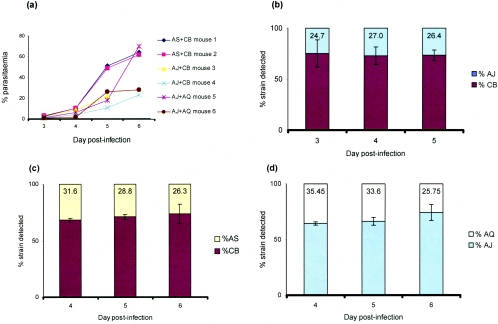
FIG. 1.
FIG. 1.
Quantitative PCR analysis of genetically mixed strain infections of P. c. chabaudi in nonimmune mice. (a) Percentages of parasitemia recorded on a log scale over the period that blood samples were collected for DNA extraction and quantitative PCR analyses. (b, c, and d) Proportions of different strains of P. c. chabaudi measured by RTQ-PCR in two nonimmune mice infected with approximately equal proportions of parasites of each strain (see Materials and Methods) in combinations of (b) AJ and CB, (c) AS and CB, and (d) AJ and AQ. Numbers in columns represent the mean value obtained for the minority strain. Error bars represent the standard deviations between the two mice in each group (AS and CB, AJ and CB, and AJ and AQ).
FIG. 2.
FIG. 2.
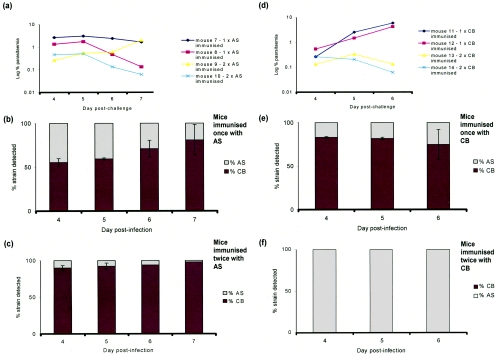
Quantitative PCR analysis of genetically mixed strain infections of P. c. chabaudi in mice and the effect of different levels of infection-acquired immunity on strain survival. (a and d) Percentages of parasitemia in mixed strain infections of AS and CB in 1×-immunized or 2×-immunized mice, recorded on a log scale during the period when mice had patent infections. (b, c, e, and f) Proportions of each strain measured in mixed infections of mice made immune by one (b and e) or two (c and f) successive drug-treated bouts of parasitemia with the homologous strain (AS or CB). Each subsequent mixed strain challenge comprised a total of 5 × 10⁶ strains, approximately half of which were AS and half CB (see Materials and Methods). (b and e) Effect of partial host immunity on the outcome of strain survival, where mice have experienced only one drug-terminated infection with the homologous strain administered 36 days before challenge with the homologous/heterologous mixed strain inoculum comprising approximately equal proportions of AS and CB strains totaling 5 × 10⁶ parasites (see Materials and Methods). (c and f) Results for mice that were treated with one further drug-terminated infection administered 80 days prior to the mixed strain challenge as described above by use of the same protocol and numbers of each strain in the postdrug treatment challenge. Error bars represent the standard deviations between two mice. No error bars are shown in panel f because no DNA from the homologous strain was found in any of the samples.
FIG. 3.
FIG. 3.
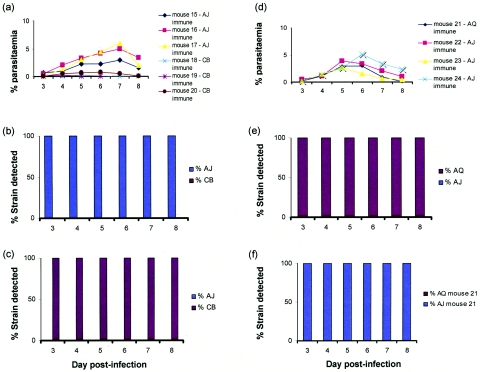
Quantitative PCR analysis of genetically mixed strain infections of P. c. chabaudi in immune mice. (a) Percentages of parasitemia on a log scale for groups of AJ- or CB-immunized mice. The infection in mouse 18 resolved to subpatent levels by day 7 and could not be used in the analyses after that day. (b and c) Proportions of each strain of P. c. chabaudi, measured by RTQ-PCR, in three mice immunized with (b) CB or (c) AJ by two successive drug-treated bouts of parasitemia with the homologous strain. The mixed strain challenge was administered 43 days later for AJ-immunized mice or 45 days later for CB-immunized mice and comprised approximately equal proportions of homologous and heterologous strains amounting to a total of 5 × 10⁶ parasites per inoculum (see Materials and Methods). No error bars are shown for the RTQ-PCR measurements as no DNA derived from the homologous strain was found in any of the samples analyzed over the 6 days where the parasitemia of the mice was high enough to be able to extract sufficient genomic DNA for quantitative analysis. The data shown in panel b comprise results from three mice for days 3 to 6 (mice 18, 19, and 20) and from two mice for days 7 and 8 (mice 18 and 20). (e and f) Proportions of each strain were measured by RTQ-PCR (another experiment) for (e) three mice made immune to AJ or (f) one mouse made immune to AQ (mouse number 21) by two successive drug-treated bouts of parasitemia with the homologous strain administered 43 days later for AJ or 45 days later for AQ. The mixed strain challenge comprised 5 × 10⁶ parasites, approximately half of which were the homologous strain and half the heterologous strain (see Materials and Methods). (d) Parasitemias for the mice described for panels e and f, monitored over the period when the mice were parasitemic.

References

    1. Brannan, L. R., C. M. Turner, and R. S. Phillips. 1994. Malaria parasites undergo antigenic variation at high rates in vivo. Proc. R. Soc. Lond. B 256:71-75. - PubMed
    1. Cadigan, F. C., and V. Chiacumpa. 1969. Plasmodium falciparum in the white-handed gibbon: protection afforded by previous infection with homologous and heterologous strains obtained in Thailand. Mil. Med. 134:1135-1139. - PubMed
    1. Carter, R. 1978. Studies on enzyme variation in the murine malaria parasites Plasmodium berghei, P. yoelii, P. vinkei and P. chabaudi by starch gel electrophoresis. Parasitology 76:241-267. - PubMed
    1. Cheesman, S., J. de Roode, A. Read, and R. Carter. 2003. Real-time quantitative PCR for analysis of genetically mixed infections in malaria parasites: technique validation and applications. Mol. Biol. Parasitol. 131:83-91. - PubMed
    1. Ciuca, M., L. Ballif, and M. Chelarescu-Vieru. 1934. Immunity in malaria. Trans. R. Soc. Trop. Med. Hyg. 27:619-622.

Publication types