


doi: 10.1128/IAI.74.5.3021-3026.2006.
Role for RpoS but not RelA of Legionella pneumophila in modulation of phagosome biogenesis and adaptation to the phagosomal microenvironment
Affiliations
- PMID: 16622243
- PMCID: PMC1459718
- DOI: 10.1128/IAI.74.5.3021-3026.2006
Item in Clipboard
Role for RpoS but not RelA of Legionella pneumophila in modulation of phagosome biogenesis and adaptation to the phagosomal microenvironment
Infect Immun.
2006 May.
Abstract
The induction of virulence traits by Legionella pneumophila at the post-exponential phase has been proposed to be triggered by the stringent response mediated by RelA, which triggers RpoS. We show that L. pneumophila rpoS but not relA is required for early intracellular survival and replication within human monocyte-derived macrophages and Acanthamoeba polyphaga. In addition, L. pneumophila rpoS but not relA is required for expression of the pore-forming activity. We provide evidence that RpoS plays a role in the modulation of phagosome biogenesis and in adaptation to the phagosomal microenvironment. Thus, there is no functional link between the stringent response and RpoS in the pathogenesis of L. pneumophila.
Figures
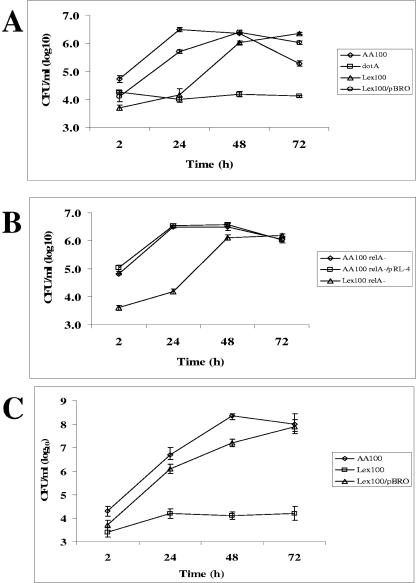
Role of L. pneumophila rpoS and relA in intracellular replication in hMDMs and A. polyphaga. (A) Growth kinetics of AA100, dotA, Lex100, and Lex100/pBRO in hMDMs. (B) Growth kinetics of AA100relA−, AA100relA−/pRL-4, and Lex100relA− in hMDMs. (C) Growth kinetics in A. polyphaga. The infection was carried out in triplicate with an MOI of 10 for 1 h, followed by 1 h of gentamicin treatment to kill extracellular bacteria. The infected monolayers were lysed and plated onto agar plates for colony enumeration. The data are representative of three independent experiments. Error bars, standard deviations.
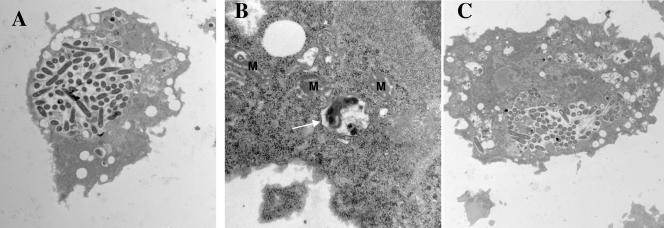
L. pneumophila rpoS is essential for the biogenesis of replicative phagosomes. Shown are representative transmission electron microscopy images of A. polyphaga cells 24 h after infection by the L. pneumophila parental strain AA100 (A), the rpoS mutant Lex100 (B), or the complemented strain Lex100/pBRO (C). The white arrow in panel B indicates a phagosome that contains a partially degraded rpoS mutant. M, mitochondria.
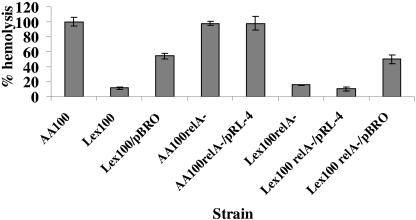
L. pneumophila rpoS is required for contact-dependent pore-forming activity. Contact-dependent hemolysis of sheep erythrocytes was performed using an MOI of 25 for 2 h. The level of contact-dependent pore-forming activity for each strain was determined as a function of the optical density of the released hemoglobin measured at a wavelength of 415 nm. The pore-forming activity of each strain is presented as a percentage of that of the parental strain AA100. The data are representative of three independent experiments. Error bars, standard deviations.
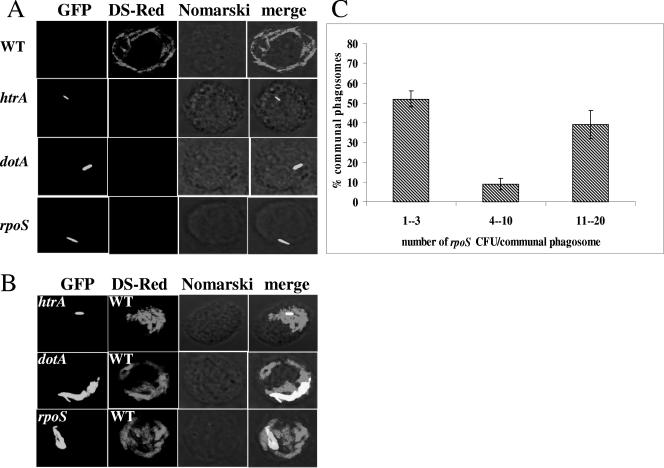
Rescue of intracellular replication of the rpoS mutant of L. pneumophila within communal phagosomes remodeled by the parental strain. (A and B) Human monocyte-derived macrophages were either singly infected with the DsRed-expressing parental strain AA100 or one of the GFP-expressing mutants htrA, dotA, and rpoS (A) or coinfected with the parental strain and one of the mutants (B) for 1 h, followed by incubation for 11 h prior to analysis by confocal microscopy for formation of large replicative phagosomes. (C) Quantitation of the number of rpoS mutant bacteria per communal phagosome at 11 h postinfection. For each infection, ∼100 single or communal phagosomes were analyzed from three coverslips for each experiment, and the results are representative of two independent experiments.
References
-
- Abu Kwaik, Y. 1998. Fatal attraction of mammalian cells to Legionella pneumophila. Mol. Microbiol. 30:689-696. - PubMed
-
- Abu Kwaik, Y., and N. C. Engleberg. 1994. Cloning and molecular characterization of a Legionella pneumophila gene induced by intracellular infection and by various in vitro stress stimuli. Mol. Microbiol. 13:243-251. - PubMed
Publication types
MeSH terms
Substances
Grants and funding
LinkOut - more resources
Full Text Sources
Research Materials
