


doi: 10.1128/IAI.74.5.3030-3034.2006.
Evidence that the BBA68 protein (BbCRASP-1) of the Lyme disease spirochetes does not contribute to factor H-mediated immune evasion in humans and other animals
Affiliations
- PMID: 16622245
- PMCID: PMC1459725
- DOI: 10.1128/IAI.74.5.3030-3034.2006
Item in Clipboard
Evidence that the BBA68 protein (BbCRASP-1) of the Lyme disease spirochetes does not contribute to factor H-mediated immune evasion in humans and other animals
Infect Immun.
2006 May.
Abstract
BBA68 (BbCRASP-1) of the Lyme disease spirochetes binds human factor H (FH) and FH-like protein 1 (FHL-1). Here we assess transcription of the BBA68 gene and production of BBA68 in infected mice and humans using real-time reverse transcriptase PCR and immunoblotting. The species specificity of FH binding to BBA68 was also tested. The data suggest that BBA68 does not play an important role in immune evasion in animals.
Figures
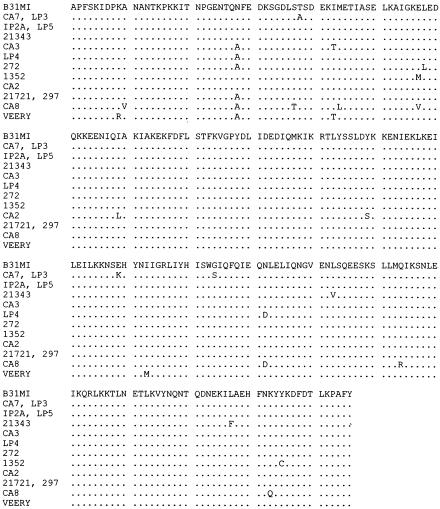
Demonstration of the conservation of BBA68 among diverse isolates of the Lyme disease spirochetes. The BBA68 gene was amplified using primers designed to amplify the entire reading frame minus the leader peptide. The amplicons were cloned into the TOPO vector and sequenced. The deduced amino acid sequences are presented. The isolate of origin is indicated to the left. Identical sequences from different strains are presented together. Periods in the alignment indicate residues identical to that of BBA68 from B. burgdorferi B31MI.
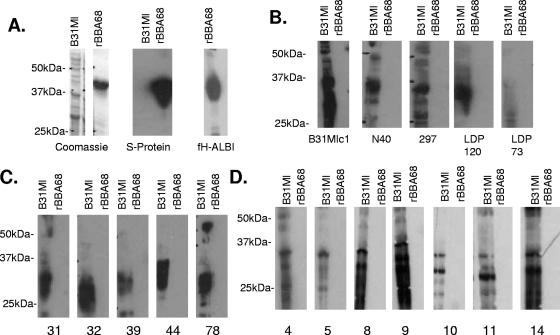
Demonstration that BBA68 does not elicit an antibody response in mice or humans infected with the Lyme disease spirochetes. (A) The loading and integrity of r-BBA68 (1 μg per lane) and cell lysates of B. burgdorferi B31MI were assessed by Coomassie staining and by screening with horseradish peroxidase-conjugated S protein. r-BBA68 was also tested for factor H binding ability using the affinity ligand binding immunoblot assay. (B) Immunoblot strips containing B31MI cell lysate and r-BBA68 were screened with serum from mice infected with different strains of B. burgdorferi (indicated below each blot). Identical immunoblots were screened with serum from human Lyme disease patients with either early (C)- or late (D)-stage infections, respectively. All methods are described in the text.
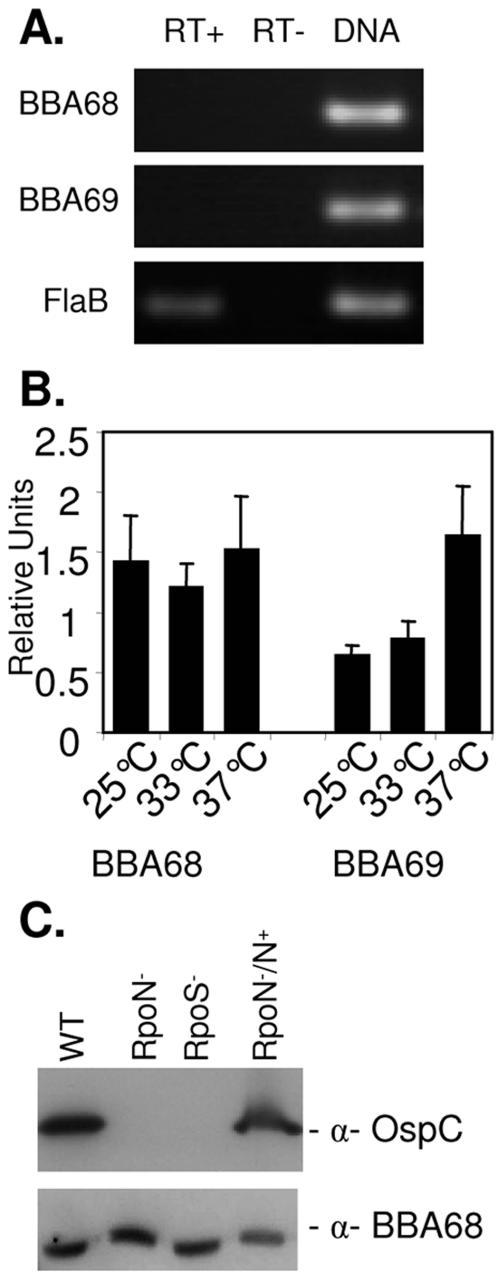
Real-time RT-PCR analysis of BBA68 and BBA69 gene transcription and analysis of the effect of RpoN and RpoS knockouts on protein production. RNA was isolated from infected mouse tissue and tested by real-time RT-PCR for BBA68 and BBA69 gene and flaB transcripts. Detection of flaB served as the positive control, and reactions run without reverse transcriptase served as the negative controls. As an additional positive control, the primers were also assessed for their ability to PCR amplify their corresponding target genes using genomic DNA as the template. After 40 cycles, an aliquot of each reaction mixture was analyzed by agarose gel electrophoresis and ethidium bromide staining (A). (B) Data from real-time RT-PCR analysis of BBA68 and BBA69 gene and flaB transcription in B. burgdorferi B31MI grown at either 25, 33, or 37°C in BSK-H complete media. Reactions were run in triplicate with two replicates, and the variance is indicated. RNA isolation and all associated methods were exactly as previously described (29). (C) Immunoblots of B. burgdorferi strain 297 in which RpoS or RpoN had been inactivated were screened with anti-BBA68 (α-BBA68) and anti-OspC antiserum (positive control). As controls, the wild type (WT) and the RpoN (RpoN−/N+) complemented strain were included on each blot.
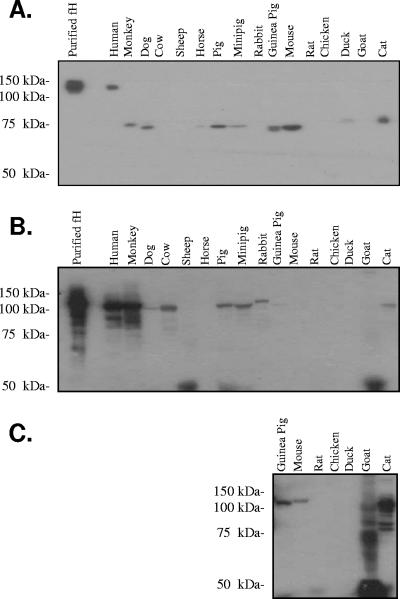
Demonstration of the species specificity of BBA68 binding to FH and detection of additional BBA68 binding serum proteins. Serum from several different animals (as indicated above each lane) was diluted 1:4 with phosphate-buffered saline and prepared in nonreducing SDS-PAGE sample buffer. The samples were incubated at 37°C for 30 min, and then the proteins were separated in 7.5% Criterion gels (Bio-Rad). The proteins were transferred to polyvinylidene difluoride membranes, blocked with 5% milk, and screened with S-tagged recombinant BBA68 (100 ng μl−1) (A). After a washing, bound BBA68 was detected with horseradish peroxidase-conjugated S protein (diluted 1:40,000). Serum samples were also fractionated by SDS-PAGE under reducing conditions, immunoblotted, and screened with goat anti-human FH antiserum (diluted 1:800; Calbiochem) (B). Rabbit anti-goat IgG antiserum served as the secondary antibody. In panel C, a longer exposure of the several lanes of the immunoblot presented in panel B is shown. Molecular mass standards are indicated.
References
-
- Alitalo, A., T. Meri, H. Lankinen, I. Seppala, P. Lahdenne, P. S. Hefty, D. Akins, and S. Meri. 2002. Complement inhibitor factor H binding to Lyme disease spirochetes is mediated by inducible expression of multiple plasmid-encoded outer surface protein E paralogs. J. Immunol. 169:3847-3853. - PubMed
-
- Brooks, C. S., S. R. Vuppala, A. M. Jett, A. Alitalo, S. Meri, and D. R. Akins. 2005. Complement regulator-acquiring surface protein 1 imparts resistance to human serum in Borrelia burgdorferi. J. Immunol. 175:3299-3308. - PubMed
-
- Earnhart, C. G., E. L. Buckles, J. S. Dumler, and R. T. Marconi. 2005. Demonstration of OspC type diversity in invasive human Lyme disease isolates and identification of previously uncharacterized epitopes that define the specificity of the OspC antibody response. Infect. Immun. 73:7869-7877. - PMC - PubMed
Publication types
MeSH terms
Substances
LinkOut - more resources
Full Text Sources
Medical
Research Materials
Miscellaneous
