


Insecticide-treated nets for preventing malaria in pregnancy
- PMID: 16625591
- PMCID: PMC6532581
- DOI: 10.1002/14651858.CD003755.pub2
Insecticide-treated nets for preventing malaria in pregnancy
Abstract
Background: Malaria in pregnancy is associated with adverse consequences for mother and fetus. Protection with insecticide-treated nets (ITNs) during pregnancy is widely advocated, but evidence of their benefit has been inconsistent.
Objectives: To compare the impact of ITNs with no nets or untreated nets on preventing malaria in pregnancy.
Search strategy: We searched the Cochrane Infectious Diseases Group Specialized Register (January 2006), CENTRAL (The Cochrane Library 2005, Issue 4), MEDLINE (1966 to January 2006), EMBASE (1974 to January 2006), LILACS (1982 to January 2006), and reference lists. We also contacted researchers working in the field.
Selection criteria: Individual and cluster randomized controlled trials of ITNs in pregnant women.
Data collection and analysis: Three authors independently assessed trials for methodological quality and extracted data. Data were combined using the generic inverse variance method.
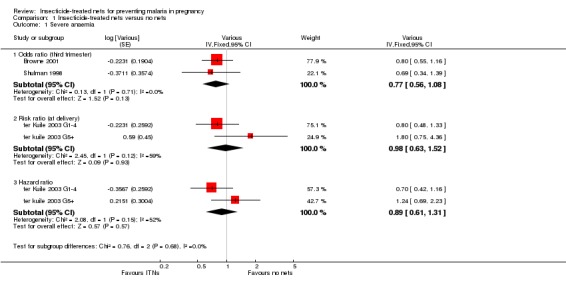
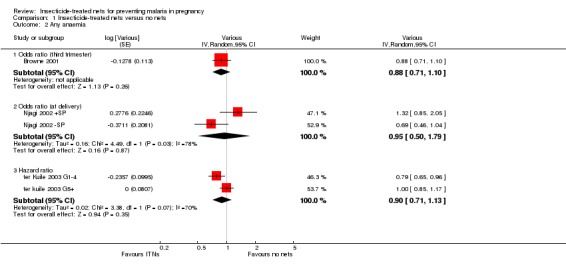
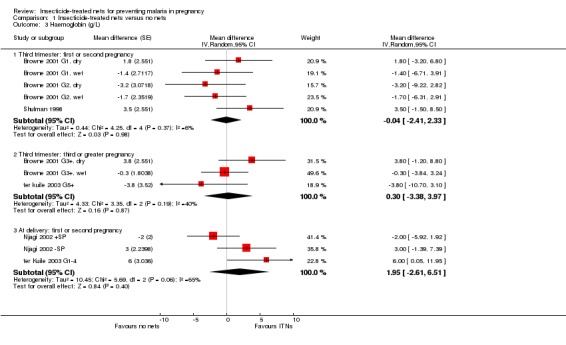
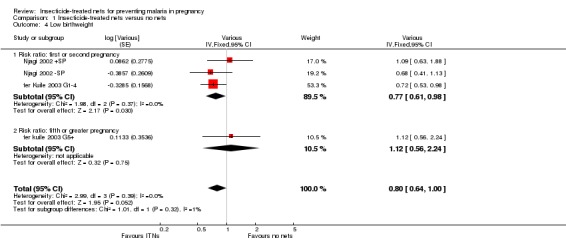
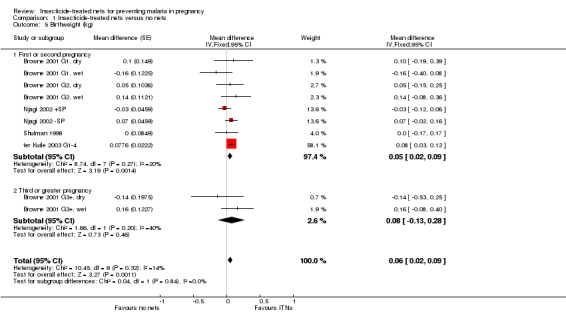
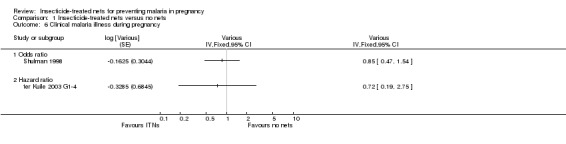
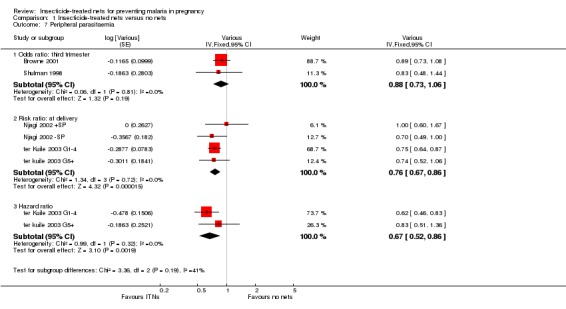
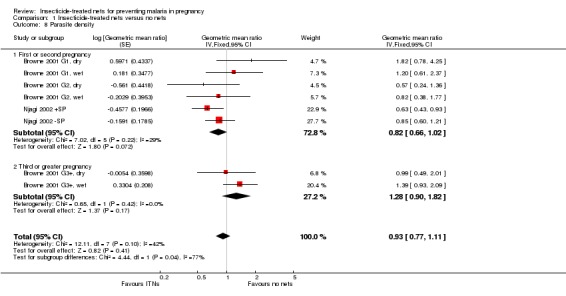
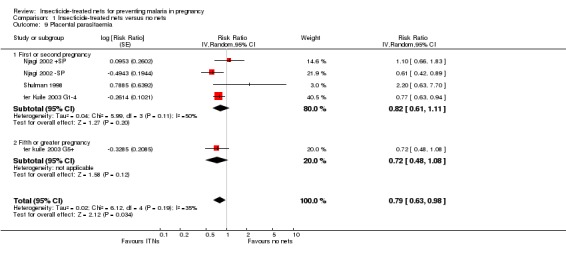
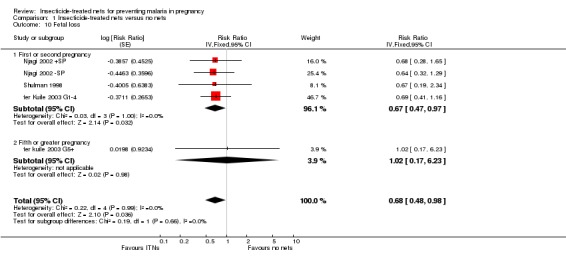
Main results: Six randomized controlled trials were identified, five of which met the inclusion criteria: four trials from sub-Saharan Africa compared ITNs with no nets, and one trial from Asia compared ITNs with untreated nets. Two trials randomized individual women and three trials randomized communities. In Africa, ITNs, compared with no nets, reduced placental malaria in all pregnancies (relative risk (RR) 0.79, 95% confidence interval (CI) 0.63 to 0.98). They also reduced low birthweight (RR 0.77, 95% CI 0.61 to 0.98) and stillbirths/abortions in the first to fourth pregnancy (RR 0.67, 95% CI 0.47 to 0.97), but not in women with more than four previous pregnancies. For anaemia and clinical malaria, results tended to favour ITNs, but the effects were not significant. In Thailand, one trial randomizing individuals to ITNs or untreated nets showed a significant reduction in anaemia and stillbirths/abortions in all pregnancies but not for clinical malaria or low birthweight.
Authors' conclusions: ITNs have a beneficial impact on pregnancy outcome in malaria-endemic regions of Africa when used by communities or by individual women. No further trials of ITNs in pregnancy are required in sub-Saharan Africa. Further evaluation of the potential impact of ITNs is required in areas with less intense and Plasmodium vivax transmission in Asia and Latin America.
Conflict of interest statement
Feiko ter Kuile was an author of two of the included trials. Carrol Gamble and Paul Ekwaru: none known.
Figures
Comment in
-
Commentary: Cochrane review on ITNs for preventing malaria in pregnancy.Int J Epidemiol. 2009 Feb;38(1):35-6. doi: 10.1093/ije/dyn272. Epub 2008 Dec 16. Int J Epidemiol. 2009. PMID: 19088128 No abstract available.
-
Commentary: Cluster trials: a few words on why and how to do them.Int J Epidemiol. 2009 Feb;38(1):36-7. Int J Epidemiol. 2009. PMID: 19198043 No abstract available.
References
References to studies included in this review
-
- Binka FN, Adongo P. Acceptability and use of insecticide impregnated bednets in northern Ghana. Tropical Medicine and International Health 1997;2(5):499‐507. - PubMed
- Binka FN, Kubaje A, Adjuik M, Williams LA, Lengeler C, Maude GH, et al. Impact of permethrin impregnated bednets on child mortality in Kassena‐Nankana district, Ghana: a randomized controlled trial. Tropical Medicine and International Health 1996;1(2):147‐54. - PubMed
- Browne EN, Maude GH, Binka FN. The impact of insecticide‐treated bednets on malaria and anaemia in pregnancy in Kassena‐Nankana district, Ghana: a randomized controlled trial. Tropical Medicine and International Health 2001;6(9):667‐76. - PubMed
-
- Browne 2001 results for women in first pregnancy during the dry season.
-
- Browne 2001 results for women in first pregnancy during the wet season.
-
- Browne 2001 results for women in second pregnancy during the dry season.
-
- Browne 2001 results for women in second pregnancy during the wet season.
References to studies excluded from this review
-
- D'Alessandro U, Langerock P, Bennett S, Francis N, Cham K, Greenwood BM, et al. The impact of a national impregnated bed net programme on the outcome of pregnancy in primigravidae in The Gambia. Transactions of the Royal Society of Tropical Medicine and Hygiene 1996;90(5):487‐92. - PubMed
- D'Alessandro U, Olaleye BO, McGuire W, Langerock P, Bennett S, Aikins MK, et al. Mortality and morbidity from malaria in Gambian children after introduction of an impregnated bednet programme. Lancet 1995;345(8948):479‐83. - PubMed
Additional references
-
- Binka FN, Kubaje A, Adjuik M, Williams LA, Lengeler C, Maude GH, et al. Impact of permethrin impregnated bednets on child mortality in Kassena‐Nankana district, Ghana: a randomized controlled trial. Tropical Medicine and International Health 1996;1(2):147‐54. - PubMed
-
- Deeks JJ, Altman DG. Effect measures for meta‐analysis of trials with binary outcome data. In: Egger M, Davey Smith G, Altman DG editor(s). Systematic reviews in health care. Meta‐analysis in context. 2nd Edition. BMJ Books, 2001:320.
-
- Deeks JJ. Swots Corner: What is an odds ratio?. www.jr2.ox.ac.uk/bandolier/band25/b25‐6.html (accessed 9 November 2005).
Publication types
MeSH terms
Substances
LinkOut - more resources
Full Text Sources
Medical
Miscellaneous
