. 2006 Apr 22;273(1589):1031-8.
doi: 10.1098/rspb.2005.3404.

Temperature-dependent transmission and latency of Holospora undulata, a micronucleus-specific parasite of the ciliate Paramecium caudatum

Affiliations

Temperature-dependent transmission and latency of Holospora undulata, a micronucleus-specific parasite of the ciliate Paramecium caudatum

Daniel Fels et al. Proc Biol Sci. .

Abstract

Transmission of parasites to new hosts crucially depends on the timing of production of transmission stages and their capacity to start an infection. These parameters may be influenced by genetic factors, but also by the environment. We tested the effects of temperature and host genotype on infection probability and latency in experimental populations of the ciliate Paramecium caudatum, after exposure to infectious forms of its bacterial parasite Holospora undulata. Temperature had a significant effect on the expression of genetic variation for transmission and maintenance of infection. Overall, low temperature (10 degrees C) increased levels of (multiple) infection, but arrested parasite development; higher temperatures (23 and 30 degrees C) accelerated the onset of production of infectious forms, but limited transmission success. Viability of infectious forms declined rapidly at 23 and 30 degrees C, thereby narrowing the time window for transmission. Thus, environmental conditions can generate trade-offs between transmission relevant parameters and alter levels of multiple infection or parasite-mediated selection, which may affect evolutionary trajectories of parasite life history or virulence.


Figures
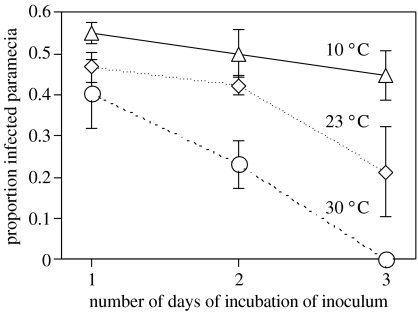
Figure 1
Figure 1
Infection success after 1–3 days of incubation of infectious forms of Holospora undulata at three temperatures. Inoculation tests were carried out at 23 °C. Each point represents the mean (±s.e.) of three replicates.
Figure 2
Figure 2
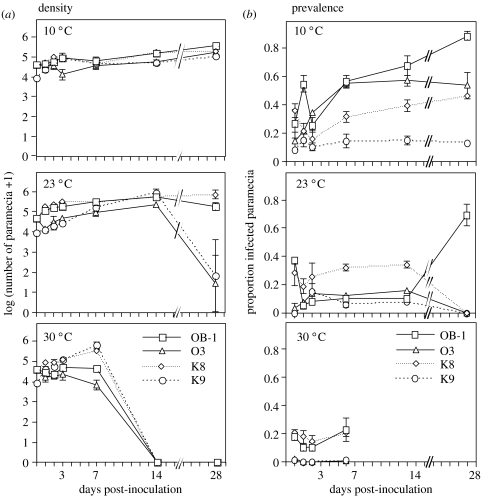
(a) Host density and (b) prevalence for four host clones and three temperatures over the course of the experiment. Most points represent the mean (±s.e.) of three replicates. Populations were inoculated at day 0.
Figure 3
Figure 3
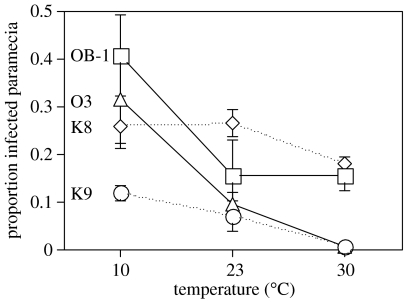
Mean prevalence for the four host clones and three temperatures. For each replicate, prevalences were combined over the first week post-inoculation, then means (±s.e.) taken for each clone and temperature.
Figure 4
Figure 4
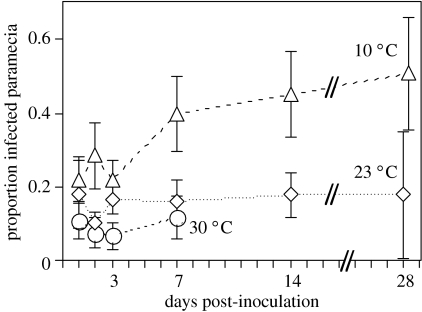
Mean prevalence at three temperatures over the course of the experiment. Each point represents the mean (±s.e.) of four host clones. Populations died out after day 7 at 30 °C.
Figure 5
Figure 5
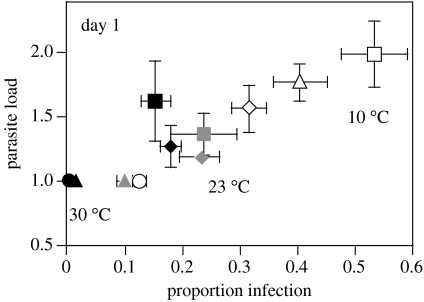
Relationship between prevalence and multiplicity of infection (mean number of infectious forms in the micronucleus) on day 1 post-infection. Means (±s.e.) were taken over the three replicates per host clone and temperature. Different symbols correspond to the four host clones (see figure 2).
Figure 6
Figure 6
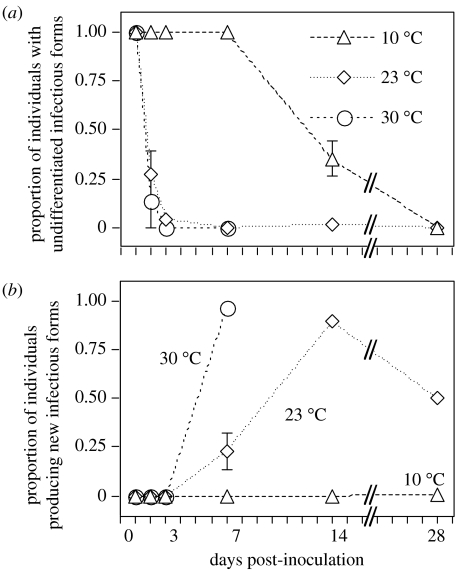
Parasite development at three temperatures over the course of the experiment. (a) Proportion of host individuals, where infectious forms of the parasite have not yet differentiated into reproductive forms; (b) proportion of individuals, where the parasite has begun to differentiate from reproductive into infectious forms. Each point represents the mean (±s.e.) of four host clones.

References

    1. Altizer S.M, Thrall P.H, Antonovics J. Vector behavior and transmission of anther-smut infection in Silene alba. Am. Midl. Nat. 1998;139:147–163.
    1. Amann R, Springer N, Ludwig W, Görtz H.-D, Schlaifer K.-H. Identification in situ and phylogeny of uncultured bacterial endosymbionts. Nature. 1991;351:161–164. - DOI - PubMed
    1. Anderson R.M, May R.M. Population biology of infectious diseases: part 1. Nature. 1979;280:361–367. - DOI - PubMed
    1. Blanford S, Thomas M.B, Pugh C, Pell J.K. Temperature checks the red Queen? Resistance and virulence in a fluctuating environment. Ecol. Lett. 2003;6:2–5. - DOI
    1. Bull J.J, Pfennig D.W, Wang I.-N. Genetic details, optimization and phage life histories. Trends Ecol. Evol. 2004;19:76–82. - DOI - PubMed

Publication types

MeSH terms