. 2006 Jul 15;397(2):369-75.
doi: 10.1042/BJ20060026.

Evidence for allosteric regulation of pH-sensitive System A (SNAT2) and System N (SNAT5) amino acid transporter activity involving a conserved histidine residue

Affiliations

Evidence for allosteric regulation of pH-sensitive System A (SNAT2) and System N (SNAT5) amino acid transporter activity involving a conserved histidine residue

Fiona E Baird et al. Biochem J. .

Abstract

System A and N amino acid transporters are key effectors of movement of amino acids across the plasma membrane of mammalian cells. These Na+-dependent transporters of the SLC38 gene family are highly sensitive to changes in pH within the physiological range, with transport markedly depressed at pH 7.0. We have investigated the possible role of histidine residues in the transporter proteins in determining this pH-sensitivity. The histidine-modifying agent DEPC (diethyl pyrocarbonate) markedly reduces the pH-sensitivity of SNAT2 and SNAT5 transporters (representative isoforms of System A and N respectively, overexpressed in Xenopus oocytes) in a concentration-dependent manner but does not completely inactivate transport activity. These effects of DEPC were reversed by hydroxylamine and partially blocked in the presence of excess amino acid substrate. DEPC treatment also blocked a reduction in apparent affinity for Na+ (K0.5Na+) of the SNAT2 transporter at low external pH. Mutation of the highly conserved C-terminal histidine residue to alanine in either SNAT2 (H504A) or SNAT5 (H471A) produced a transport phenotype exhibiting reduced, DEPC-resistant pH-sensitivity with no change in K0.5Na+ at low external pH. We suggest that the pH-sensitivity of these structurally related transporters results at least partly from a common allosteric mechanism influencing Na+ binding, which involves an H+-modifier site associated with C-terminal histidine residues.


Figures
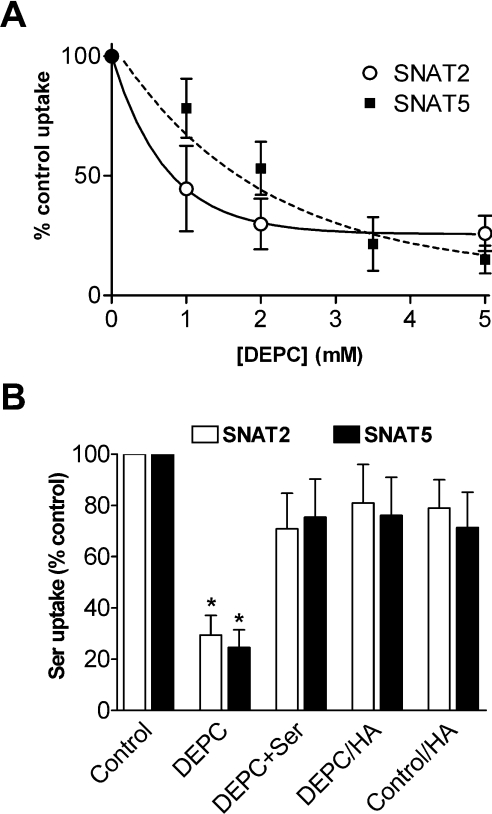
Figure 1
Figure 1. Effects of pre-treatment with DEPC on serine influx in SNAT2- and SNAT5-expressing oocytes
(A) Oocytes were pre-incubated for 10 min in MBM (pH 7.5) containing the indicated concentrations of DEPC or vehicle control, then rinsed before 0.5 mM L-[3H]serine influx was measured over 30 min in transport buffer (pH 8.0). Influx of serine in uninjected control oocytes has been subtracted from the values for SNAT2/5-expressing oocytes and results are percentages of the control value (±S.E.M. for nine to twelve oocytes) for amino acid influx. (B) Oocytes were pre-incubated for 10 min in NaCl transport buffer (pH 7.5) containing 2 mM DEPC (SNAT2), 3.5 mM DEPC (SNAT5) or vehicle control with or without 5 mM serine (Ser), followed where indicated by treatment with 50 mM hydroxylamine (HA) for 60 min. Oocytes were then rinsed in NaCl transport buffer and 0.5 mM L-[3H]serine influx was measured over 30 min. Pre-incubation of oocytes with serine alone had no significant independent effect on substrate influx. Each point represents the mean±S.E.M. for eight to eleven oocytes from one batch. Influx of serine in appropriately treated uninjected oocytes was subtracted from the values for SNAT2/5-expressing oocytes. *P<0.05 compared with the respective control value.
Figure 2
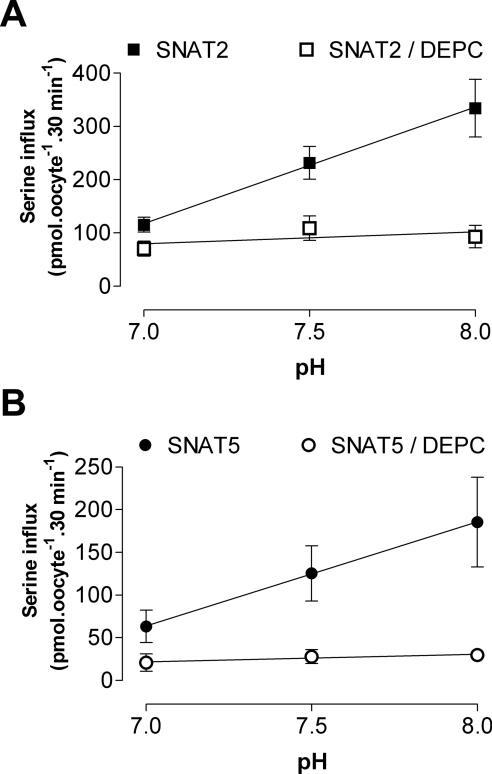
Figure 2. Effects of DEPC pre-treatment on the pH-sensitivity of serine influx through (A) SNAT2 and (B) SNAT5 overexpressed in Xenopus oocytes
Oocytes were subjected to a 10 min pre-incubation period in MBM (pH 7.5) containing 2 mM DEPC (SNAT2), 5 mM DEPC (SNAT5) or vehicle control. Oocytes were washed and influx of 0.5 mM L-[3H]serine was measured over 30 min at the pH values indicated. Values for uninjected oocytes have been subtracted from the values for SNAT2/5-expressing oocytes. Each point represents the mean±S.E.M. for five batches of oocytes. Regression lines fitted using the method of least-squares to experimental data are shown: regression-line slopes are significantly different from zero (P<0.05) for untreated SNAT2/5-expressing oocytes, but are not significantly different from zero after DEPC treatment.
Figure 3
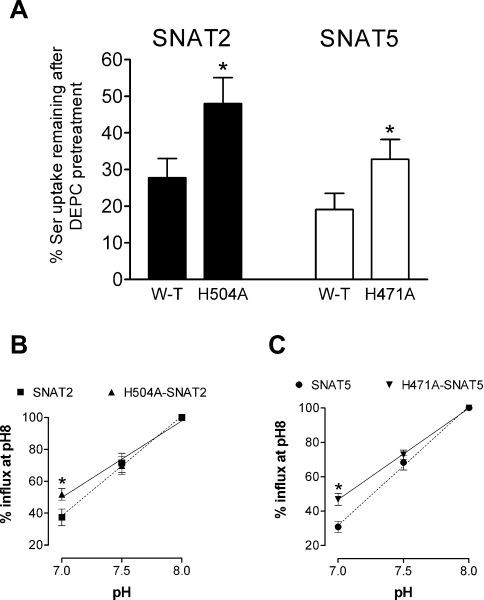
Figure 3. Serine influx through wild-type and mutant SNAT2 and SNAT5 transporters overexpressed in oocytes
(A) Reduced effect of DEPC pre-treatment on serine influx through H504A-SNAT2 and H471A-SNAT5 compared to wild-type transporters. Oocytes were subjected to a 10 min pre-incubation period in MBM (pH 7.5) containing 2 mM DEPC (SNAT2), 5 mM DEPC (SNAT5) or vehicle control. Oocytes were then washed and influx of 0.5 mM L-[3H]serine was measured over 30 min at pH 8. Values for uninjected oocytes have been subtracted from the values for SNAT2/5-expressing oocytes. Mean values±S.E.M. for five (SNAT2) or seven (SNAT5) batches of oocytes are shown. *P<0.05 compared with respective value for wild-type (W-T) transporter. (B, C) The pH relations of serine influx through wild-type and mutant SNAT2 and SNAT5 transporters overexpressed in oocytes: (B) SNAT2 relative to H504A-SNAT2, (C) SNAT5 relative to H471A-SNAT5. Influx of 0.5 mM L-[3H]serine was measured over 30 min at the pH values indicated for oocytes overexpressing transporters of interest. Values are presented as a percentage (mean±S.E.M) of flux measured at pH 8, after subtraction of respective values measured for control (uninjected) oocytes. In (B), pH 8 fluxes were 375±49 and 378±65 pmol of serine·oocyte−1·(30 min)−1 for SNAT2 and H504A-SNAT2 respectively (n=5 oocyte batches). In (C), pH 8 fluxes were 225±40 and 265±36 pmol of serine·oocyte−1·(30 min)−1 for SNAT5 and H471A-SNAT5 respectively (n=9 oocyte batches). *P<0.05 compared with value for wild-type transporter at same pH.
Figure 4
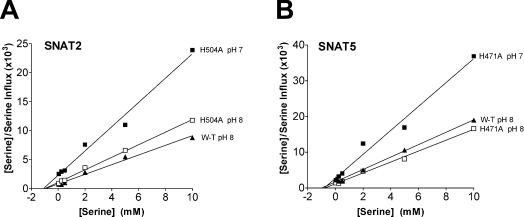
Figure 4. Effects of altered external pH on the apparent Km and Vmax of serine influx through H504A-SNAT2 and H471A-SNAT5 transporters overexpressed in oocytes
Influx of L-[3H]serine at the indicated concentrations was measured over 30 min at external pH 7 or 8, alongside equivalent measurements for wild-type (W-T) transporters at pH 8 only (for comparative purposes). Results are Hanes plots for which each point is the mean value for eight to eleven oocytes (after subtraction of values measured in uninjected control oocytes) and lines were fitted using the method of least-squares: from each line Km was estimated as −(x-axis intercept) and Vmax as 1/line slope. (A) H504A-SNAT2. At pH 8: Km, 0.98 mM serine, Vmax, 920 pmol of serine·oocyte−1·(30 min)−1; at pH 7: Km, 1.05 mM serine, Vmax, 480 pmol of serine·oocyte−1·(30 min)−1 [for W-T SNAT2: Km, 0.94 mM serine, Vmax, 1200 pmol of serine·oocyte−1·(30 min)−1 at pH 8]. All results are from a single batch of oocytes. (B) H471A-SNAT5. At pH 8: Km, 0.74 mM serine, Vmax, 650 pmol of serine·oocyte−1·(30 min)−1; at pH 7: Km, 0.83 mM serine, Vmax, 300 pmol of serine·oocyte−1·(30 min)−1 [for W-T SNAT5: Km, 0.92 mM serine, Vmax, 580 pmol serine·oocyte−1·(30 min)−1 at pH 8]. All results are from a single batch of oocytes.
Figure 5
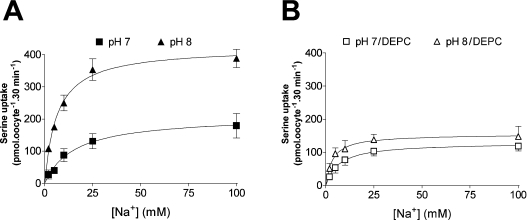
Figure 5. Effects of altering external pH on the Na+-dependence of serine influx through SNAT2 overexpressed in Xenopus oocytes
(A) Oocytes without DEPC pre-treatment. Influx of 0.5 mM L-[3H]serine was measured over 30 min at the pH values indicated. Values for uninjected oocytes have been subtracted from the values for SNAT2-expressing oocytes. Each point represents the mean±S.E.M. for five batches of oocytes. (B) DEPC-pre-treated oocytes. Oocytes were subjected to a 10 min pre-incubation period in MBM (pH 7.5) containing 2 mM DEPC or vehicle control, washed and serine influx was measured as described above. Each point represents the mean±S.E.M. for three batches of oocytes. For (A) and (B), lines represent best-fit hyperbola to experimental data obtained by iterative curve-fitting (using GraphPad Prism software): kinetic characteristics describing all lines (apparent VmaxNa+; K0.5Na+) are presented in Table 2.
Figure 6
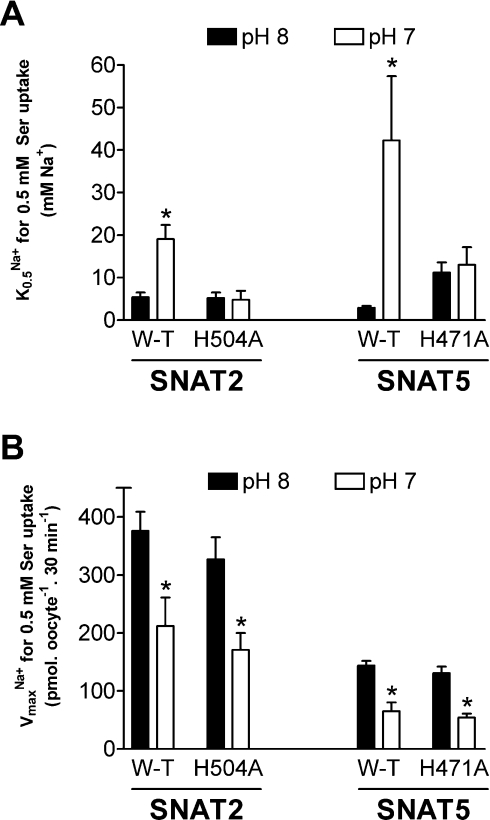
Figure 6. Effects of pH on the K0.5Na+ and VmaxNa+ of wild-type and mutant SNAT2 and SNAT5 transporters overexpressed in oocytes
[3H]Serine uptake (0.5 mM) was performed with NaCl concentrations of 0–100 mM at the indicated pH (as illustrated in Figure 5 for SNAT2). Values shown are means±S.E.M calculated from iterative curve-fitting (using GraphPad Prism software) to experimental data of the type shown in Figure 5. (A) K0.5Na+ values refer to the [Na+] required for half-maximal activation of 0.5 mM serine transport and are shown as the means±S.E.M. from experiments with three (SNAT2) or four (SNAT5) batches of oocytes. *P<0.05 (Student's unpaired t test) compared with the value at pH 8. (B) VmaxNa+ values refer to the maximum rate of 0.5 mM serine transport supported at saturating external Na+ concentrations and are shown as the means±S.E.M. for nine to twelve oocytes from a representative experiment using a single batch of oocytes. *P<0.05 (Student's unpaired t-test) compared to value at pH 8. Similar proportional differences in VmaxNa+ measured at the two pHs were seen in experiments with other oocyte batches, giving mean pH 7/pH 8 ratios for this value of 0.49 for SNAT2, 0.51 for H504A-SNAT2 (n=3), 0.46 for SNAT5 and 0.43 for H471A-SNAT5 (n=4).

References

    1. Mackenzie B., Erickson J. D. Sodium-coupled neutral amino acid (System N/A) transporters of the SLC38 gene family. Pflugers Arch. 2004;447:784–795. - PubMed
    1. Reimer R. J., Chaudhry F. A., Gray A. T., Edwards R. H. Amino acid transport system A resembles system N in sequence but differs in mechanism. Proc. Natl. Acad. Sci. U.S.A. 2000;97:7715–7720. - PMC - PubMed
    1. Sugawara M., Nakanishi T., Fei Y., Martindale R. G., Ganapathy M. E., Leibach F. H., Ganapathy V. Structure and function of ATA3, a new subtype of amino acid transport system A, primarily expressed in the liver and skeletal muscle. Biochim. Biophys. Acta. 2000;1509:7–13. - PubMed
    1. Sugawara M., Nakanishi T., Fei Y. J., Huang W., Ganapathy M. E., Leibach F. H., Ganapathy V. Cloning of an amino acid transporter with functional characteristics and tissue expression pattern identical to that of system A. J. Biol. Chem. 2000;275:16473–16477. - PubMed
    1. Varoqui H., Zhu H., Yao D., Ming H., Erickson J. D. Cloning and functional identification of a neuronal glutamine transporter. J. Biol. Chem. 2000;275:4049–4054. - PubMed

Publication types