


Detection of bovine torovirus in neonatal calf diarrhoea in Lower Austria and Styria (Austria)
- PMID: 16629982
- PMCID: PMC7165904
- DOI: 10.1111/j.1439-0450.2006.00936.x
Detection of bovine torovirus in neonatal calf diarrhoea in Lower Austria and Styria (Austria)
Abstract
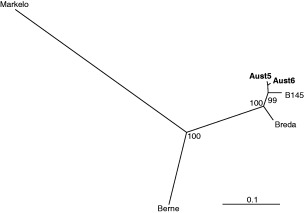
Faeces of 230 calves with and without diarrhoea collected during the winter period 2004/2005 in 100 Austrian farms (Styria and Lower Austria) were examined for viral, bacterial and parasitic enteropathogens. Torovirus-specific nucleic acid confirmed by reverse transcriptase-polymerase chain reaction was found in 12 of 230 calves (5.2%). Ten of these calves were clinically ill, several of them showing signs of dehydration and abnormal faecal consistency at the time of sampling. Computer assisted analysis of two nucleotide sequences obtained from Austrian bovine samples revealed 93% similarity to Breda strain, but only 71% or 52% similarity to Equine Berne or Porcine Markelo torovirus strains respectively. Phylogenetic analysis grouped Austrian torovirus samples into the Bovine torovirus cluster indicating the first detection of Bovine torovirus in Austria. In addition, the following agents were detected in bovine faecal samples: Bovine coronavirus, 25.7%; Escherichia coli, 17%; Cryptosporidium spp., 11.7%; Eimeria spp., 10.4%; Rotavirus, 9.1%; Clostridium perfringens, 9.1% and Giardia spp., 6.1%. Salmonella spp. was not detected.
Figures
References
-
- Anonymous , 1983: Laboratory Methods for Detecting Calf Diarrhea Viruses. Norden Laboratories, Lincoln, NE.
-
- Collins, J. K. , Riegel C. A., Olson J. D., and Fountain A., 1987: Shedding of enteric coronavirus in adult cattle. Am. J. Vet. Res. 48, 361–365. - PubMed
-
- Doll, K. , 2002: Neugeborenendiarrhoe In: Dirksen G., Gründer H. ‐D., and Stöber M. (eds), Innere Medizin und Chirurgie des Rindes, 4. Auflage, pp. 561–572. Parey, Berlin.
Publication types
MeSH terms
LinkOut - more resources
Full Text Sources
Medical
Miscellaneous
