


Differential regulation of NF-kappaB activation and function by topoisomerase II inhibitors
- PMID: 16630341
- PMCID: PMC1459870
- DOI: 10.1186/1471-2407-6-101
Differential regulation of NF-kappaB activation and function by topoisomerase II inhibitors
Abstract
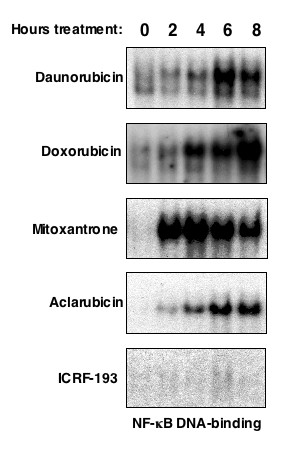
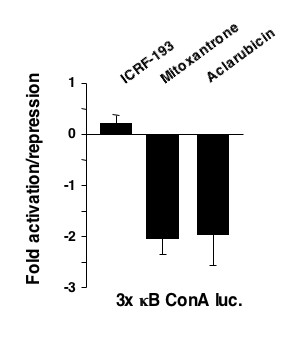
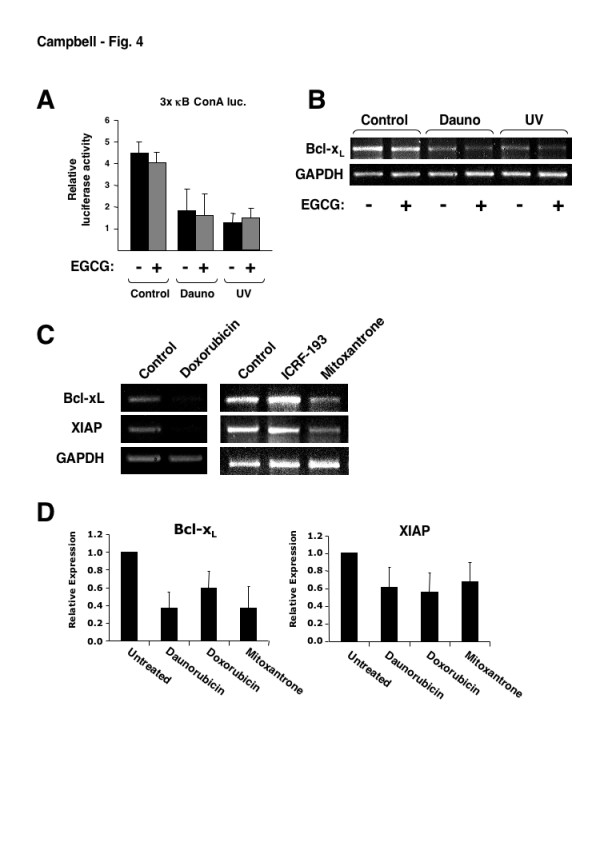
Background: While many common chemotherapeutic drugs and other inducers of DNA-damage result in both NF-kappaB nuclear translocation and DNA-binding, we have previously observed that, depending on the precise stimulus, there is great diversity of the function of NF-kappaB. In particular, we found that treatment of U-2 OS osteosarcoma cells with the anthracycine daunorubicin or with ultraviolet (UV-C) light resulted in a form of NF-kappaB that repressed rather than induced NF-kappaB reporter plasmids and the expression of specific anti-apoptotic genes. Anthracyclines such as daunorubicin can induce DNA-damage though inhibiting topoisomerase II, intercalating with DNA and undergoing redox cycling to produce oxygen free radicals. In this study we have investigated other anthracyclines, doxorubicin and aclarubicin, as well as the anthracenedione mitoxantrone together with the topoisomerase II inhibitor ICRF-193, which all possess differing characteristics, to determine which of these features is specifically required to induce both NF-kappaB DNA-binding and transcriptional repression in U-2 OS cells.
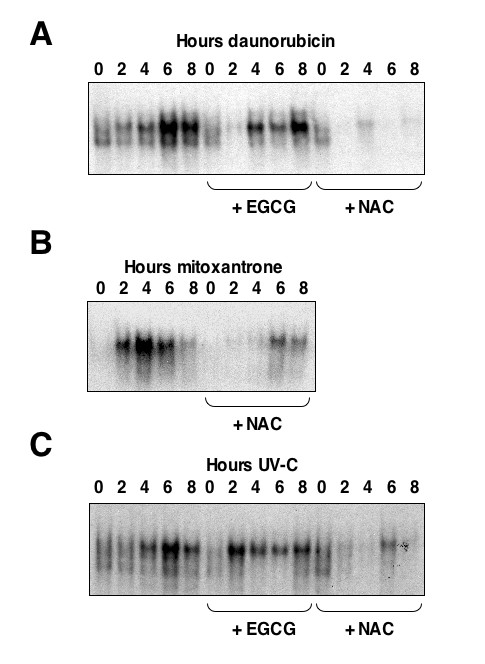
Results: The use of mitoxantrone, which does not undergo redox cycling, and the reducing agent epigallocatechingallate (EGCG) demonstrated that oxygen free radical production is not required for induction of NF-kappaB DNA-binding and transcriptional repression by these agents and UV-C. In addition, the use of aclarubicin, which does not directly inhibit topoisomerase II and ICRF-193, which inhibits topoisomerase II but does not intercalate into DNA, demonstrated that topoisomerase II inhibition is not sufficient to induce the repressor form of NF-kappaB.
Conclusion: Induction of NF-kappaB DNA-binding and transcriptional repression by topoisomerase II inhibitors was found to correlate with an ability to intercalate into DNA. Although data from our and other laboratories indicates that topoisomerase II inhibition and oxygen free radicals do regulate NF-kappaB, they are not required for the particular ability of NF-kappaB to repress rather than activate transcription. Together with our previous data, these results demonstrate that the nature of the NF-kappaB response is context dependent. In a clinical setting such effects could profoundly influence the response to chemotherapy and suggest that new methods of analyzing NF-kappaB function could have both diagnostic and prognostic value.
Figures
References
-
- Campbell KJ, Perkins ND. Regulation of NF-κB function. Biochem Soc Symp. 2005;73:165–180. - PubMed
MeSH terms
Substances
LinkOut - more resources
Full Text Sources
