


Cathelicidin deficiency predisposes to eczema herpeticum
- PMID: 16630942
- PMCID: PMC2727734
- DOI: 10.1016/j.jaci.2005.12.1345
Cathelicidin deficiency predisposes to eczema herpeticum
Abstract
Background: The cathelicidin family of antimicrobial peptides is an integral component of the innate immune response that exhibits activity against bacterial, fungal, and viral pathogens. Eczema herpeticum (ADEH) develops in a subset of patients with atopic dermatitis (AD) because of disseminated infection with herpes simplex virus (HSV).
Objective: This study investigated the potential role of cathelicidins in host susceptibility to HSV infection.
Methods: Glycoprotein D was measured by means of real-time RT-PCR as a marker of HSV replication in skin biopsy specimens and human keratinocyte cultures. Cathelicidin expression was evaluated in skin biopsy specimens from patients with AD (n = 10) without a history of HSV skin infection and from patients with ADEH (n = 10).
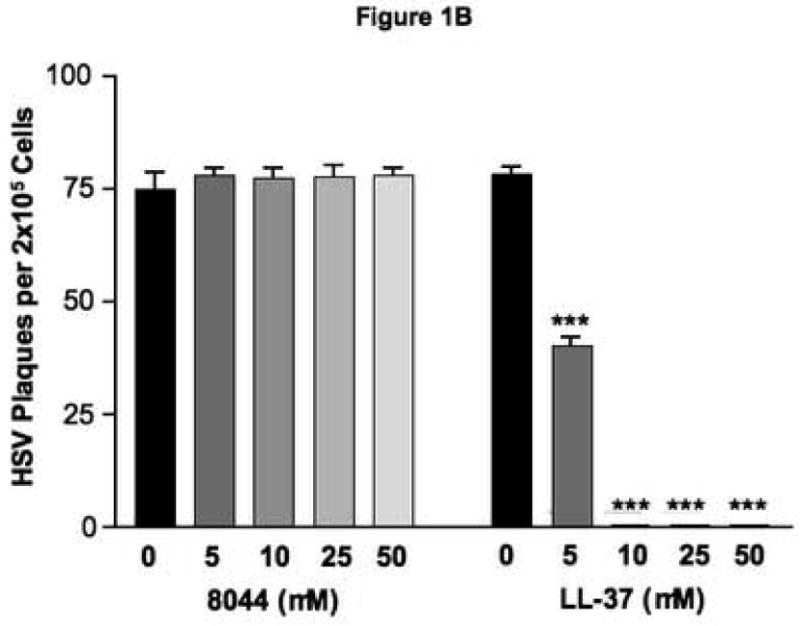
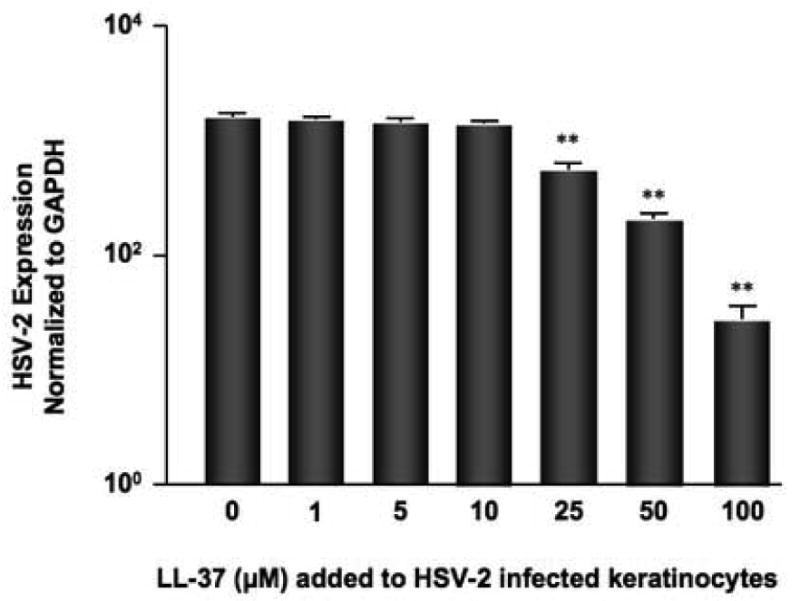
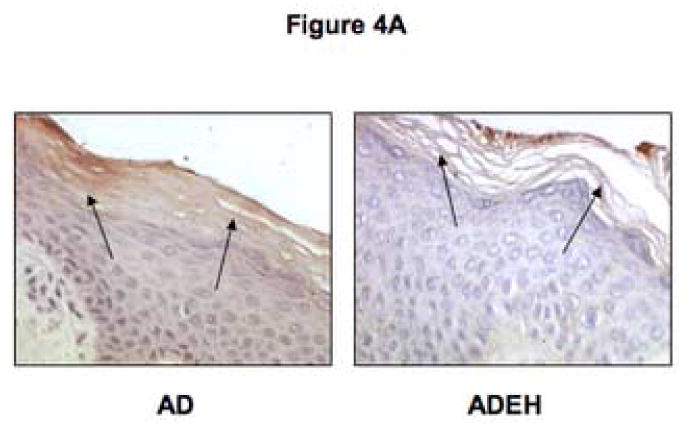
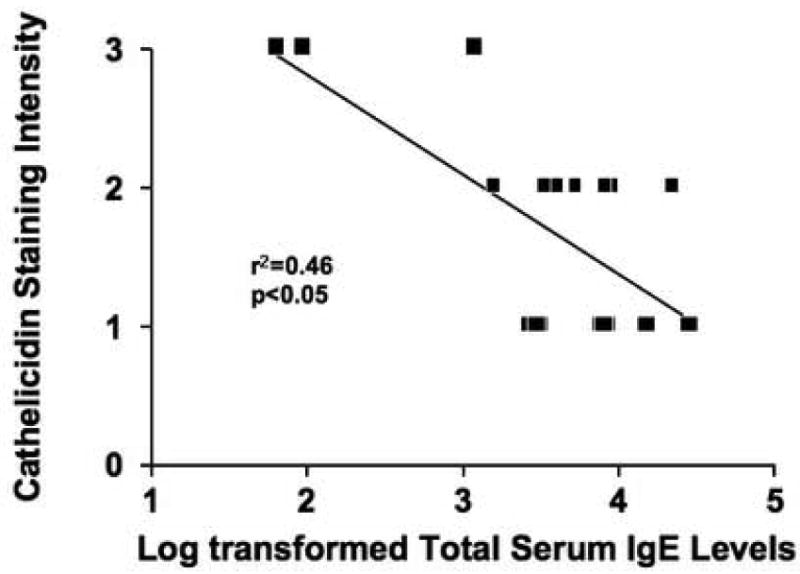
Results: The cathelicidin peptide LL-37 (human cathelicidin) exhibited activity against HSV in an antiviral assay, with significant killing (P < .001) within the physiologic range. The importance of cathelicidins in antiviral skin host defense was confirmed by the observation of higher levels of HSV-2 replication in cathelicidin-deficient (Cnlp-/-) mouse skin (2.6 +/- 0.5 pg HSV/pg GAPDH, P < .05) compared with that seen in skin from their wild-type counterparts (0.9 +/- 0.3). Skin from patients with ADEH exhibited significantly (P < .05) lower levels of cathelicidin protein expression than skin from patients with AD. We also found a significant inverse correlation between cathelicidin expression and serum IgE levels (r2 = 0.46, P < .05) in patients with AD and patients with ADEH.
Conclusion: This study demonstrates that the cathelicidin peptide LL-37 possesses antiviral activity against HSV and demonstrates the importance of variable skin expression of cathelicidins in controlling susceptibility to ADEH. Additionally, serum IgE levels might be a surrogate marker for innate immune function and serve as a biomarker for which patients with AD are susceptible to ADEH.
Clinical implications: A deficiency of LL-37 might render patients with AD susceptible to ADEH. Therefore increasing production of skin LL-37 might prevent herpes infection in patients with AD.
Figures



References
-
- Leung DY, Bieber T. Atopic dermatitis. Lancet. 2003;361:151–60. - PubMed
-
- Ong PY, Ohtake T, Brandt C, Strickland I, Boguniewicz M, Ganz T, et al. Endogenous antimicrobial peptides and skin infections in atopic dermatitis. N Engl J Med. 2002;347:1151–60. - PubMed
-
- Nomura I, Goleva E, Howell MD, Hamid QA, Ong PY, Hall CF, et al. Cytokine milieu of atopic dermatitis, as compared to psoriasis, skin prevents induction of innate immune response genes. J Immunol. 2003;171:3262–9. - PubMed
-
- Wollenberg A, Wetzel S, Burgdorf WHC, Haas J. Viral infections in atopic dermatitis: pathogenic aspects and clinical management. J Allergy Clin Immunol. 2003;112:667–74. - PubMed
Publication types
MeSH terms
Substances
Grants and funding
- T32 AI007365/AI/NIAID NIH HHS/United States
- R37 AI052453/AI/NIAID NIH HHS/United States
- R01 AR041256/AR/NIAMS NIH HHS/United States
- AR41256/AR/NIAMS NIH HHS/United States
- AR45676/AR/NIAMS NIH HHS/United States
- N01 AI040030/AI/NIAID NIH HHS/United States
- R21 AR051634/AR/NIAMS NIH HHS/United States
- N01 AI040029/AI/NIAID NIH HHS/United States
- M01 RR000051/RR/NCRR NIH HHS/United States
- AI052453/AI/NIAID NIH HHS/United States
- U01 AI147462/AI/NIAID NIH HHS/United States
- T32 AI 07365/AI/NIAID NIH HHS/United States
- 5R21AR051634/AR/NIAMS NIH HHS/United States
- M01 RR00051/RR/NCRR NIH HHS/United States
- R01 AR045676/AR/NIAMS NIH HHS/United States
- R01 AI052453/AI/NIAID NIH HHS/United States
LinkOut - more resources
Full Text Sources
Medical
Research Materials
