


Characterization of the structure of RAMP1 by mutagenesis and molecular modeling
- PMID: 16632510
- PMCID: PMC1483116
- DOI: 10.1529/biophysj.106.084582
Characterization of the structure of RAMP1 by mutagenesis and molecular modeling
Abstract
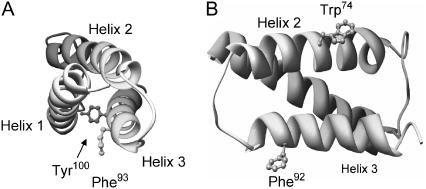
Receptor activity modifying proteins (RAMPs) are a family of single-pass transmembrane proteins that dimerize with G-protein-coupled receptors. They may alter the ligand recognition properties of the receptors (particularly for the calcitonin receptor-like receptor, CLR). Very little structural information is available about RAMPs. Here, an ab initio model has been generated for the extracellular domain of RAMP1. The disulfide bond arrangement (Cys27-Cys82, Cys40-Cys72, and Cys57-Cys104) was determined by site-directed mutagenesis. The secondary structure (alpha-helices from residues 29-51, 60-80, and 87-100) was established from a consensus of predictive routines. Using these constraints, an assemblage of 25,000 structures was constructed and these were ranked using an all-atom statistical potential. The best 1000 conformations were energy minimized. The lowest scoring model was refined by molecular dynamics simulation. To validate our strategy, the same methods were applied to three proteins of known structure; PDB:1HP8, PDB:1V54 chain H (residues 21-85), and PDB:1T0P. When compared to the crystal structures, the models had root mean-square deviations of 3.8 A, 4.1 A, and 4.0 A, respectively. The model of RAMP1 suggested that Phe93, Tyr100, and Phe101 form a binding interface for CLR, whereas Trp74 and Phe92 may interact with ligands that bind to the CLR/RAMP1 heterodimer.
Figures


References
-
- Prinster, S. C., C. Hague, and R. A. Hall. 2005. Heterodimerization of g protein-coupled receptors: specificity and functional significance. Pharmacol. Rev. 57:289–298. - PubMed
-
- McLatchie, L. M., N. J. Fraser, M. J. Main, A. Wise, J. Brown, N. Thompson, R. Solari, M. G. Lee, and S. M. Foord. 1998. RAMPs regulate the transport and ligand specificity of the calcitonin-receptor-like receptor. Nature. 393:333–339. - PubMed
-
- Christopoulos, G., K. J. Perry, M. Morfis, N. Tilakaratne, Y. Gao, N. J. Fraser, M. J. Main, S. M. Foord, and P. M. Sexton. 1999. Multiple amylin receptors arise from receptor activity-modifying protein interaction with the calcitonin receptor gene product. Mol. Pharmacol. 56:235–242. - PubMed
-
- Christopoulos, A., G. Christopoulos, M. Morfis, M. Udawela, M. Laburthe, A. Couvineau, K. Kuwasako, N. Tilakaratne, and P. M. Sexton. 2003. Novel receptor partners and function of receptor activity-modifying proteins. J. Biol. Chem. 278:3293–3297. - PubMed
Publication types
MeSH terms
Substances
Grants and funding
LinkOut - more resources
Full Text Sources
Other Literature Sources
