


Voluntary fluid intake and core temperature responses in adolescent tennis players: sports beverage versus water
- PMID: 16632570
- PMCID: PMC2653873
- DOI: 10.1136/bjsm.2005.023333
Voluntary fluid intake and core temperature responses in adolescent tennis players: sports beverage versus water
Abstract
Objective: To examine differences in ad libitum fluid intake, comparing a 6% carbohydrate/electrolyte drink (CHO-E) and water, and associated differences in core temperature and other selected physiological and perceptual responses in adolescent athletes during tennis training in the heat.
Methods: Fourteen healthy, fit, young tennis players (nine male; five female; mean (SD) age 15.1 (1.4) years; weight 60.6 (8.3) kg; height 172.8 (8.6) cm) completed two 120 minute tennis specific training sessions on separate days (randomised, crossover design) in a warm environment (wet bulb globe temperature: CHO-E, 79.3 (2.6) degrees F; water, 79.9 (2.2) degrees F; p>0.05).
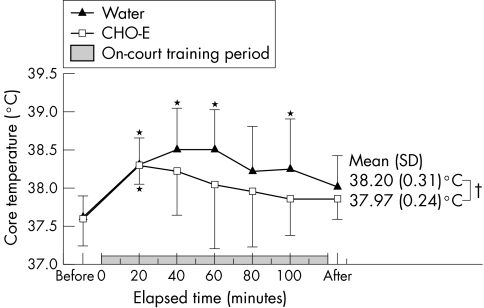
Results: There were no significant differences (p>0.05) between the trials with respect to fluid intake, urine volume, fluid retention, sweat loss, perceived exertion, thirst, or gastrointestinal discomfort. However, there was a difference (p<0.05) in the percentage body weight change after training (CHO-E, -0.5 (0.7)%; water, -0.9 (0.6)%). Urine specific gravity before training (CHO-E, 1.024 (0.006); water, 1.025 (0.005)) did not correlate significantly (p>0.05) with any of these measurements or with core body temperature. In examining the main effect for trial, the CHO-E trial showed a significantly lower (p<0.001) mean body temperature (irrespective of measurement time) than the water trial. However, the mean body temperature in each trial was not associated (p>0.05) with fluid intake, fluid retention, sweat loss, or percentage body weight change.
Conclusion: Ad libitum consumption of a CHO-E drink may be more effective than water in minimising fluid deficits and mean core temperature responses during tennis and other similar training in adolescent athletes.
Conflict of interest statement
Competing interests: This study was supported by the Gatorade Sport Science Institute
References
-
- American Academy of Pediatrics, Committee on Sports Medicine and Fitness Climatic heat stress and the exercising child and adolescent. Pediatrics 2000106158–159. - PubMed
-
- Falk B, Bar‐Or O, MacDougall J D. Thermoregulatory responses of pre‐, mid‐, and late‐pubertal boys to exercise in dry heat. Med Sci Sports Exerc 199224688–694. - PubMed
-
- Gutierrez G. Solar injury and heat illness: treatment and prevention in children. Phys Sportsmed 19952343–48. - PubMed
-
- Hoffman J L. Heat‐related illness in children. Clin Pediatr Emerg Med 20012203–210.
-
- Martin T J, Martin J S. Special issues and concerns for the high school‐ and college‐aged athletes. Pediatr Clin N Am 200249 - PubMed
Publication types
MeSH terms
Substances
LinkOut - more resources
Full Text Sources
Other Literature Sources
Medical
