


Isokinetic profile of wrist and forearm strength in elite female junior tennis players
- PMID: 16632571
- PMCID: PMC2577484
- DOI: 10.1136/bjsm.2005.023358
Isokinetic profile of wrist and forearm strength in elite female junior tennis players
Abstract
Background: In tennis, injuries to the elbow and wrist occur secondary to the repetitive nature of play and are seen at increasingly young ages. Isokinetic testing can be used to determine muscular strength levels, but dominant/non-dominant and agonist/antagonist relations are needed for meaningful interpretation of the results.
Objectives: To determine whether there are laterality differences in wrist extension/flexion (E/F) and forearm supination/pronation (S/P) strength in elite female tennis players.
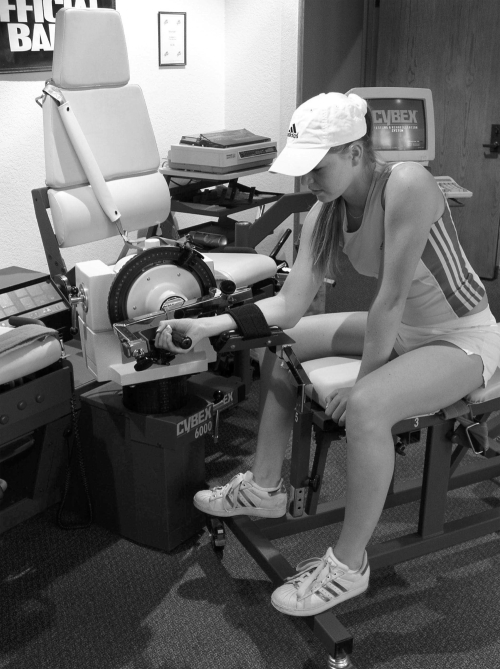
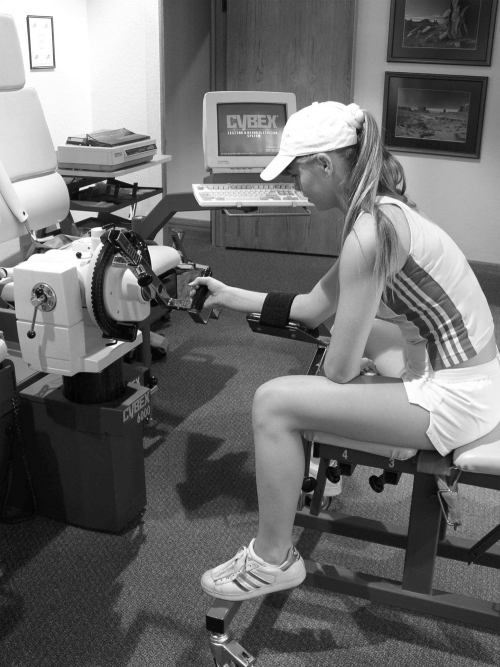
Methods: 32 elite female tennis players (age 12 to 16 years) with no history of upper extremity injury underwent bilateral isokinetic testing using a Cybex 6000 dynamometer. Peak torque and single repetition work values for wrist E/F and forearm S/P were measured at speeds of 90 degrees/s and 210 degrees/s, with random determination of the starting extremity. Repeated measures analysis of variance was used to determine differences between extremities for peak torque and single repetition work values.
Results: Significantly greater (p<0.01) dominant arm wrist E/F and forearm pronation strength was measured at both testing speeds. Significantly less (p<0.01) dominant side forearm supination strength was measured at both testing speeds.
Conclusions: Greater dominant arm wrist E/F and forearm pronation strength is common and normal in young elite level female tennis players. These strength relations indicate sport specific muscular adaptations in the dominant tennis playing extremity. The results of this study can guide clinicians who work with young athletes from this population. Restoring greater dominant side wrist and forearm strength is indicated after an injury to the dominant upper extremity in such players.
Conflict of interest statement
Competing interests: none declared
References
-
- Safran M R, Hutchinson M R, Moss R.et al A comparison of injuries in elite boys and girls tennis players. Transactions of the 9th Annual Meeting of the Society of Tennis Medicine and Science. California: Indian Wells, 1999
-
- Roetert E P, Groppel J.World class tennis technique. Champaign IL: Human Kinetics Publishers, 2001
-
- Marshall R N, Noffal G J, Legnani G.Simluation of the tennis serve. Factors affecting elbow torques related to medial epicondylitis. Paris: Biomechanics ISB, 1993
-
- Dillman C J, Schultheis J M, Hintermeister R A.et al What do we know about body mechanics involved in tennis skills? In: Krahl H, Pieper H, Kibler WB, et al, editors. Tennis: sports medicine and science . Auglage: Society for Tennis Medicine and Science,6–11.
-
- Ellenbecker T S. Rehabilitation of shoulder and elbow injuries in tennis players. Clin Sports Med 19951487–110. - PubMed
MeSH terms
LinkOut - more resources
Full Text Sources
Medical
