


End stopping in V1 is sensitive to contrast
- PMID: 16633342
- PMCID: PMC2645271
- DOI: 10.1038/nn1693
End stopping in V1 is sensitive to contrast
Abstract
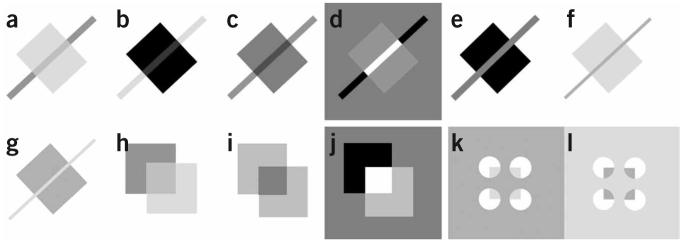
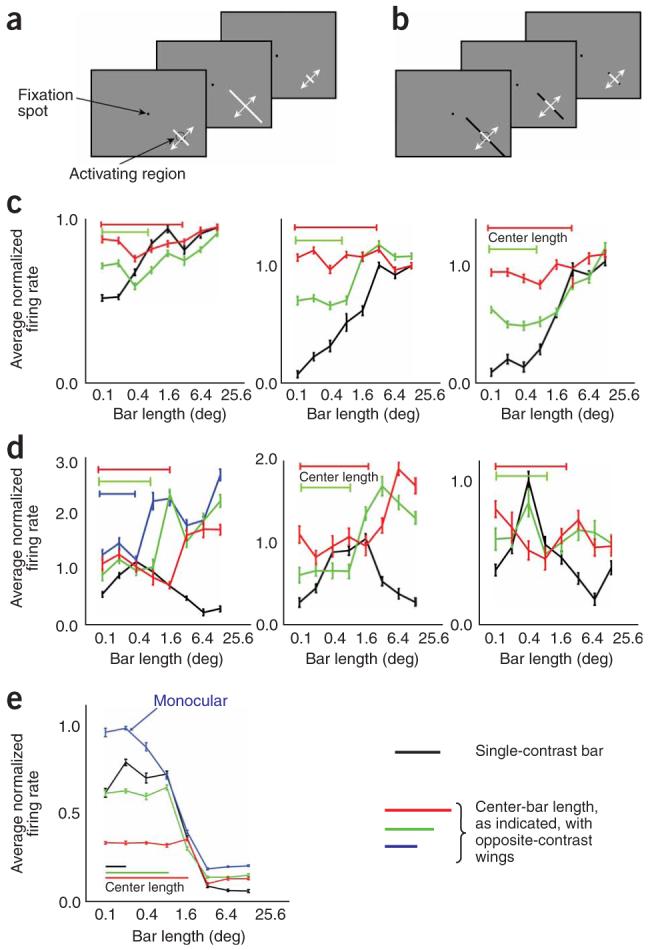
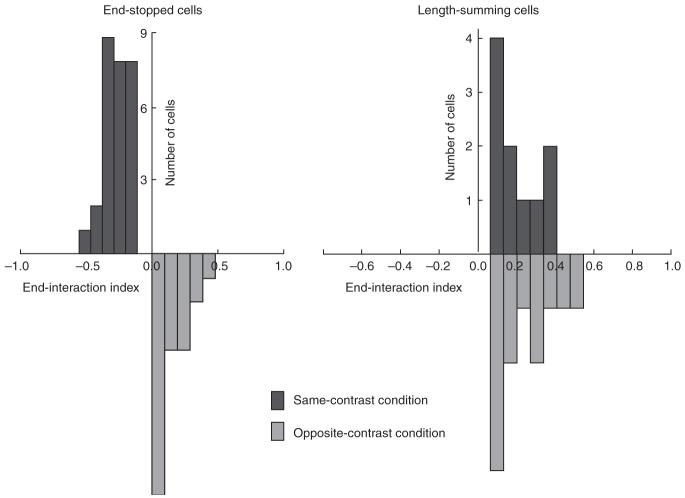
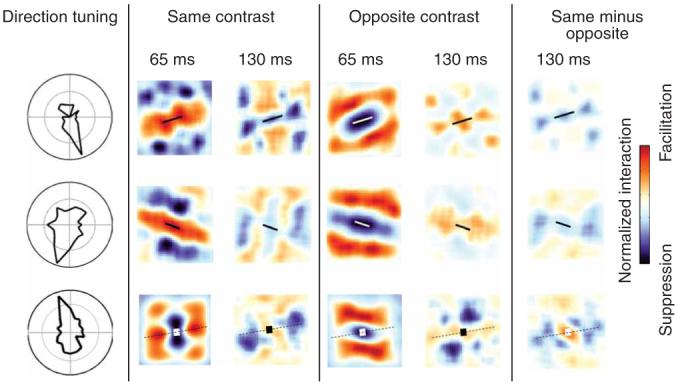
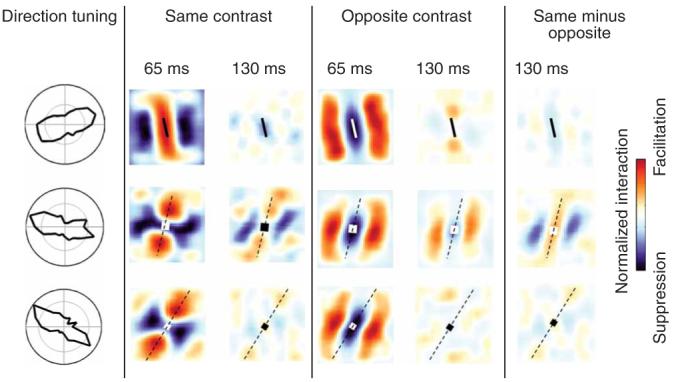
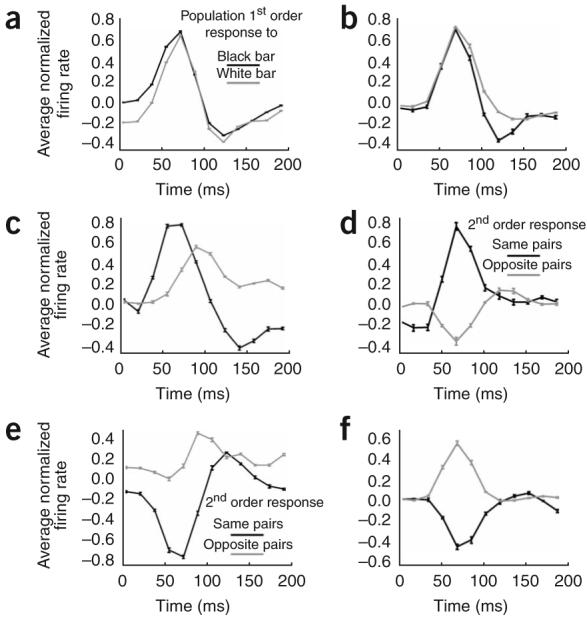
Common situations that result in different perceptions of grouping and border ownership, such as shadows and occlusion, have distinct sign-of-contrast relationships at their edge-crossing junctions. Here we report a property of end stopping in V1 that distinguishes among different sign-of-contrast situations, thereby obviating the need for explicit junction detectors. We show that the inhibitory effect of the end zones in end-stopped cells is highly selective for the relative sign of contrast between the central activating stimulus and stimuli presented at the end zones. Conversely, the facilitatory effect of end zones in length-summing cells is not selective for the relative sign of contrast between the central activating stimulus and stimuli presented at the end zones. This finding indicates that end stopping belongs in the category of cortical computations that are selective for sign of contrast, such as direction selectivity and disparity selectivity, but length summation does not.
Figures
References
-
- Adelson EH. Lightness perception and lightness illusions. In: Gazzaniga M, editor. The New Cognitive Neurosciences. MIT Press; Cambridge, MA: 2000. pp. 339–351.
-
- Attneave F. Some informational aspects of visual perception. Psychol. Rev. 1954;61:183–193. - PubMed
-
- Beck J, Prazdny K, Ivry R. The perception of transparency with achromatic colors. Percept. Psychophys. 1984;35:407–422. - PubMed
-
- Watanabe T, Cavanagh P. The role of transparency in perceptual grouping and pattern recognition. Perception. 1992;21:133–139. - PubMed
-
- Watanabe T, Cavanagh P. Transparent surfaces defined by implicit X junctions. Vision Res. 1993;33:2339–2346. - PubMed
Publication types
MeSH terms
Grants and funding
LinkOut - more resources
Full Text Sources
