


Increased consumption but not operant self-administration of ethanol in mice lacking the RIIbeta subunit of protein kinase A
- PMID: 16634851
- PMCID: PMC1458376
- DOI: 10.1111/j.1530-0277.2006.00096.x
Increased consumption but not operant self-administration of ethanol in mice lacking the RIIbeta subunit of protein kinase A
Abstract
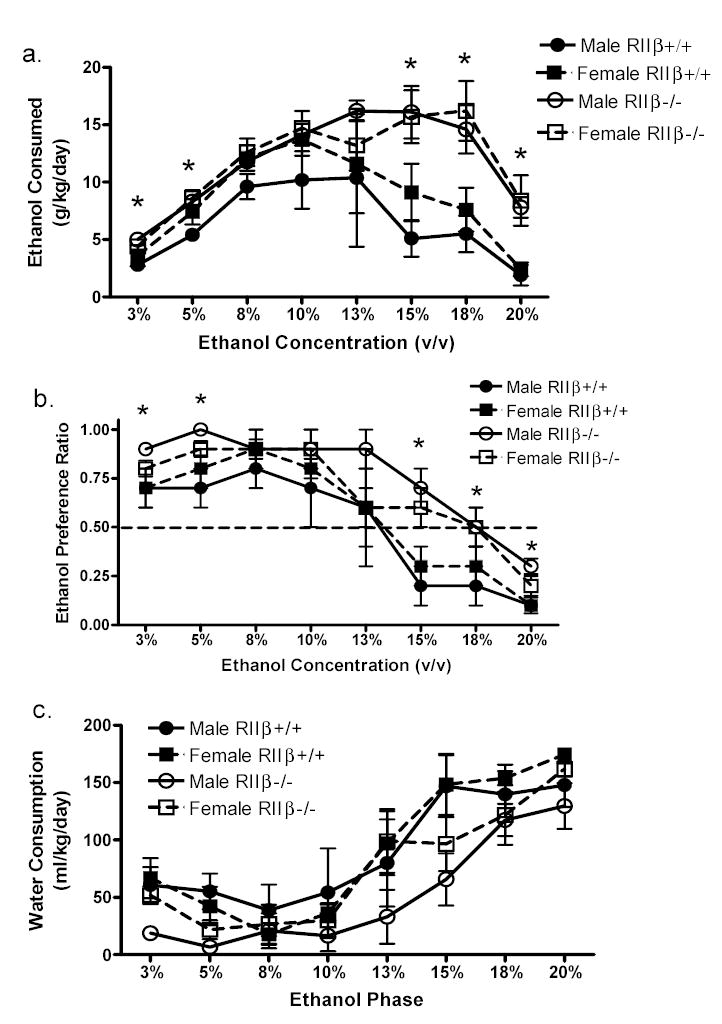
Background: Accumulating evidence indicates that adenosine monophosphate (cAMP)-dependent protein kinase A (PKA) is involved in the neurobiological responses to ethanol. Previous reports indicate that mice lacking the RIIbeta subunit of PKA (RIIbeta(-/-)) voluntarily consume more ethanol than wild-type controls (RIIbeta(+/+)) using 2-bottle testing procedures. Although such procedures primarily measure consummatory behavior, operant self-administration procedures allow analysis of consummatory as well as appetitive or "ethanol-seeking" behavior (i.e., lever pressing is required to gain access to the ethanol solution). Therefore, we determined whether the high ethanol consumption characteristic of RIIbeta(-/-) mice would be complemented by increased appetitive ethanol-seeking behavior in an operant paradigm.
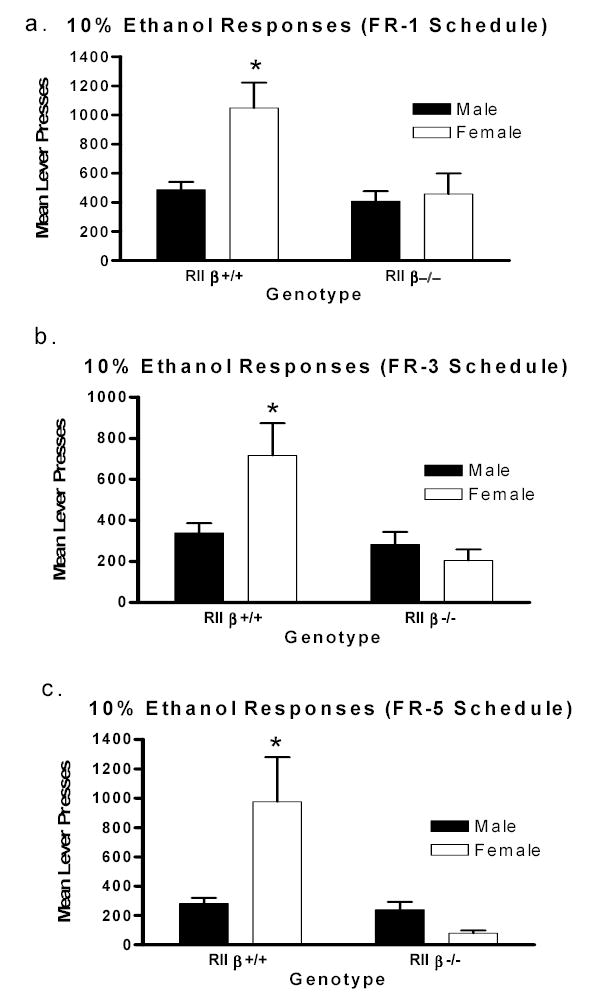
Methods: RIIbeta(-/-) (n=8) and RIIbeta(+/+) (n=8) mice were initially sucrose-faded until they were lever responding for nonsweetened ethanol (10, 14, and 18%). Following the self-administration testing, RIIbeta(+/+) and RIIbeta(-/-) mice were given access to 2 bottles, one containing water and the other ethanol to replicate the voluntary ethanol drinking data previously from our laboratory. Finally, immediately after voluntary consumption all mice were again tested for self-administration of 10% ethanol. Alterations in the reinforcement schedule were also explored as RIIbeta(+/+) and RIIbeta(-/-) mice were tested for self-administration of 10% ethanol at FR-3 and FR-5 schedules.
Results: The RIIbeta(-/-) mice displayed lower operant responding for ethanol and food reinforcement compared with RIIbeta(+/+) controls. However, this effect was driven by a significant increase in lever responses made by female RIIbeta(+/+) mice. When the excessive lever responses of the female RIIbeta(+/+) mice are accounted for, the RIIbeta(-/-) mice show ethanol lever responses comparable to controls. Following operant self-administration testing, RIIbeta(-/-) mice of both sexes consumed more ethanol solution compared with RIIbeta(+/+) mice during 2-bottle testing.
Conclusions: Increased ingestion of ethanol by RIIbeta(-/-) mice is likely the result of altered PKA activity within neuronal pathways that control ethanol-consummatory behaviors. Conversely, the RIIbeta subunit of PKA appears not to play a critical role in neuronal pathways that regulate appetitive behaviors directed at obtaining ethanol. Finally, increased operant self-administration of food and ethanol by female wild-type mice was absent in female RIIbeta(-/-) mice, suggesting that normal PKA signaling may be part of a general, and sex-dependent, mechanism involved with reinforcement-seeking behavior.
Figures

References
-
- Amieux PS, Cummings DE, Motamed K, Brandon EP, Wailes LA, Le K, Idzerda RL, McKnight GS. Compensatory regulation of RIalpha protein levels in protein kinase. A mutant J Biol Chem. 1997;272:3993–3998. - PubMed
-
- Andretic R, Chaney S, Hirsh J. Requirement of circadian genes for cocaine sensitization in Drosophila. Science. 1999;285:1066–8. - PubMed
-
- Backstrom P, Bachteler D, Koch S, Hyytia P, Spanagel R. mGluR5 antagonist MPEP reduces ethanol-seeking and relapse behavior. Neuropsychopharmacology. 2004;29:921–928. - PubMed
-
- Belcher SM, Le HH, Spurling L, Wong JK. Rapid estrogenic regulation of extracellular signal-regulated kinase 1/2 signaling in cerebellar granule cells involves a G protein and protein kinase A dependent mechanism and intracellular activation of protein phosphate 2A. Endocrinology. 2005;146:5397–5406. - PubMed
-
- Belknap JK, Crabbe JC, Young ER. Voluntary consumption of ethanol in 15 inbred mouse strains. Psychopharmacology. 1993:503–510. - PubMed
Publication types
MeSH terms
Substances
Grants and funding
- F32 AA015878/AA/NIAAA NIH HHS/United States
- P60 AA011605/AA/NIAAA NIH HHS/United States
- R37 AA013573/AA/NIAAA NIH HHS/United States
- P50 AA011605/AA/NIAAA NIH HHS/United States
- AA14949/AA/NIAAA NIH HHS/United States
- R01 AA014949/AA/NIAAA NIH HHS/United States
- R01 AA015148/AA/NIAAA NIH HHS/United States
- AA015148/AA/NIAAA NIH HHS/United States
- AA07573/AA/NIAAA NIH HHS/United States
- AA13573/AA/NIAAA NIH HHS/United States
- AA011605/AA/NIAAA NIH HHS/United States
- R01 AA013573/AA/NIAAA NIH HHS/United States
- AA015878/AA/NIAAA NIH HHS/United States
- T32 AA007573/AA/NIAAA NIH HHS/United States
LinkOut - more resources
Full Text Sources
