. 2006 May 3;128(17):5786-91.
doi: 10.1021/ja058465i.

Conformational equilibrium of cytochrome P450 BM-3 complexed with N-palmitoylglycine: a replica exchange molecular dynamics study

Affiliations

Conformational equilibrium of cytochrome P450 BM-3 complexed with N-palmitoylglycine: a replica exchange molecular dynamics study

Krishna Pratap Ravindranathan et al. J Am Chem Soc. .

Abstract

UV-vis absorbance measurements and associated studies of cytochrome P450 BM-3 in complex with N-palmitoylglycine (NPG) indicate that a conformational change occurs in the active site of the complex where the terminal atoms of the ligand move from a site distant from the heme iron, as seen in the low temperature crystal structure to a site proximal to the heme iron at biological temperatures. We employ replica exchange molecular dynamics simulations to study this conformational change. The population of the proximal state is found to increase with temperature in agreement with UV-vis absorbance and NMR measurements. In addition to the conformations characterized by X-ray crystallography and computer modeling, this study shows that a new conformational state is significantly populated at room temperature. The observed increase in the population of conformations where the terminal atoms of NPG are proximal to the heme iron with increasing temperature indicates that the proximal state is stabilized by conformational entropy. A proposal for the origin of this entropic stabilization is provided on the basis of the structure of the newly identified state. We use the temperature weighted histogram (T-WHAM) method to characterize the transition state regions of the conformational ensemble and propose a mechanism of interconversion between these low free energy conformational states.


Figures
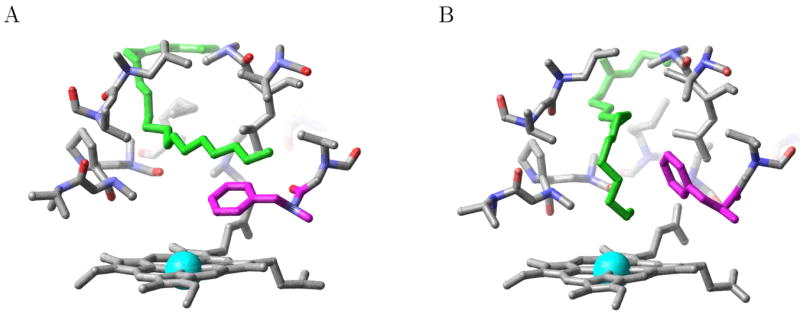
Figure 1
Figure 1
The active site of the P450 BM-3/NPG complex in (a) the low temperature x-ray conformation (PDB id 1jpz) representative of distal state where the NPG (shown in green) is distant from the heme iron, with Phe87 (shown in magenta) interposed between NPG and heme iron (shown in blue) (b) the alternative active site of the conformation predicted by Jovanovic et al. representative of the proximal state where Phe87 has changed its rotameric state to allow NPG to approach the heme iron.
Figure 2
Figure 2
The chemical structure of N-palmitoylglycine. The terminal carbon atom that is close to the heme iron is labeled by ω. The sites which undergo hydroxylation are labeled as ω–1, ω–2 and ω–3.
Figure 3
Figure 3
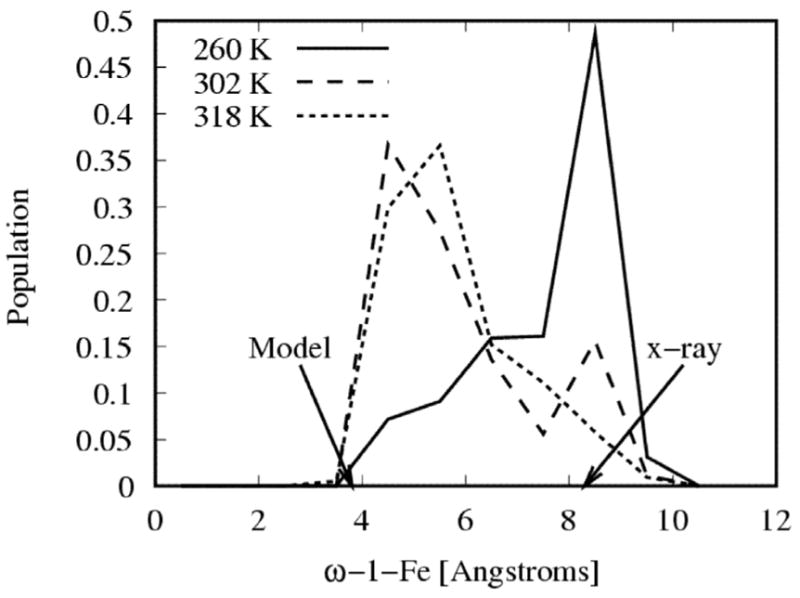
The population distribution of conformations of P450 BM-3/NPG complex as a function of ω–1-Fe distance at temperatures 260 K (solid line), 302 K (dashed line) and 318 K (dotted line). The arrows indicate the values of the ω–1-Fe distance in the x-ray crystal structure (1jpz) and the conformation modeled by Jovanovic et al. At 260 K most of the population is concentrated in the peak corresponding to the distal state. At 302 K population peaks corresponding to both proximal and distal states are seen. At 318 K the proximal state is the most populated.
Figure 4
Figure 4
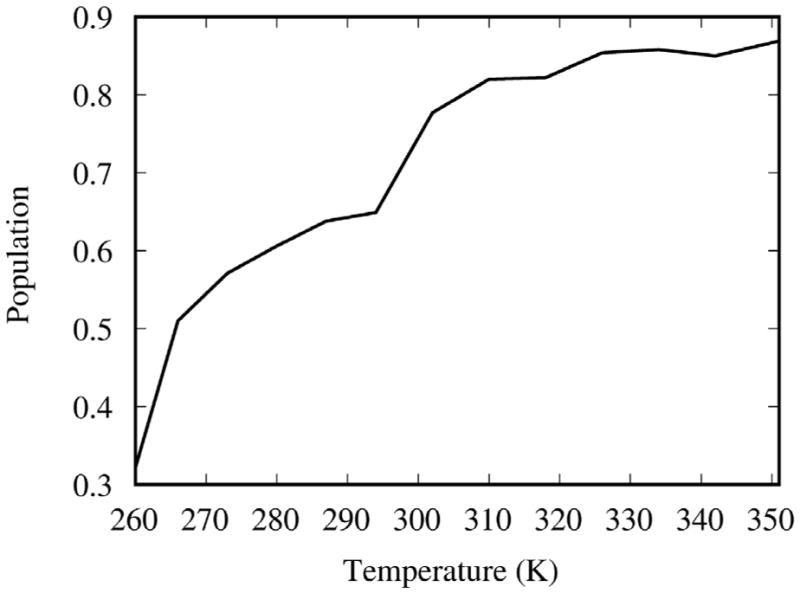
The population as a function of temperature p(T) corresponding to the conformations in which ligand is proximal to the heme iron (obtained by integration of the population distribution from Figure 2 along the ω–1-Fe distance coordinate between 0 Å to 6.5 Å ). The proximal state population increases monotonically with temperature indicating that the proximal state is stabilized by conformational entropy at temperatures greater than at least 268 K. This is borne out by the expression for the conformational entropy difference between the proximal and the distal states, ΔS = k ln[p/(1−p)]+{kT/[p(1−p)]}∂p/∂p, where the second term is positive and the first term is positive for T >268 K (p(T) >1/2).
Figure 5
Figure 5
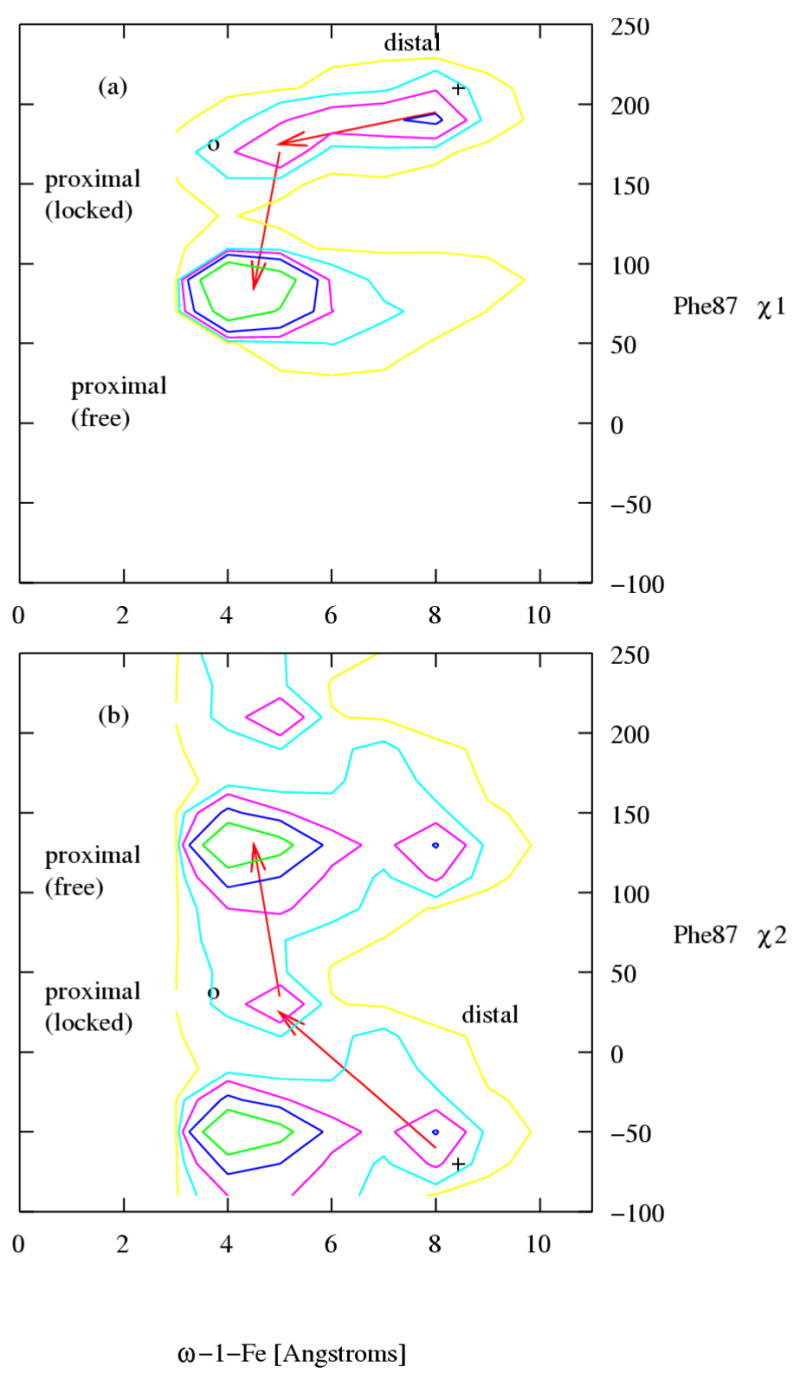
The population distributions at 302 K of P450 BM-3/NPG conformations as a function of (a) the ω–1-Fe distance and the χ1 angle of Phe87 and (b) the ω–1-Fe distance and the χ2 angle of Phe87. The coordinates corresponding to the x-ray crystal conformation and the proximal state conformation predicted by Jovanovic et al. are indicated by a cross and a circle respectively. The distal state, the proximal locked ligand and proximal free ligand states are indicated. Contours are drawn at 1×10⁻³, 1×10⁻², 2.5×10⁻², 5×10⁻² and 1×10⁻¹ fractional population.
Figure 6
Figure 6
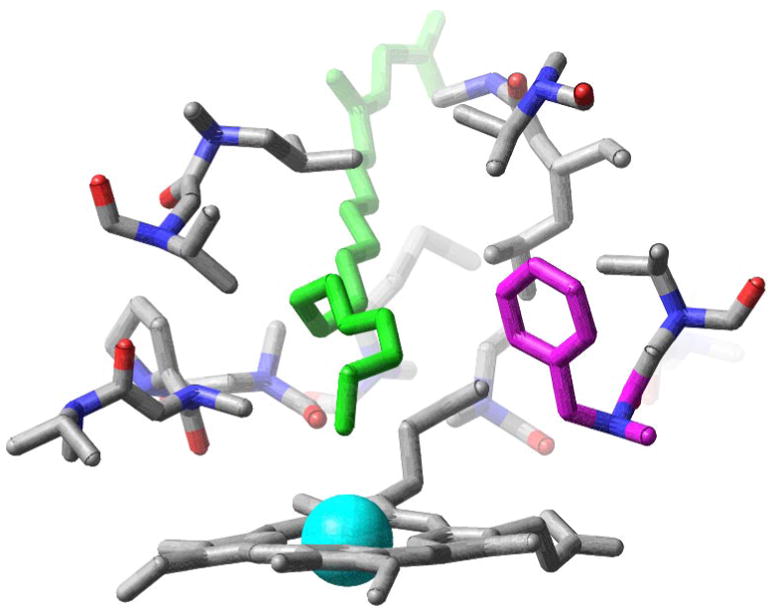
Active site of the P450 BM-3/NPG complex in a representative proximal free ligand conformation. Note that in this conformation not only has the side chain Phe87 (shown in magenta) changed its rotameric state to allow NPG (shown in green) to approach the heme iron (shown in blue), but also Phe87 is oriented so as to give NPG the ability to move more freely (as compared to the the proximal state conformation predicted by Jovanovic et. al.) to and away from the heme.

References

    1. Montellano PRO. Cytochrome P450: Structure, Mechanism and Biochemistry. 2. Plenum Press; New York and London: 1995.
    1. Guallar V, Friesner RA. J Am Chem Soc. 2004;126:8501. - PubMed
    1. Poulos TL, Raag R. FASEB J. 1992;6:674. - PubMed
    1. Sligar SG. Biochemistry. 1976;15:5399. - PubMed
    1. Wester MR, Johnson EF, Marques-Soares C, Dijols S, Dansette PM, Mansuy D, Stout CD. Biochemistry. 2003;42:9335. - PubMed

Publication types