


Predicting persistent disabling low back pain in general practice: a prospective cohort study
- PMID: 16638248
- PMCID: PMC1837841
Predicting persistent disabling low back pain in general practice: a prospective cohort study
Abstract
Background: Patients may adopt active and/or passive coping strategies in response to pain. However, it is not known whether these strategies may also precede the onset of chronic symptoms and, if so, whether they are independent predictors of prognosis.
Aim: To examine, in patients with low back pain in general practice, the prognostic value of active and passive coping styles, in the context of baseline levels of pain, disability and pain duration.
Design of study: Prospective cohort study.
Setting: Nine general practices in north west England.
Method: Patients consulting their GP with a new episode of low back pain were recruited to the study. Information on coping styles, pain severity, disability, duration, and a brief history of other chronic pain symptoms was recorded using a self-completion postal questionnaire. Participants were then sent a follow-up questionnaire, 3 months after their initial consultation, to assess the occurrence of low back pain. The primary outcome was persistent disabling low back pain, that is, low back pain at 3-month follow-up self-rated as >or=20 mm on a 100 mm visual analogue scale, and >or=5 on the Roland and Morris Disability Questionnaire.
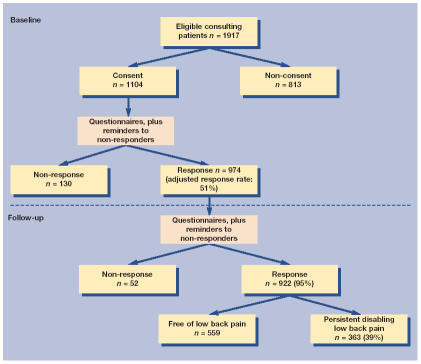
Results: A total of 974 patients took part in the baseline survey, of whom 922 (95%) completed a follow-up questionnaire; 363 individuals (39%) reported persistent disabling pain at follow-up. Persons who reported high levels of passive coping experienced a threefold increase in the risk of persistent disabling low back pain (relative risk [RR] = 3.0; 95% confidence interval [CI] = 2.3 to 4.0). In contrast, active coping was associated with neither an increase nor a decrease in the risk of a poor prognosis. After adjusting for baseline pain severity, disability, and other measures of pain and pain history, persons who reported a high passive coping score were still at 50% increased risk of a poor outcome (RR = 1.5; 95% CI = 1.1 to 2.0).
Conclusion: Patients who report passive coping strategies experience a significant increase in the risk of persistent symptoms. Further, this risk persists after controlling for initial pain severity and disability. The identification of this low back pain subgroup may help target future treatments to those at greatest risk of a poor outcome.
Figures
Comment in
-
Back pain-- reducing long-term problems.Br J Gen Pract. 2006 May;56(526):324-6. Br J Gen Pract. 2006. PMID: 16638246 Free PMC article. No abstract available.
References
-
- McCormick A. Morbidity statistics from general practice: fourth national study 1991–92. A study carried out by the Royal College of General Practitioners, the Office of Population Censuses and Surveys, and the Department of Health. London: HMSO; 1995.
-
- Deyo RA, Rainville J, Kent DL. What can the history and physical examination tell us about low back pain? JAMA. 1992;268:760–765. - PubMed
-
- Maniadakis N, Gray A. The economic burden of back pain in the UK. Pain. 2000;84:95–103. - PubMed
-
- Coste J, Lefrancois G, Guillemin F, Pouchot J. French Study Group for Quality of Life in Rheumatology. Prognosis and quality of life in patients with acute low back pain: insights from a comprehensive inception cohort study. Arthritis Rheum. 2004;51:168–176. - PubMed
Publication types
MeSH terms
LinkOut - more resources
Full Text Sources
Research Materials
