


Measuring tissue-based biomarkers by immunochromatography coupled with reverse-phase lysate microarray
- PMID: 16638853
- PMCID: PMC2147079
- DOI: 10.1158/1078-0432.CCR-05-1479
Measuring tissue-based biomarkers by immunochromatography coupled with reverse-phase lysate microarray
Abstract
Purpose: There is a need for new technologies to study tissue-based biomarkers. The current gold standard, immunohistochemistry, is compromised by variability in tissue processing and observer bias. Reverse transcription-PCR (RT-PCR), immunocytochemistry, and reverse-phase lysate microarrays (RPM) are promising alternative technologies but have not yet been validated, or correlated, on the same patient-derived tissues. Furthermore, RPM is currently limited by time-consuming microdissection and low amounts of evaluable protein lysates.
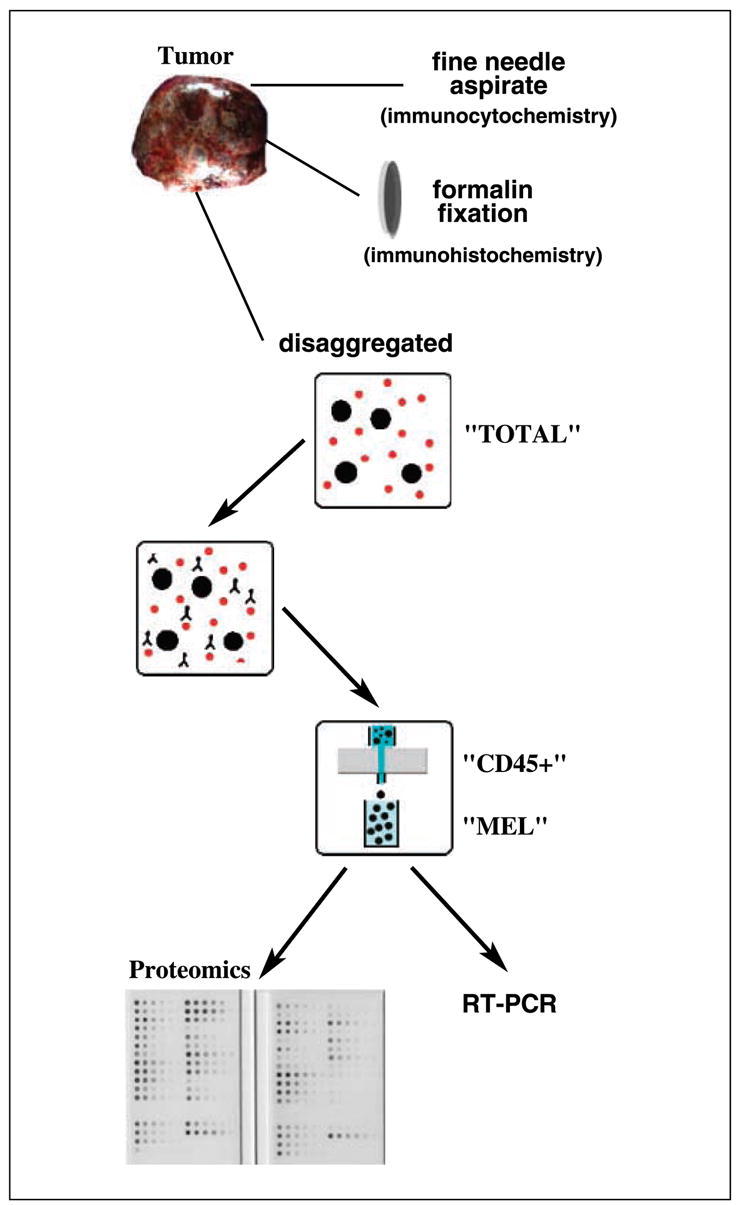
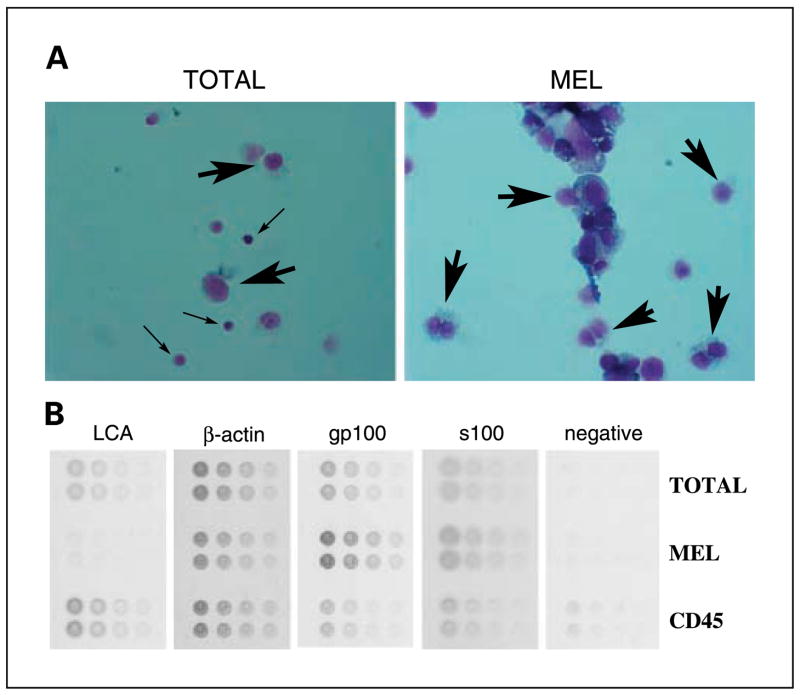
Experimental design: Metastatic melanoma was surgically excised from 30 patients and macroscopically dissected from surrounding stroma. Each specimen was processed by formalin-fixation (immunohistochemistry), cytospin (immunocytochemistry), or disaggreagation and enrichment (RT-PCR and RPM). The latter protocol uses immunochromatography to remove hematopoetic-derived cells, thus enriching for melanoma cells. Each sample was measured for the expression of gp100 or MART-1 normalized to actin.
Results: Immunochromatography coupled with RPM (I-RPM) is reproducible (r >/= 0.70) and, for gp100, correlates strongly with immunohistochemistry and immunocytochemistry (r = 0.78 and 0.76, respectively) and moderately with transcript levels, measured by RT-PCR (r = 0.61). In contrast, for MART-1, I-RPM correlates strongly with transcript level (r = 0.78) but only moderately strong correlations are noted with immunohistochemistry and immunocytochemistry (r = 0.64 and 0.59, respectively). In general, transcript levels show only moderately strong correlations with immunohistochemistry and immunocytochemistry (r = 0.41-0.64).
Conclusion: I-RPM is a promising technology for quantitative grading of tissue biomarkers; however, antigen-dependent correlations are noted.
Figures
References
-
- Zolg JW, Langen H. How industry is approaching the search for new diagnostic markers and biomarkers. Mol Cell Proteomics. 2004;3:345–54. - PubMed
-
- Taylor CR. The total test approach to standardization of immunohistochemistry. [see comment] Arch Pathol Lab Med. 2000;124:945–51. - PubMed
-
- Stoughton RB, Friend SH. Innovation: how molecular profiling could revolutionize drug discovery. Nat Rev Drug Discov. 2005;4:345–50. - PubMed
-
- Liotta LA, Espina V, Mehta AI, et al. Protein microarrays: meeting analytical challenges for clinical applications. Cancer Cell. 2003;3:317–25. - PubMed
-
- Chan SM, Ermann J, Su L, Fathman CG, Utz PJ. Protein microarrays for multiplex analysis of signal transduction pathways. Nat Med. 2004;10:1390–6. - PubMed
MeSH terms
Substances
Grants and funding
LinkOut - more resources
Full Text Sources
Other Literature Sources
