


Observations on related ecological exponents
- PMID: 16641099
- PMCID: PMC1458996
- DOI: 10.1073/pnas.0600988103
Observations on related ecological exponents
Abstract
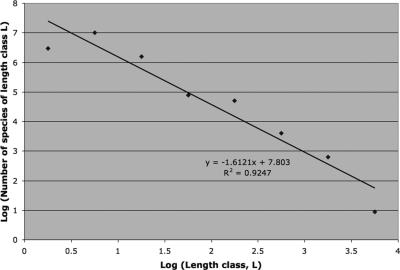
We observe a relationship among three independently derived power laws in ecology: (i) total number of species versus area, (ii) species frequency versus species length, and (iii) maximal body size versus area. Aside from showing how these historically disparate phenomena are connected, we show how recent empirical results relating the maximal body size of top terrestrial vertebrates to the square root of land area conform to a prior theoretical expectation given by two of the above power laws. Of particular interest is the observation that the exponent relating species length to species frequency suggests a dimension for niche space for terrestrial vertebrate assemblages of D approximately 3/2. This value, along with power law for maximal body size, versus area, gives rise to the canonical species area exponent z approximately 1/4.
Conflict of interest statement
Conflict of interest statement: No conflicts declared.
Figures
References
Publication types
MeSH terms
LinkOut - more resources
Full Text Sources
