. 2006 May;50(5):1841-51.
doi: 10.1128/AAC.50.5.1841-1851.2006.

Functional characterization and target validation of alternative complex I of Plasmodium falciparum mitochondria

Affiliations

Functional characterization and target validation of alternative complex I of Plasmodium falciparum mitochondria

Giancarlo A Biagini et al. Antimicrob Agents Chemother. 2006 May.

Abstract

This study reports on the first characterization of the alternative NADH:dehydrogenase (also known as alternative complex I or type II NADH:dehydrogenase) of the human malaria parasite Plasmodium falciparum, known as PfNDH2. PfNDH2 was shown to actively oxidize NADH in the presence of quinone electron acceptors CoQ(1) and decylubiquinone with an apparent K(m) for NADH of approximately 17 and 5 muM, respectively. The inhibitory profile of PfNDH2 revealed that the enzyme activity was insensitive to rotenone, consistent with recent genomic data indicating the absence of the canonical NADH:dehydrogenase enzyme. PfNDH2 activity was sensitive to diphenylene iodonium chloride and diphenyl iodonium chloride, known inhibitors of alternative NADH:dehydrogenases. Spatiotemporal confocal imaging of parasite mitochondria revealed that loss of PfNDH2 function provoked a collapse of mitochondrial transmembrane potential (Psi(m)), leading to parasite death. As with other alternative NADH:dehydrogenases, PfNDH2 lacks transmembrane domains in its protein structure, and therefore, it is proposed that this enzyme is not directly involved in mitochondrial transmembrane proton pumping. Rather, the enzyme provides reducing equivalents for downstream proton-pumping enzyme complexes. As inhibition of PfNDH2 leads to a depolarization of mitochondrial Psi(m), this enzyme is likely to be a critical component of the electron transport chain (ETC). This notion is further supported by proof-of-concept experiments revealing that targeting the ETC's Q-cycle by inhibition of both PfNDH2 and the bc(1) complex is highly synergistic. The potential of targeting PfNDH2 as a chemotherapeutic strategy for drug development is discussed.


Figures
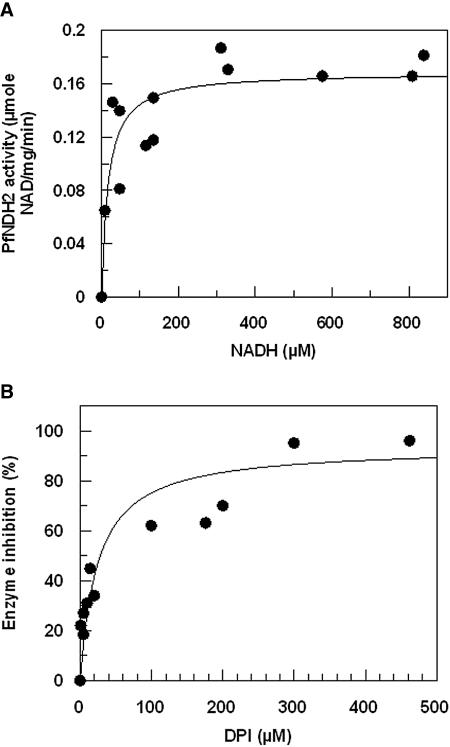
FIG. 1.
FIG. 1.
Kinetics of alternative complex I (PfNDH2) activity in P. falciparum. (A) Concentration dependence of rotenone-insensitive oxidation of NADH in cell-free parasite extracts with CoQ1 as an exogenous substrate. Data points are means of results from three individual experiments. (B) Concentration-dependent DPI inhibition of PfNDH2 enzyme activity with CoQ1 as an exogenous substrate. Data points are means from duplicate observations from three individual experiments. Data were fitted to a function describing simple ligand binding at a single site by nonlinear regression analysis (Marquart method) using an iterative procedure to generate the best fit (χ2) of the curve to the data. Standard errors were calculated for each parameter using the matrix inversion method (Grafit user manual).
FIG. 2.
FIG. 2.
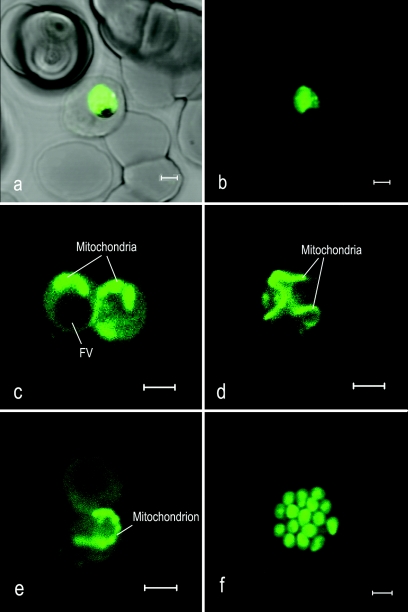
The plasma and mitochondrial membranes of P. falciparum generate a high transmembrane electrochemical potential (Ψm). Confocal laser scanning microscopy of live P. falciparum-infected erythrocytes loaded with the potentiometric probe TMRE. The panels show bright-field fluorescence (a) and fluorescence (b) images of an infected erythrocyte loaded with TMRE, TMRE fluorescence of parasite mitochondria from bafilomycin-treated parasites (c, d, and e), and TMRE fluorescence from merozoites (f). The green in these images is a pseudocolor. TMRE was excited at 543 nm, and emission was collected with a 560-nm long pass filter. Bars, 2 μm.
FIG. 3.
FIG. 3.
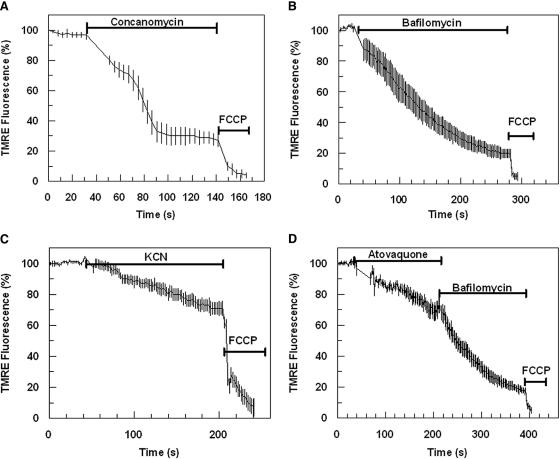
Fluorescence detection of mitochondrial and plasma membrane Ψm components. Effect of concanomycin (200 nM) (A), bafilomycin (200 nM) (B), cyanide (10 mM) (C), and atovaquone (10 μM) (D) on TMRE-dependent parasite fluorescence. Data were normalized to 100% in untreated cells and to 0% in FCCP (10 μM)-treated cells. Graphs show means from experiments performed independently ± standard errors (n ≥ 5).
FIG. 4.
FIG. 4.
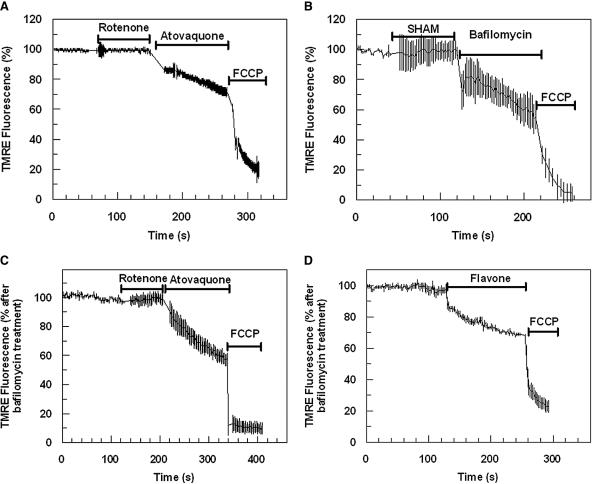
Effect of mitochondrial inhibitors on mitochondrial Ψm. Time course of TMRE-dependent fluorescence of P. falciparum-infected erythrocytes after the addition of rotenone (50 μM), atovaquone (10 μM), and FCCP (10 μM) (A) and SHAM (1 mM), bafilomycin (200 nM), and FCCP (10 μM) (B). Inhibitors were also tested against bafilomycin-treated cells. Time-dependent TMRE fluorescence was monitored after addition of rotenone (50 μM), atovaquone (10 μM), and FCCP (10 μM) (C) and flavone (0.5 mM) and FCCP (10 μM) (D). Data were normalized to 100% in untreated (A and B) or bafilomycin-treated (C and D) cells and to 0% in FCCP (10 μM)-treated cells. Graphs show means from experiments performed independently ± standard errors (n ≥ 6).
FIG. 5.
FIG. 5.
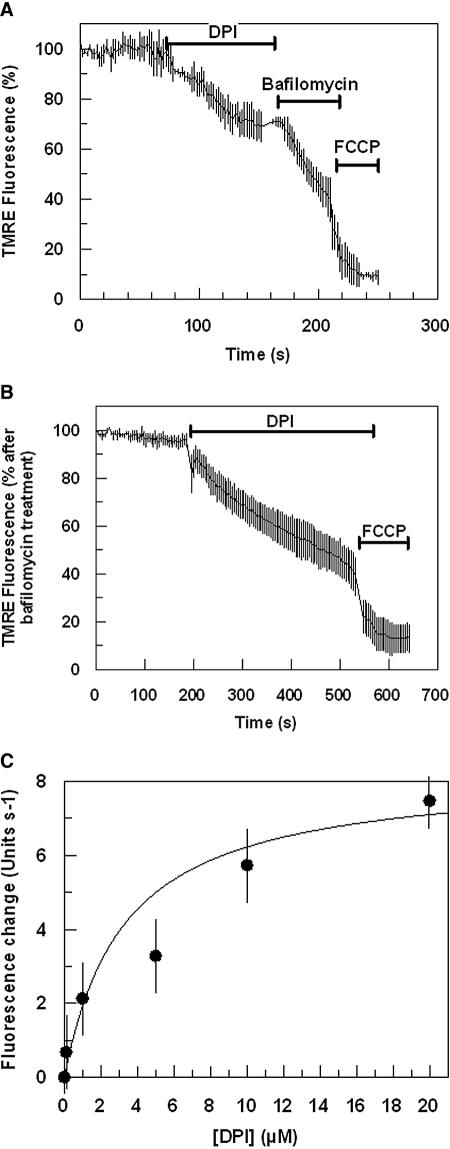
Effect of DPI on P. falciparum mitochondrial Ψm. TMRE-dependent fluorescence was monitored with time after the addition of DPI (10 μM) to untreated (A) and bafilomycin-treated (B) malaria-infected erythrocytes. Data represent means from independent experiments ± standard errors (n ≥ 9). (C) Concentration dependence of DPI on the initial rate of mitochondrial Ψm depolarization. Data points are means from three individual experiments. Data were fitted by nonlinear regression analysis (Marquart method) using an iterative procedure to generate the best fit (χ2) of the curve to the data. Standard errors were calculated for each parameter using the matrix inversion method (Grafit Software).
FIG. 6.
FIG. 6.
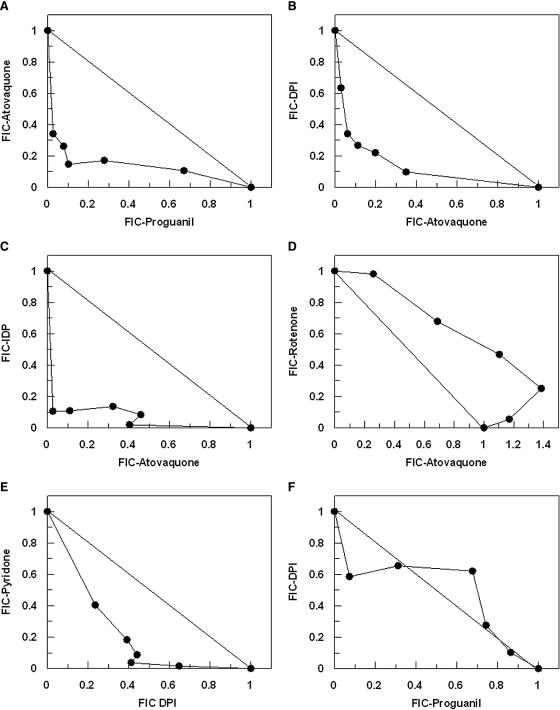
Isobole analysis of mitochondrial inhibitors on antimalarial activity. The fractional inhibitory concentrations of IC50 values for drugs in combination are shown for atovaquone versus proguanil (A), atovaquone versus DPI (B), atovaquone versus IDP (C), atovaquone versus rotenone (D), DPI versus pyridone (E), and DPI versus proguanil (F). Data are means of results from four independent experiments.
FIG. 7.
FIG. 7.
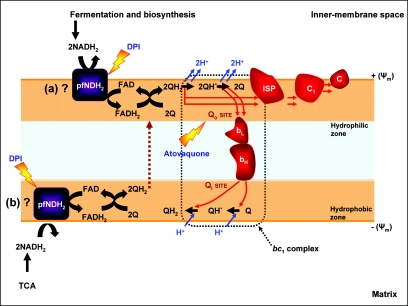
Schematic representation of PfNDH2 function in the P. falciparum mitochondrial ETC. The exact location of PfNDH2 is not known; in the schematic it is shown as localized on either the cytosolic (a) or the matrix (b) side of the mitochondrial inner membrane. Inhibition of PfNDH2 and the bc1 complex (lighting bolts) has been shown to be synergistic, probably by affecting the redox reactions of the Q cycle.

References

    1. Allen, R. J., and K. Kirk. 2004. The membrane potential of the intraerythrocytic malaria parasite plasmodium falciparum. J. Biol. Chem. 279:11264-11272. - PubMed
    1. Berenbaum, M. C. 1978. A method for testing for synergy with any number of agents. J. Infect. Dis. 137:122-130. - PubMed
    1. Biagini, G. A., D. Lloyd, K. Kirk, and M. R. Edwards. 2000. The membrane potential of Giardia intestinalis. FEMS Microbiol. Lett. 192:153-157. - PubMed
    1. Biagini, G. A., P. M. O'Neill, A. Nzila, S. A. Ward, and P. G. Bray. 2003. Antimalarial chemotherapy: young guns or back to the future? Trends Parasitol. 19:479-487. - PubMed
    1. Bjorklof, K., V. Zickermann, and M. Finel. 2000. Purification of the 45 kDa, membrane bound NADH dehydrogenase of Escherichia coli (NDH-2) and analysis of its interaction with ubiquinone analogues. FEBS Lett. 467:105-110. - PubMed

Publication types

MeSH terms

Substances

LinkOut - more resources