


A genetic dissection of the LlaJI restriction cassette reveals insights on a novel bacteriophage resistance system
- PMID: 16646963
- PMCID: PMC1459862
- DOI: 10.1186/1471-2180-6-40
A genetic dissection of the LlaJI restriction cassette reveals insights on a novel bacteriophage resistance system
Abstract
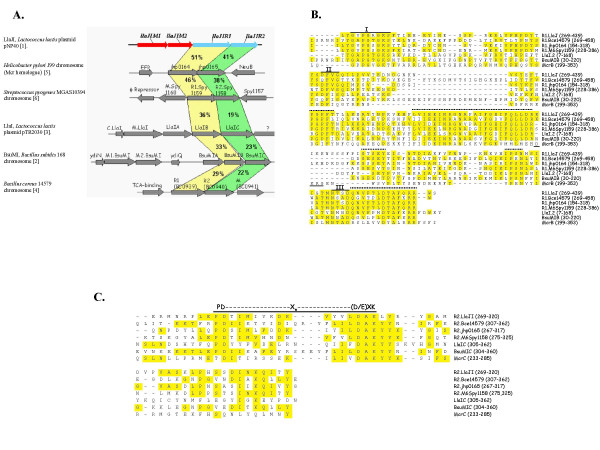
Background: Restriction/modification systems provide the dual function of protecting host DNA against restriction by methylation of appropriate bases within their recognition sequences, and restriction of foreign invading un-methylated DNA, such as promiscuous plasmids or infecting bacteriphage. The plasmid-encoded LlaJI restriction/modification system from Lactococcus lactis recognizes an asymmetric, complementary DNA sequence, consisting of 5'GACGC'3 in one strand and 5'GCGTC'3 in the other and provides a prodigious barrier to bacteriophage infection. LlaJI is comprised of four similarly oriented genes, encoding two 5mC-MTases (M1.LlaJI and M2.LlaJI) and two subunits responsible for restriction activity (R1.LlaJI and R2.LlaJI). Here we employ a detailed genetic analysis of the LlaJI restriction determinants in an attempt to characterize mechanistic features of this unusual hetero-oligomeric endonuclease.
Results: Detailed bioinformatics analysis confirmed the presence of a conserved GTP binding and hydrolysis domain within the C-terminal half of the R1.LlaJI amino acid sequence whilst the N-terminal half appeared to be entirely unique. This domain architecture was homologous with that of the "B" subunit of the GTP-dependent, methyl-specific McrBC endonuclease from E.coli K-12. R1.LlaJI did not appear to contain a catalytic centre, whereas this conserved motif; PD....D/EXK, was clearly identified within the amino acid sequence for R2.LlaJI. Both R1.LlaJI and R2.LlaJI were found to be absolutely required for detectable LlaJI activity in vivo. The LlaJI restriction subunits were purified and examined in vitro, which allowed the assignment of R1.LlaJI as the sole specificity determining subunit, whilst R2.LlaJI is believed to mediate DNA cleavage.
Conclusion: The hetero-subunit structure of LlaJI, wherein one subunit mediates DNA binding whilst the other subunit is predicted to catalyze strand hydrolysis distinguishes LlaJI from previously characterized restriction-modification systems. Furthermore, this distinction is accentuated by the fact that whilst LlaJI behaves as a conventional Type IIA system in vivo, in that it restricts un-methylated DNA, it resembles the Type IV McrBC endonuclease, an enzyme specific for methylated DNA. A number of similar restriction determinants were identified in the database and it is likely LlaJI together with these homologous systems, comprise a new subtype of the Type II class incorporating features of Type II and Type IV systems.
Figures

References
-
- Kunst F, Ogasawara N, Moszer I, Albertini AM, Alloni G, Azevedo V, Bertero MG, Bessieres P, Bolotin A, Borchert S, Borriss R, Boursier L, Brans A, Braun M, Brignell SC, Bron S, Brouillet S, Bruschi CV, Caldwell B, Capuano V, Carter NM, Choi SK, Codani JJ, Connerton IF, Cummings NJ, Daniel RA, Denizot F, Devine KM, Dusterhoft A, Ehrlich SD, Emmerson PT, Entian KD, Errington J, Fabret C, Ferrari E, Foulger D, Fritz C, Fujita M, Fujita Y, Fuma S, Galizzi A, Galleron N, Ghim SY, Glaser P, Goffeau A, Golightly EJ, Grandi G, Guiseppi G, Guy BJ, Haga K, Haiech J, Harwood CR, Henaut A, Hilbert H, Holsappel S, Hosono S, Hullo MF, Itaya M, Jones L, Joris B, Karamata D, Kasahara Y, Klaerr-Blanchard M, Klein C, Kobayashi Y, Koetter P, Koningstein G, Krogh S, Kumano M, Kurita K, Lapidus A, Lardinois S, Lauber J, Lazarevic V, Lee SM, Levine A, Liu H, Masuda S, Mauel C, Medigue C, Medina N, Mellado RP, Mizuno M, Moestl D, Nakai S, Noback M, Noone D, O'Reilly M, Ogawa K, Ogiwara A, Oudega B, Park SH, Parro V, Pohl TM, Portetelle D, Porwollik S, Prescott AM, Presecan E, Pujic P, Purnelle B, Rapoport G, Rey M, Reynolds S, Rieger M, Rivolta C, Rocha E, Roche B, Rose M, Sadaie Y, Sato T, Scanlan E, Schleich S, Schroeter R, Scoffone F, Sekiguchi J, Sekowska A, Seror SJ, Serror P, Shin BS, Soldo B, Sorokin A, Tacconi E, Takagi T, Takahashi H, Takemaru K, Takeuchi M, Tamakoshi A, Tanaka T, Terpstra P, Tognoni A, Tosato V, Uchiyama S, Vandenbol M, Vannier F, Vassarotti A, Viari A, Wambutt R, Wedler E, Wedler H, Weitzenegger T, Winters P, Wipat A, Yamamoto H, Yamane K, Yasumoto K, Yata K, Yoshida K, Yoshikawa HF, Zumstein E, Yoshikawa H, Danchin A. The complete genome sequence of the Gram-positive bacterium Bacillus subtilis. Nature. 1997;390:249–256. doi: 10.1038/36786. - DOI - PubMed
-
- Ivanova N, Sorokin A, Anderson I, Galleron N, Candelon B, Kapatral V, Bhattacharyya A, Reznik G, Mikhailova N, Lapidus A, Chu L, Mazur M, Goltsman E, Larsen N, D'Souza M, Walunas T, Grechkin Y, Pusch G, Haselkorn R, Fonstein M, Ehrlich SD, Overbeek R, Kyrpides N. Genome sequence of Bacillus cereus and comparative analysis with Bacillus anthracis. Nature. 2003;423:87–91. doi: 10.1038/nature01582. - DOI - PubMed
-
- Alm RA, Ling LS, Moir DT, King BL, Brown ED, Doig PC, Smith DR, Noonan B, Guild BC, deJonge BL, Carmel G, Tummino PJ, Caruso A, Uria-Nickelsen M, Mills DM, Ives C, Gibson R, Merberg D, Mills SD, Jiang Q, Taylor DE, Vovis GF, Trust TJ. Genomic-sequence comparison of two unrelated isolates of the human gastric pathogen Helicobacter pylori. Nature. 1999;397:176–180. doi: 10.1038/16495. - DOI - PubMed
Publication types
MeSH terms
Substances
LinkOut - more resources
Full Text Sources
Molecular Biology Databases
